| Author |
Message |
kbgreen
Joined: 25 Apr 2007
Posts: 12
|
| Posted: Sat Mar 08, 2008 1:25 am Post subject: HD-144/145 lens |
|
|
Hi
Can anyone tell me the difference between HD-144 and 145 lenses? And is one or the other compatible with barco 1208/2
thanks
kbgreen
|
|
| Back to top |
|
 |
Zebu Fellenz
Joined: 21 Dec 2006
Posts: 2567
|
| Posted: Sat Mar 08, 2008 1:35 am Post subject: |
|
|
|
The throw distance is a little closer with the 144, you will need some adaptors to mount on a 1208
|
|
| Back to top |
|
|
kbgreen
Joined: 25 Apr 2007
Posts: 12
|
| Posted: Sat Mar 08, 2008 11:50 am Post subject: 144/145 |
|
|
Thanks
Does one have better picture quality ?
kbgreen
|
|
| Back to top |
|
|
Joust
Joined: 05 May 2006
Posts: 2429
Location: Almonte, Ontario, Canada
TV/Projector: Marquee 8501LC
|
| Posted: Sat Mar 08, 2008 1:36 pm Post subject: |
|
|
exactly the same IMHO.
the 145 has a larger aperture size internally. There is a debate as to whether this makes it better or not.
I've tried both. I don't see a difference.
|
|
| Back to top |
|
|
kschmit2
Joined: 09 Mar 2006
Posts: 1141
Location: Heidelberg, Germany
|
| Posted: Sat Mar 08, 2008 2:46 pm Post subject: |
|
|
just to give you an idea, here are the stock lenses for all XG models:
XG 750G - HD-144N
XG 1100G - HD-144N
XG 1350G - HD-145N
XG 751G - HD-144
XG 1101G LC - HD-18
XG 1351G LC - HD-18
XG 852 - HD-144
XG 1352LC - HD-134
Kai
|
|
| Back to top |
|
|
rod
Joined: 18 Mar 2006
Posts: 418
Location: Northern Ontario, Canada
|
| Posted: Sat Mar 08, 2008 4:45 pm Post subject: |
|
|
I have the 145s on my 1208/2 and they make big difference in PQ but the color really makes the difference. Make sure you get color filtered/corrected lenses. some 144s/145s are clear and I believe some are filtered but not corrected or other way around. I'm not quite sure what the difference is between filtered and corrected.
_________________
Rod
|
|
| Back to top |
|
|
Joust
Joined: 05 May 2006
Posts: 2429
Location: Almonte, Ontario, Canada
TV/Projector: Marquee 8501LC
|
| Posted: Sat Mar 08, 2008 4:56 pm Post subject: |
|
|
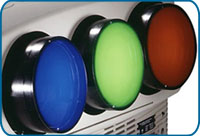
the Filters are coloured. ( the colour elements you can see...)
the lens coating is the colour correction. ( I never really understood this though)
|
|
| Back to top |
|
|
kschmit2
Joined: 09 Mar 2006
Posts: 1141
Location: Heidelberg, Germany
|
| Posted: Sat Mar 08, 2008 5:53 pm Post subject: |
|
|
all HD-144 and HD-145 lenses are color corrected.
And I have had a number of NEC PJs with HD-144 or HD-145 lenses (not HD-144N or HD-145N).
The "N" designation doesn't seem to have any specific meaning.
|
|
| Back to top |
|
|
Joust
Joined: 05 May 2006
Posts: 2429
Location: Almonte, Ontario, Canada
TV/Projector: Marquee 8501LC
|
| Posted: Sat Mar 08, 2008 5:56 pm Post subject: |
|
|
N means "NEC"
they were original equipment lenses from an NEC projector.
|
|
| Back to top |
|
|
jask

Joined: 17 Mar 2006
Posts: 10187
Location: kamloops BC
|
| Posted: Sat Mar 08, 2008 6:23 pm Post subject: |
|
|
| kschmit2 wrote: | all HD-144 and HD-145 lenses are color corrected.
And I have had a number of NEC PJs with HD-144 or HD-145 lenses (not HD-144N or HD-145N).
The "N" designation doesn't seem to have any specific meaning. |
I think you mean "all NEC HD-144/145 lenses are colour corrected" other vendors used non-corrected sets
like these:
https://www.curtpalme.com/forum_archived/viewtopic.php@t=9538.html
|
|
| Back to top |
|
|
Joust
Joined: 05 May 2006
Posts: 2429
Location: Almonte, Ontario, Canada
TV/Projector: Marquee 8501LC
|
| Posted: Sat Mar 08, 2008 7:38 pm Post subject: |
|
|
those are Non_FILTERED
they are corrected.
|
|
| Back to top |
|
|
AnalogRocks
Forum Moderator
Joined: 08 Mar 2006
Posts: 26706
Location: Toronto, Ontario, Canada
TV/Projector: Sony 1252Q, AMPRO 4000G
|
| Posted: Sat Mar 08, 2008 7:45 pm Post subject: |
|
|
| Joust wrote: | the Filters are coloured. ( the colour elements you can see...)
the lens coating is the colour correction. ( I never really understood this though) |
The lenses are color corrected meaning the coatings the put on them pass whichever color the most and reject the other colors. That is my understanding.
_________________
Tech support for nothing
CRT.
HD done right!
|
|
| Back to top |
|
|
Joust
Joined: 05 May 2006
Posts: 2429
Location: Almonte, Ontario, Canada
TV/Projector: Marquee 8501LC
|
| Posted: Sat Mar 08, 2008 8:07 pm Post subject: |
|
|
no, not at all.
Why do coated lenses look purple (or blue or green or whatever)?
First, let’s get the most obvious misconception out of the way:
Lens coating has NO COLOR. It is a water-clear material throughout the visible spectrum. It has only 2 meaningful characteristics that make it appear colored: (1) Refractive Index, and (2) Thickness.
To understand why coated lenses look colored, you have to understand what the coating is there for, and how it works. The purpose of coating on a lens is to reduce reflections from the lens’ surface. Light reflects from the surface of the glass because the refractive index of the glass is different from that of the air, and the reflection is formed at this interface of different refractive indices.
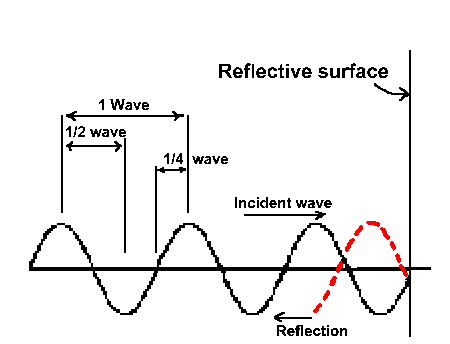
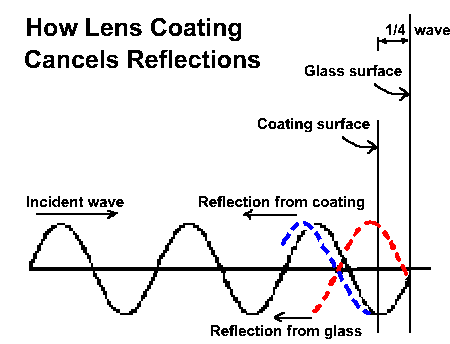
Light (for the purpose of this discussion at any rate) behaves as a wave: when a light wave strikes the glass surface, some of it bounces off as a reflection – the reflected ray still has the same wave characteristics as the incident ray, just moving in the opposite direction.
SEE FIG1.
Wave reflection from a single glass surface (reflection shown in red)
This reflection has no apparent color, it reflects all wavelengths equally and has a greyish or silver appearance.
Because the reflection is a wave, though, it has an important characteristic: it can be cancelled out by another wave, if that other wave can be made to be of equal frequency, direction and magnitude and opposite phase. In the sketch above, you can see that a second wave spaced 1/2 wavelength out of phase would have its highest point aligned with our wave’s lowest point; if this can be made to happen, the 2 waves will cancel each other out.
It turns out that we CAN make this happen. What we need to do is to create a second reflection, in a slightly different location from the glass surface that created the first. In order to space the 2 reflections exactly 1/2 wavelength apart, the 2 reflective surfaces need to be spaced 1/4 wavelength apart: 1/4 wavelength for the incident wave going in plus 1/4 wavelength for its reflection coming back out = 1/2 wavelength. For this reason, antireflective coatings are sometimes referred to as “Quarter Wave” coatings.
See FIG2
Wave reflection from a coated glass surface, with reflections from glass and coating cancelling each other (reflection from glass shown in red, reflection from coating shown in blue)
Remember, though, that the reflection occurs where there is a difference in refractive index from one material to the next. So not just any coating material will work; if the coating has the same refractive index as glass (about 1.6), there will be no “red” reflection, only the blue one – and there will be no anti-reflective effect, the lens will behave just as if it was uncoated. Similarly, if the coating had the refractive index of air (1.0), there would be no “blue” reflection and the lens would appear to be uncoated. In order to make the red and blue reflections equal so that they can cancel each other out, the refractive index of the coating needs to be about halfway between that of glass and air so that the difference at each interface will be equal. The perfect single coating material would therefore have a refractive index of about 1.3. The material most commonly used for this purpose, Magnesium Fluoride, has a refractive index of about 1.37 – not a bad compromise, considering that it offers durability and other desirable properties.
Okay, great, I get it. But why the color?
As you can see in the diagram above, for any given wavelength it should be possible to obtain nearly 100% cancellation of reflections by means of applying a 1/4 wavelength-thick layer of Magnesium Fluoride to the surface of the glass. But the trick is, 1/4 of WHAT wavelength? Light isn’t all one wavelength, there’s a different wavelength for every color from 400nm (violet) to 700nm (red). No thickness of coating can be 1/4 wavelength of ALL of them…. so the designer has to choose. Typically, they choose a wavelength that’s close to the center of the visible spectrum, so that the beneficial effects of the coating will be as uniformly distributed over the visible range as possible. The visible range being 400-700nm, the wavelength generally chosen as the target was in the neighborhood of 550nm, or right in the center.
(top) Wavelength vs color
(bottom) Wavelength vs color of reflection
As you can see in the top chart above, the mathematical center of the visible spectrum, 550nm, corresponds to a color in the yellow-green range. A coating of 137.5nm thickness (550 divided by 4) would virtually eliminate any reflections of this color from the surface of the lens. It would reduce reflections of other wavelengths also, but the efficiency of its effect would become progressively lower as the wavelength deviates from 550. The net result is that the overall goal of suppressing reflections is achieved, but it is not achieved equally for all colors. We see this when we look at the reflections from the coated glass surface: there is no green light reflected at all, but there are reflections of the other colors. The overall effect is that of a reflection in the complement of the targeted color. These complements are shown in the lower chart in the figure above – 550nm corresponds to a blue-violet color ….. exactly what we see in a coated lens.
So, if coated lenses are purple, won’t my photos have a purple tint?
No…. actually, they’ll have a slight yellow-green tint – the extra light that didn’t get reflected passes on through to the film, and there’s a little more of the 550nm yellow-green than there is of the other colors. But it’s not very much – glass only reflects about 4% of light from each surface to begin with, and the coating has some effect at all wavelengths – so there’s maybe a couple of percent of extra green light getting to the film. For most normal photography, this isn’t enough to be noticeable in the pictures. However, some lens makers were concerned about it, and did something to reduce the risk of off-color photos.
Every lens has at least two reflective surfaces, the front and the back. In lenses used for practical photography, there are generally at least six, and there can be 18 or more in complex wide angles or zooms. Each surface presents an opportunity to adjust the color effect of the coating: with, say, six surfaces to coat, the designer can specify six slightly different thicknesses of coating, each corresponding to a different point in the spectrum. If one surface transmits a little extra yellow-green, another a little extra blue-green, a third a little extra orange and so on, the total lens can be balanced to pass a very neutral color of light through to the film. This is why, in some lenses, you will see a number of reflections in different colors: each coating layer is the same Magnesium Fluoride material, each is a single layer, but each is a slightly different thickness to correspond to a different color within the visible spectrum to optimize balance. Not all designers did this – some felt it was better to optimize the entire lens in the center of the spectrum for best overall efficiency, and their lenses tend to have a uniform blue-violet color on every surface.
| Description: |
|
| Filesize: |
3.81 KB |
| Viewed: |
10721 Time(s) |
|
| Description: |
|
| Filesize: |
4.8 KB |
| Viewed: |
10721 Time(s) |
|
|
|
| Back to top |
|
|
AnalogRocks
Forum Moderator
Joined: 08 Mar 2006
Posts: 26706
Location: Toronto, Ontario, Canada
TV/Projector: Sony 1252Q, AMPRO 4000G
|
| Posted: Sat Mar 08, 2008 11:09 pm Post subject: |
|
|
Isn't that the long winded explination of what I just said?
I never did delve into the mechanics of it, so thank's for the lesson. 
_________________
Tech support for nothing
CRT.
HD done right!
|
|
| Back to top |
|
|
kschmit2
Joined: 09 Mar 2006
Posts: 1141
Location: Heidelberg, Germany
|
| Posted: Sat Mar 08, 2008 11:23 pm Post subject: |
|
|
| Joust wrote: | N means "NEC"
they were original equipment lenses from an NEC projector. |
Yeah, I'm aware that it means NEC and only NEC sold PJs with HD-144N or HD-145N lenses.
But what I was saying is that I have had a number of NEC PJs that came with non-N HD-145 or HD-144 lenses.
All of them were in stock condition.
|
|
| Back to top |
|
|
lovebohn

Joined: 16 Mar 2006
Posts: 181
Location: Wisconsin
|
| Posted: Sun Mar 09, 2008 4:31 am Post subject: |
|
|
|
I have a Panasonic 1085 that has HD-145R, HD-145G and HD-145.....I'm sure you can guess what the R and G stand for.
|
|
| Back to top |
|
|
kschmit2
Joined: 09 Mar 2006
Posts: 1141
Location: Heidelberg, Germany
|
| Posted: Sun Mar 09, 2008 8:52 am Post subject: |
|
|
| lovebohn wrote: | | I have a Panasonic 1085 that has HD-145R, HD-145G and HD-145.....I'm sure you can guess what the R and G stand for. |
are they clear lenses or color filtered?
It's not as obvious as you may think:
During the HD-6C times there were color corrected (non-filtered) lenses that had color correction for a specific color only. So they were clear tubes, but had R, G or B stickers on them. The coating had a slightly different tint for each of them.
Some time later the HD-6C ML (multilayer coated) lenses were introduced. These lenses are able to correct all three colors, so the lenses were no longer tied to a specific tube color. ML coated tubes all have the same tint.
EDIT:
there also were HD-6C ML color filtered lenses (on NEC PG6/9000 PJs). Clear blue, colored red, colored green.
Kai
Last edited by kschmit2 on Sun Mar 09, 2008 11:49 am; edited 1 time in total
|
|
| Back to top |
|
|
jask
Joined: 17 Mar 2006
Posts: 10187
Location: kamloops BC
|
| Posted: Sun Mar 09, 2008 9:38 am Post subject: |
|
|
| AnalogRocks wrote: | | Joust wrote: | the Filters are coloured. ( the colour elements you can see...)
the lens coating is the colour correction. ( I never really understood this though) |
The lenses are color corrected meaning the coatings the put on them pass whichever color the most and reject the other colors. That is my understanding. |
Filtered= non-coloured lens with specific colour attenuation through material or coating to create a "bandpass" ie: dichroic filter..
http://en.wikipedia.org/wiki/Dichroic_filter
filtered= A tinted or coloured lens or element to alter the tint of light transmitted through the same...
http://www.hoyaoptics.com/color_filter/index.htm
Corrected=The use of a coloured filter to absorb the "anti-colour" of a light source and enhance a specific colour...
http://www.aeimages.com/learn/color-correction.html ( half way down the page )
Corrected= the minimization of axial chromatic aberration in a lens system of clear lenses...through materials or coatings
http://patft.uspto.gov/netacgi/nph-Parser?Sect1=PTO1&Sect2=HITOFF&d=PALL&p=1&u=%2Fnetahtml%2FPTO%2Fsrchnum.htm&r=1&f=G&l=50&s1=RE35,310.PN.&OS=PN/RE35,310&RS=PN/RE35,310
( US Precision lens patent )
so to sum up a coloured gel FILTER can be used to colour CORRECT by subtractive FILTERING
a clear coated lens will FILTER unwanted spectrum to CORRECT through bandpass FILTERING
 clear as mud,right??....so why don't we just say clear or tinted if I read that a set of Lenses are tinted I will know that they have an added colour element. clear as mud,right??....so why don't we just say clear or tinted if I read that a set of Lenses are tinted I will know that they have an added colour element.
If I read that they are corrected I will need to see pictures 
|
|
| Back to top |
|
|
kschmit2
Joined: 09 Mar 2006
Posts: 1141
Location: Heidelberg, Germany
|
| Posted: Sun Mar 09, 2008 1:11 pm Post subject: |
|
|
from what I know basically all color filtered lenses that are still useful are also color corrected.
Most sellers know about that, and will described those lenses as color corrected + color filtered.
Examples would be
HD-144 and HD-145 (excluding the non color filtered, read: non-tinted HD-145 lenses)
HD-8 color filtered
HD-6C ML color filtered
|
|
| Back to top |
|
|
AnalogRocks
Forum Moderator
Joined: 08 Mar 2006
Posts: 26706
Location: Toronto, Ontario, Canada
TV/Projector: Sony 1252Q, AMPRO 4000G
|
| Posted: Sun Mar 09, 2008 7:12 pm Post subject: |
|
|
| kschmit2 wrote: |
EDIT:
there also were HD-6C ML color filtered lenses (on NEC PG6/9000 PJs). Clear blue, colored red, colored green.
Kai |
That's what came in my Runco 900 (6PG )
_________________
Tech support for nothing
CRT.
HD done right!
|
|
| Back to top |
|
|
|
|