| Author |
Message |
David_Web
Joined: 02 May 2007
Posts: 418
Location: Sweden
|
| Posted: Wed Jun 23, 2010 6:15 pm Post subject: External peaking circuit? |
|
|
As you may know the longbow (and some others?) comes with peaking circuit to extend bandwidth, or rather compensate for the high frequency attenuation that prevents a square wave to be reproduced.
Would this be something you could do externally to "sharpen" up a signal and compensate it flat again?
The source already add harmonic content to make the output a square wave but we kind of want to over compensate to end up with a sharp but non ringing result on screen.
Would (if it works) this be a worthwhile endeavor?
_________________
SNR of people are ridiculously low.
|
|
| Back to top |
|
 |
piratepowwow
Joined: 27 May 2010
Posts: 51
|
| Posted: Wed Jun 23, 2010 6:25 pm Post subject: |
|
|
David,
My Extron RGB 120 has a 'peaking' feature.
It only has 3 positions: off, 50%, and 100%.
50% is very noticeably sharper than off, 100% seems sharper still, but puts a strange looking outline around everything.
So I guess that's a 'yes you can do it externally".
The RGB 120 cost me a total of $20 btw.
|
|
| Back to top |
|
|
David_Web
Joined: 02 May 2007
Posts: 418
Location: Sweden
|
| Posted: Wed Jun 23, 2010 7:04 pm Post subject: |
|
|
Maybe Scott can shed some light on the peaking circuit and what it takes to do.
I might be able to get an Extron that has broken red output when using 75ohm termination. It has variable peaking.
Still there might be a more CRT specific way to do it that would be better. Especially if tuned to a specific frequency.
_________________
SNR of people are ridiculously low.
|
|
| Back to top |
|
|
tse
Joined: 03 May 2006
Posts: 1014
Location: Sweatbucket, Fl.
|
| Posted: Thu Jun 24, 2010 12:41 am Post subject: |
|
|
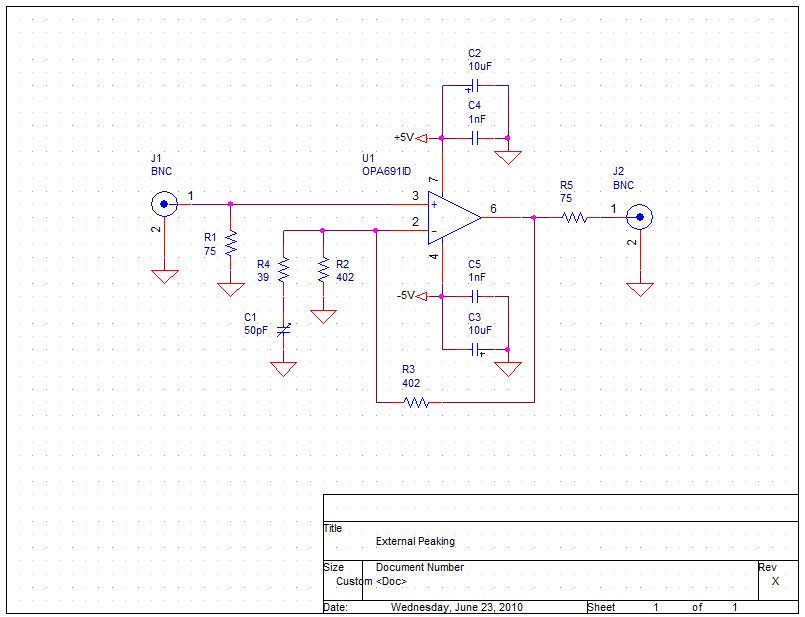
Something like this will give you peaking. Use your opamp of choice. Each one has specific resistor values for Rf and Rg at gain = +2. Most data sheets will have info for PCB layout. Remember, you are working with radio frequencies. The PCB layout is critical.
Scott
| Description: |
|
| Filesize: |
14.89 KB |
| Viewed: |
2696 Time(s) |
|
_________________
"Were we directed from Washington when to sow and when to reap, we would soon want bread."
Thomas Jefferson
|
|
| Back to top |
|
|
David_Web
Joined: 02 May 2007
Posts: 418
Location: Sweden
|
| Posted: Thu Jun 24, 2010 4:32 pm Post subject: |
|
|
Thank you.
So C1 acts as a simple first order lowpass for the feedback thus increasing gain for higher frequencies?
R4 would limit possible HF gain to a reasonable level.
It might be easier to do it internally anyway unless you buy a ready made box. My knowledge ends at 20Khz =)
I have a 50-1976-02P ISS (with RGB loopthrough) that I could potentially mod to try it out. With some luck it could be used both internally and external as the output is taken after the opamp.
It uses CLC409.
So it looks like I should be able to add a resistor and variable cap from Vinv to GND.
A smaller R4 and bigger C1 would be more suitable for the 240ohm feedback resistors present right?
I tried to simulate it with an ideal opamp in LTSPICE but bandwidth ended at 100kHz which also seems to be the frequency of the circuit.
Do you know where the -3dB of C1 is and suppose to be? 1080p 60 or 1080i 90 would likely be used.
Will this pose any stability issues with the opamp?
Ore give any negative effect on image quality?
_________________
SNR of people are ridiculously low.
|
|
| Back to top |
|
|
|
|