| Author |
Message |
David_Web
Joined: 02 May 2007
Posts: 418
Location: Sweden
|
| Posted: Tue Feb 24, 2009 6:11 pm Post subject: Performance of lenses |
|
|
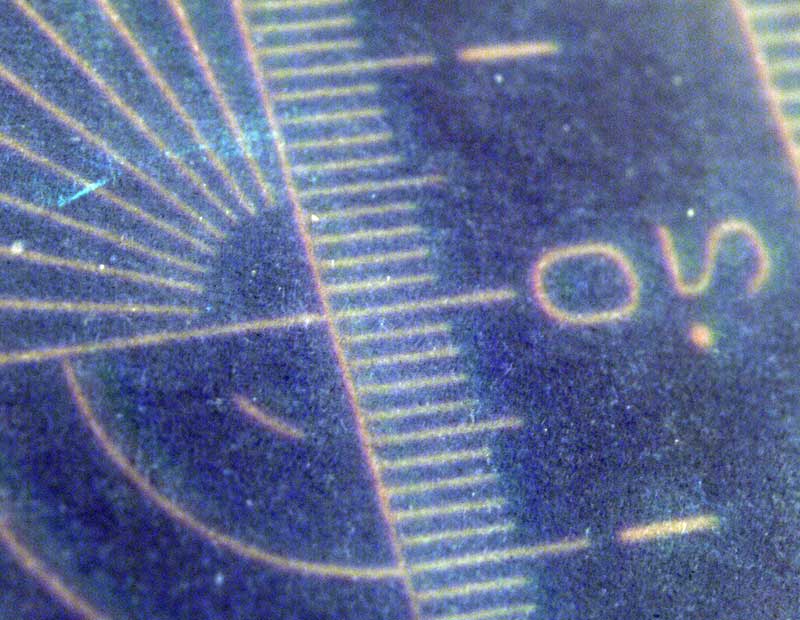
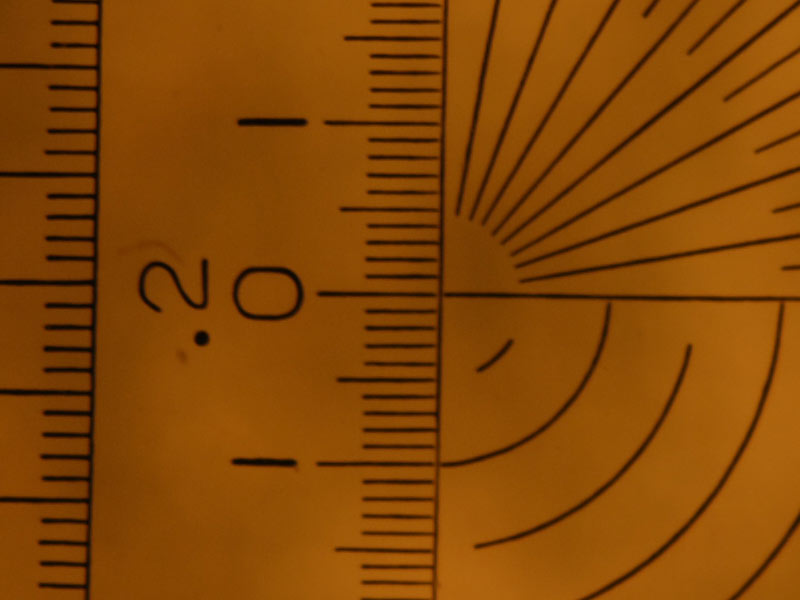
I did a little experiment today when I found a perfect target.
It's a small glass plate with what appears to be silver oxide as the marking.
So why not rig up some sort of light source and project it with a HD8 rev2 left from my marquee (now fitted with HD145)
I used my 60mm macro on my D80 to take the pictures as close as I could get.
The lens was set to OK focus and then I moved the screen (a white box) to get as good focus as I could get.
The distance was approx 1.5m as I don't have a bigger place to test atm.
Will do later though. When it get darker in the other rooms.
The big markings with the "1" are 1mm apart with 1/10th mm markings in between.
The bad part is that I can't see if it flares and adjust focus to avoid that.
Hmm, maybe I could make a target for that.
| Description: |
| The projected image inverted and enhanced in PS to see detail. |
|
| Filesize: |
69.33 KB |
| Viewed: |
5298 Time(s) |
|
| Description: |
|
| Filesize: |
49.67 KB |
| Viewed: |
5298 Time(s) |
|
|
|
| Back to top |
|
 |
Nashou66

Joined: 12 Jan 2007
Posts: 16171
Location: West Seneca NY
|
|
| Back to top |
|
|
1031

Joined: 22 Mar 2006
Posts: 657
Location: Finland
|
|
| Back to top |
|
|
ecrabb
Forum Moderator

Joined: 13 Mar 2006
Posts: 15909
Location: Utah
TV/Projector: JVC RS40, Epson 5010
|
| Posted: Tue Feb 24, 2009 8:27 pm Post subject: |
|
|
Hmmm... Very interesting. The only problem I see is without a scaled wedge, any comparisons between lenses will still be fairly subjective, ala "this looks sharper than that". You still wouldn't know how much sharper - quantitatively speaking.
If we had a scaled wedge, we could objectively say at what point you reach the resolution limit of any given lens. This particular target is also pretty low-resolution, relatively speaking.
If somebody had a decent physical setup and several different lenses to test, I could make up a resolution wedge test pattern on a piece of clear film at 4000ppi that should clearly show the limits of even the very best 9" lenses. I could even make it "CRT sized" and put wedges in the corners to test sharpness in both the center and the edges of the lens. That would be fascinating... To me, at least... Because I'm a geek.
SC
|
|
| Back to top |
|
|
perisoft
Joined: 29 Aug 2007
Posts: 2920
Location: Ithaca, NY
|
| Posted: Tue Feb 24, 2009 8:43 pm Post subject: |
|
|
| ecrabb wrote: | I could make up a resolution wedge test pattern on a piece of clear film at 4000ppi that should clearly show the limits of even the very best 9" lenses. I could even make it "CRT sized" and put wedges in the corners to test sharpness in both the center and the edges of the lens. That would be fascinating... To me, at least... Because I'm a geek.
SC |
Sounds pretty fascinating to me, too. So either both of us are normal, or... 
_________________

|
|
| Back to top |
|
|
David_Web
Joined: 02 May 2007
Posts: 418
Location: Sweden
|
| Posted: Tue Feb 24, 2009 10:08 pm Post subject: |
|
|
I did some quick testing by poking a tiny hole in alu foil. And at it's best sharpness it had some flaring.
I have to see if this will be corrected by the foremost focus knob, which I guess as the flare comes from the edge.
A full sized target sounds like a good idea. Although I don't see an easy way to do it.
Mechanical setup sounds like a pita.
_________________
SNR of people are ridiculously low.
|
|
| Back to top |
|
|
ecrabb
Forum Moderator
Joined: 13 Mar 2006
Posts: 15909
Location: Utah
TV/Projector: JVC RS40, Epson 5010
|
| Posted: Tue Feb 24, 2009 10:18 pm Post subject: |
|
|
The target itself would be the easy part. I'd build a vector file with a line wedge, and index in line pairs/mm. Then image to film at 4,000 ppi, which should cleanly represent ~75 black/white line pairs/mm by my calculations - no more. Still, that should be about double what any CRT lens is capable of... I think. Aren't the good 9" lenses in the 20-30 lp/mm ballpark?
Yes, the physical/mechanical setup would indeed be a pita.
SC
|
|
| Back to top |
|
|
Tom.W

Joined: 09 Mar 2006
Posts: 6635
|
| Posted: Tue Feb 24, 2009 10:36 pm Post subject: |
|
|
The GT-17.
HD120 are the most desirable lens for the 9" liquid coupled projectors, they are optimized for image widths from 2 to 3 meters and have 12 line per mm resolution.
Where is Zeiss when you really need them ? 
I understand achase is using Zeiss lenses but they do not come cheap ! And it's not quite a CRT projector but close...
|
|
| Back to top |
|
|
ecrabb
Forum Moderator
Joined: 13 Mar 2006
Posts: 15909
Location: Utah
TV/Projector: JVC RS40, Epson 5010
|
| Posted: Tue Feb 24, 2009 11:22 pm Post subject: |
|
|
Thanks, Tom. So, if the GT-17's are good to 12 lines/mm, a target that approaches 150 lines/mm should be adequate for evaluation, then.
SC
|
|
| Back to top |
|
|
Tom.W
Joined: 09 Mar 2006
Posts: 6635
|
| Posted: Tue Feb 24, 2009 11:55 pm Post subject: |
|
|
[quote="ecrabb"]Thanks, Tom. So, if the GT-17's are good to 12 lines/mm, a target that approaches 150 lines/mm should be adequate for evaluation, then.
SC[/quote
With what lens ?
|
|
| Back to top |
|
|
tse
Joined: 03 May 2006
Posts: 1014
Location: Sweatbucket, Fl.
|
| Posted: Wed Feb 25, 2009 1:06 am Post subject: |
|
|
| Tom.W wrote: | The GT-17.
HD120 are the most desirable lens for the 9" liquid coupled projectors, they are optimized for image widths from 2 to 3 meters and have 12 line per mm resolution.
Where is Zeiss when you really need them ?
I understand achase is using Zeiss lenses but they do not come cheap ! And it's not quite a CRT projector but close... |
The resolution is specified in line pairs / mm. The better lenses are 11 or 12 line pairs/mm at 50% MTF. 11 line pairs are 11 white lines and 11 black lines, alternating, in a mm. Project this on the screen and measure the light level of the "white" line then measure the light level of the "black" line. To be > 50% MTF the "black" light level has to be 33% or less than the "white" bar light level. MTF formula = white+blk/white-blk x 100. A light meter that measures a narrow slit of light can be used or camera and oscope set-up.
Scott
_________________
"Were we directed from Washington when to sow and when to reap, we would soon want bread."
Thomas Jefferson
|
|
| Back to top |
|
|
|
|