| Author |
Message |
ecrabb
Forum Moderator

Joined: 13 Mar 2006
Posts: 15909
Location: Utah
TV/Projector: JVC RS40, Epson 5010
|
| Posted: Thu Nov 06, 2008 10:19 pm Post subject: How to properly ground a satellite dish... |
|
|
Guys,
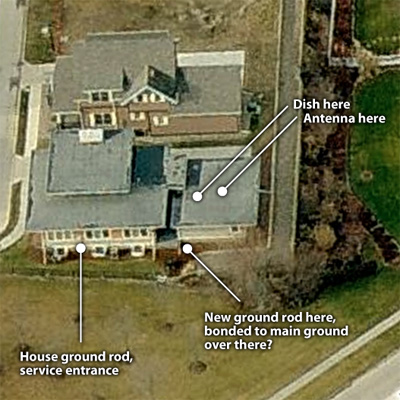
I'm moving a satellite dish (I installed it) from a temp ground mount (been there for 4 years - so much for temporary) to the roof of the garage, along with a new OTA antenna. Including the drop from the roof, it'll probably be a 50-60' run from the new location to the point of entry on the house. I'm confused about what I should or shouldn't do with the ground.
I was thinking that where the run drops off the roof of the garage, I'd put in a new grounding rod, and run a #10 from the antenna and dish. From there, I'd bond that the rod and the house's main ground with a 30' piece of #6 so I wouldn't have a floating ground. That OK?
The point of entry is right next to the house ground rod, so I can ground the ground blocks right there with a short piece of #10.
I know I probably don't even need the new ground rod, but I think the NEC says ~25 feet for a #10 ground, and I'll be at 50 or 60.
Am I on the right track?
SC
| Description: |
|
| Filesize: |
71.77 KB |
| Viewed: |
24797 Time(s) |
|
|
|
| Back to top |
|
 |
jkruger

Joined: 24 Oct 2007
Posts: 2435
Location: Carlsbad, CA
|
| Posted: Fri Nov 07, 2008 2:21 am Post subject: |
|
|
|
That looks like the right way to do it. I would do the same.
|
|
| Back to top |
|
|
wallace123456

Joined: 14 Aug 2006
Posts: 2236
Location: Northwest VA area
|
| Posted: Fri Nov 07, 2008 2:43 am Post subject: |
|
|
I'm not sure I would put a new ground rod in that far away from the "house/master" ground rod. Why not just run #10 to the house ground? It also wouldn't hurt to drive another ground rod right next to the house ground rod.
Do not under estimate the power of good grounding.....
wallace
_________________
Life Is Good, But BBQ Is Better! BBQ Competition Team
|
|
| Back to top |
|
|
ecrabb
Forum Moderator
Joined: 13 Mar 2006
Posts: 15909
Location: Utah
TV/Projector: JVC RS40, Epson 5010
|
| Posted: Fri Nov 07, 2008 2:57 am Post subject: |
|
|
I was actually going to do it that way, Don. But, then I read somewhere that the NEC says 25' max on #10. I assume I could go larger (#6), but then I'm running 60' of #6 ($$) AND I'm taking the high current from a lighting strike right back to the main house ground rod - which you know will go back into the house.
Now, I know ground rods aren't for lightning protection... and if I take a direct hit, it's probably going to fry everything anyway... Still, I feel like it would be better and safer having a drain nearer the antennas. 
SC
|
|
| Back to top |
|
|
Nashou66

Joined: 12 Jan 2007
Posts: 16171
Location: West Seneca NY
|
|
| Back to top |
|
|
wallace123456
Joined: 14 Aug 2006
Posts: 2236
Location: Northwest VA area
|
| Posted: Fri Nov 07, 2008 3:34 am Post subject: |
|
|
IMO, the only thing ground rods and grounding is good for is to prevent ground loops and possibly to help if there is a near-by lightning strike.
I am sure the NEC standard is there for a good reason, but for my thought of preventing ground loops (difference of potential), the #10 bare ground wire would suffice.
Again, my thought is that if lightning strikes (direct hit) ain't nothing going to help; everything is toast. 
If you look at commercial buildings (my experience is with buildings built for telephone central offices), they have ground grids that are massive is size. And yes, they do tie a lot of stuff together at a common point. But they do spend a lot of bucks on wire size (gauge) to make this happen.
wallace
_________________
Life Is Good, But BBQ Is Better! BBQ Competition Team
|
|
| Back to top |
|
|
ecrabb
Forum Moderator
Joined: 13 Mar 2006
Posts: 15909
Location: Utah
TV/Projector: JVC RS40, Epson 5010
|
| Posted: Fri Nov 07, 2008 4:30 am Post subject: |
|
|
Good points, and I agree. Thinking about it more, I should throw the lightning issue aside. Grounding has nothing to do with lighting and if there is a direct hit, as we both mentioned - everything is toast. If we accept that the grounding has nothing to do with lightning and everything to do with static, the lighter gauge (#10) - even stranded copper - is probably just fine.
Thinking about it some more from a lightning perspective, the lighter-gauge wire is probably better, because it's more apt to just blow apart instead of actually carrying a lot of current back to the ground.
The NEC req is kind of goofy. If grounding is all about static, how much resistance can even 100' of 10 ga wire present? Certainly not enough to retard static drain?!?!?! I don't get that.
I went ahead and posted this question to dbstalk, too to see what those guys had to say. Maybe one of them can shed some light on the NEC req.
SC
|
|
| Back to top |
|
|
jask

Joined: 17 Mar 2006
Posts: 10187
Location: kamloops BC
|
| Posted: Fri Nov 07, 2008 8:25 am Post subject: |
|
|
Good question, standard practice around here is not to set the dish as a high point on the structure and to use a grounding block and drip loop.
Now you have me worried...
good link here: http://www.sadoun.com/Sat/Installation/Grounding.htm
|
|
| Back to top |
|
|
WTS
Joined: 08 Mar 2006
Posts: 1276
Location: Calgary
|
| Posted: Fri Nov 07, 2008 2:15 pm Post subject: |
|
|
I have 2 dishes and neither one is grounded and I have now problems. Using ground rods could give you ground loop problems because of the difference in potentials between the grounding points.
_________________
Thanks
Walter
|
|
| Back to top |
|
|
Curt Palme
CRT Tech
Joined: 08 Mar 2006
Posts: 24396
Location: Langley, BC
TV/Projector: All of them!
|
| Posted: Fri Nov 07, 2008 3:01 pm Post subject: |
|
|
THIS is how you ground a satellite dish. 

|
|
| Back to top |
|
|
wallace123456
Joined: 14 Aug 2006
Posts: 2236
Location: Northwest VA area
|
| Posted: Fri Nov 07, 2008 3:19 pm Post subject: |
|
|
| Curt Palme wrote: | THIS is how you ground a satellite dish.
|
Looks more like "ground zero"...

wallace
_________________
Life Is Good, But BBQ Is Better! BBQ Competition Team
|
|
| Back to top |
|
|
JustGreg

Joined: 07 Mar 2006
Posts: 3098
Location: Kenosha, WI
|
| Posted: Fri Nov 07, 2008 3:49 pm Post subject: |
|
|
Where's the Russian Spy Trawler those came from? 
BTW-Nice house SC 
_________________
Greg
"Is it ignorance or apathy? Hey, I don't know and I don't care!" --Jimmy Buffett
|
|
| Back to top |
|
|
ecrabb
Forum Moderator
Joined: 13 Mar 2006
Posts: 15909
Location: Utah
TV/Projector: JVC RS40, Epson 5010
|
| Posted: Fri Nov 07, 2008 4:56 pm Post subject: |
|
|
Thanks for the link, Jask. That helps... I know I absolutely have to ground the coax right at entry - those will go to main house ground right at the service entrance. The question is whether to ground the dish and antenna where it drops off the roof to a new grounding rod (also bonded to the main ground to eliminate a floating ground/ground loop), or whether to run the ground from both all the way back to the main. I'm still not clear on what's best and the guys at DBStalk have nothing to offer so far. 60-some views and no reply to my question!
Walter, I know it would could great a ground loop if they were separate, but the plan was that if I used a second ground, they would be bonded together, which should hold them at same potential.
Thanks, Greg... Too bad you can barely see it!!!
SC
|
|
| Back to top |
|
|
ecrabb
Forum Moderator
Joined: 13 Mar 2006
Posts: 15909
Location: Utah
TV/Projector: JVC RS40, Epson 5010
|
| Posted: Fri Nov 07, 2008 4:59 pm Post subject: |
|
|
Oh, get this... Talk about coincidence... Part of this thread is lightning-related, right? Well, I'm the pres of the HOA we live in... I just got an email from a fellow resident, that her house was hit by lightning Wednesday morning at 4:45. Not surprisingly, my wife and I both shot up in bed (my wife even screamed a little) when that lighting bolt hit. It was like a damn bomb going off. It was F'ing LOUD. I knew it was a really close hit, both from sound (obviously), but also that it tripped the arc fault breaker for our master bedroom. Wow!
SO, how do those things work? I mean, I know there was BIG DAMN ARC nearby alright, but how does it work?
I'll be at her house to snap a few pics this weekend and I'll post them here. Apparently, it blew out some drywall, busted open a gas line in the wall (THAT'S not scary at all!), scorched some wiring in the wall, and fried a bunch of electrical stuff in the house. Her teenage son heard the gas line hissing and they called the utility to come shut off her gas.
That's some scary sh*t, eh?
SC
|
|
| Back to top |
|
|
AnalogRocks
Forum Moderator

Joined: 08 Mar 2006
Posts: 26706
Location: Toronto, Ontario, Canada
TV/Projector: Sony 1252Q, AMPRO 4000G
|
| Posted: Fri Nov 07, 2008 5:20 pm Post subject: |
|
|
| ecrabb wrote: | Her teenage son heard the gas line hissing and they called the utility to come shut off her gas.
That's some scary sh*t, eh?
SC |
Yeah eh? Danm man. One more secondary hit and they coulda gone Kaboom!
_________________
Tech support for nothing
CRT.
HD done right!
|
|
| Back to top |
|
|
JustGreg
Joined: 07 Mar 2006
Posts: 3098
Location: Kenosha, WI
|
| Posted: Fri Nov 07, 2008 6:52 pm Post subject: |
|
|
My neighbors house a stones throw away got hit by lighting. The owner walked around the house but didn't see anything so went to bed. At around 2:30am the ceiling over their heads in the master BR burst down in a shower of flame and sparks...about 6 ft from their bed.  Evidently the lightning blew a hole about as big as a golfball through the roof and started the insulation smoldering. The house was a total loss by the time the cellar savers, erm, fire dept got there. Evidently the lightning blew a hole about as big as a golfball through the roof and started the insulation smoldering. The house was a total loss by the time the cellar savers, erm, fire dept got there.
My wife and I were out on our deck where we could see the house over our stockade fence and my 12 year old son came out and loudly exclaimed "OH COOL! A FIRE!!!" The crying family was RIGHT on the other side of the fence when he said it. 
AFCI info in laymens terms:
http://www.mikeholt.com/mojonewsarchive/AFCI-HTML/HTML/AFCI_Questions_and_Answers~20030301.htm
From another source:
"The AFCI has an electronic circuit in it that monitors the waveform of the electricity flowing in the circuit and when an arc occurs it distorts the waveform and the breaker is tripped." Which may explain how an indirect lightning hit could trip an AFCI via EMP like waves???
One last thing:
‘Important Product Recall Information: Arc Fault Circuit Breakers manufactured by Square D Corporation’
Square D Corporation has issued a product recall for Arc Fault Circuit Breakers, which were manufactured between
March 1, 2004 and September 23, 2004. Although these breakers may not sense an arc, the short-circuit
and overcurrent protection continue to function properly as per Square D.
_________________
Greg
"Is it ignorance or apathy? Hey, I don't know and I don't care!" --Jimmy Buffett
|
|
| Back to top |
|
|
wallace123456
Joined: 14 Aug 2006
Posts: 2236
Location: Northwest VA area
|
| Posted: Fri Nov 07, 2008 7:18 pm Post subject: |
|
|
| ecrabb wrote: | Oh, get this... Talk about coincidence... Part of this thread is lightning-related, right? Well, I'm the pres of the HOA we live in... I just got an email from a fellow resident, that her house was hit by lightning Wednesday morning at 4:45. Not surprisingly, my wife and I both shot up in bed (my wife even screamed a little) when that lighting bolt hit. It was like a damn bomb going off. It was F'ing LOUD. I knew it was a really close hit, both from sound (obviously), but also that it tripped the arc fault breaker for our master bedroom. Wow!
SO, how do those things work? I mean, I know there was BIG DAMN ARC nearby alright, but how does it work?
I'll be at her house to snap a few pics this weekend and I'll post them here. Apparently, it blew out some drywall, busted open a gas line in the wall (THAT'S not scary at all!), scorched some wiring in the wall, and fried a bunch of electrical stuff in the house. Her teenage son heard the gas line hissing and they called the utility to come shut off her gas.
That's some scary sh*t, eh?
SC |
All bathroom, kitchen and outdoor receptacles are GFI (ground fault interrupt) protected. If the GFI circuit senses even a small milli-amp short, it will trip. This is why sometimes when using a drill, saw or in my case, a leaf blower for a long time on a GFI outlet, it will trip. These type devices come close to a short as possible without actually causing one.
Back in my old days, we used to put a GFI breaker at the panel and it would protect the entire circuit(s) in the house. But, now-a-days, they install a GFI outlet at the first needed location in the circuit run.
See what I mean about a direct hit? Ain't nothing going to help.
wallace
_________________
Life Is Good, But BBQ Is Better! BBQ Competition Team
|
|
| Back to top |
|
|
jask
Joined: 17 Mar 2006
Posts: 10187
Location: kamloops BC
|
| Posted: Sat Nov 08, 2008 5:15 am Post subject: |
|
|
I was mentioning this to a friend today and he looked at me like I was retarded and said "That would make it a ground path,why would you want to incorporate a lightning rod into your A/V system?"
tough to argue with logic...
|
|
| Back to top |
|
|
AnalogRocks
Forum Moderator
Joined: 08 Mar 2006
Posts: 26706
Location: Toronto, Ontario, Canada
TV/Projector: Sony 1252Q, AMPRO 4000G
|
| Posted: Sat Nov 08, 2008 5:55 am Post subject: |
|
|
What about one of those "Spark Gap" devices where you screw the incoming coax in one side, it has the #10 wire running to a ground rodthen the coax out the other side.
_________________
Tech support for nothing
CRT.
HD done right!
|
|
| Back to top |
|
|
ecrabb
Forum Moderator
Joined: 13 Mar 2006
Posts: 15909
Location: Utah
TV/Projector: JVC RS40, Epson 5010
|
| Posted: Sat Nov 08, 2008 6:56 am Post subject: |
|
|
Jeremy, that's called a ground block - and I'll be using those - that's how you ground the coax shield on every drop.
Jask, what the friend doesn't seem to understand is that the antenna or dish is ALREADY grounded... via your TV or sat receiver inside your house! So, it's a given that it's a lighting rod - that's the way it is. The question is, do you want to give the lightning one path to ground (through the equipment in your rack), or do you want to give it a low-resistance alternate path to ground OUTSIDE your house into a grounding rod stuck in the dirt? That's where the NEC comes in with the safety codes.
As has been pointed out, a direct lighting strike is probably going to fry anything and everything sensitive in your house. The question though, is do you just lose some equipment from overvoltage because most of the current went to ground outside? Or, do you have a fire in your theater or living room because a BUNCH of current went through the TV or Sat receiver.
SC
Last edited by ecrabb on Tue Dec 09, 2008 8:52 pm; edited 1 time in total
|
|
| Back to top |
|
|
|
|