| Author |
Message |
mtmelvin
Joined: 18 Mar 2006
Posts: 153
Location: Bay Area, CA
|
| Posted: Wed Feb 06, 2008 7:07 am Post subject: Fun with my Ampro 4600 |
|
|
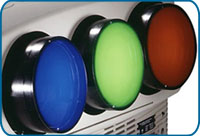
I've decided that I'd like to do something with the Ampro 4600 that has been sitting in various positions in various rooms throughout my house over the past year or so. It's in good working order with a recently replaced HVPS and some great condition tubes, color filtered c-elements and new glycol. And it's just been sitting...
So now I've dragged it out and I'm gonna see how great I can or can't make it look. I did a super-quick rough set-up last night just so that I could become familiar with the remote again. Damn, I wish the backlight on the LCD display still worked!
So now I've decided to look at the Greyscale setings... G2 controls, Sub-brights and sub-contrasts. I've been reading through Rajdude's epic "4200 setup and troubleshooting" thread over at AVS. Man, that's a tough read... but there's lots of good info buried in there.
So I'm taking a look at the procedure Rajiv went through starting at this post:
http://www.avsforum.com/avs-vb/showthread.php?p=10137312#post10137312
I'm following the same directions that he did:
http://www.avsforum.com/avs-vb/showthread.php?p=10368672#post10368672
Before I've even hooked up my scope, however, I've already got some questions.
Scott, I hope you're listening 
First of all, does the 4600 have "Gain Controls" as described in the "Pre-Adjustment Requirements?" I don't see any pots on the back of the RGB card itself... or anywhere on the card for that matter. The directions call for these controls to be maxed before starting this procedure. Is there something equivalent or similar to adjust on the 4600?
Second, when setting the "CRT Cutoffs" (ADJUSTMENT PROCEDURE, Step 1) I can adjust the G2 on each CRT card so that the raster is not visable... except on Green. Even with G2 turned all the way down I can still see the raster on Green. Any idea why that is?
Thanks in advance. I'm hopping to figure these two things out before proceeding.
-Mark

|
|
| Back to top |
|
 |
Curt Palme
CRT Tech
Joined: 08 Mar 2006
Posts: 24396
Location: Langley, BC
TV/Projector: All of them!
|
| Posted: Wed Feb 06, 2008 7:23 am Post subject: |
|
|
Putting a scope that close to an Ampro is a bad idea. You're insinuating that it has problems, see how the projector already has it's back up?

Too late to give any intelligent response, so I'll wait until tomorrow.
|
|
| Back to top |
|
|
stefuel
Joined: 07 Mar 2006
Posts: 3353
Location: Green Harbor MA USA
|
| Posted: Wed Feb 06, 2008 11:19 am Post subject: |
|
|
Swap the green and blue neck boards and see if the glowing raster follows the board.
_________________
Chip
A Barco is only a AmPro with training wheels
Card carrying member of the AVS chain gang.
|
|
| Back to top |
|
|
papalek
Joined: 08 Mar 2006
Posts: 1536
Location: Longs SC
|
| Posted: Wed Feb 06, 2008 11:20 am Post subject: |
|
|
The 4600 is completely different from the 4200. Especially in the video chain. Codes 94 and 95 are your gain(sub contrast) and cutoff(sub bright) settings. But from what Scott has said you leave the sub brights at 50 and adjust the lower part of gray scale with the G2. Upper Part with the sub contrast.
_________________
My current list of PJ's AmPro 1 1/2-4600,4200, 1/2-3600,2600.
I do love my AmPro's
|
|
| Back to top |
|
|
papalek
Joined: 08 Mar 2006
Posts: 1536
Location: Longs SC
|
| Posted: Wed Feb 06, 2008 11:23 am Post subject: |
|
|
The blue tube in mine will not let the raster go completely dark. I have tried different neck cards with no change. but it is so faint that it is not visible on the screen even with full black scenes. Standing in front of the PJ you can not see it unless your face is right up to the lens.
_________________
My current list of PJ's AmPro 1 1/2-4600,4200, 1/2-3600,2600.
I do love my AmPro's
|
|
| Back to top |
|
|
Curt Palme
CRT Tech
Joined: 08 Mar 2006
Posts: 24396
Location: Langley, BC
TV/Projector: All of them!
|
| Posted: Wed Feb 06, 2008 2:18 pm Post subject: |
|
|
|
If swapping the neck boards doesn't do it, then the green tube element has contamination in it. It can burn off within a few (100) hours, if it's really bad the tube might need to be sent to VDC or replace the tube. I'd live with it and see if the problem goes away.
|
|
| Back to top |
|
|
mtmelvin
Joined: 18 Mar 2006
Posts: 153
Location: Bay Area, CA
|
| Posted: Wed Feb 06, 2008 5:55 pm Post subject: |
|
|
| stefuel wrote: | | Swap the green and blue neck boards and see if the glowing raster follows the board. |
Cool! Thanks for the suggestion Chip. I've also got a parts 3600 out in the garage. I think the neck boards are the same...
-Mark
|
|
| Back to top |
|
|
papalek
Joined: 08 Mar 2006
Posts: 1536
Location: Longs SC
|
| Posted: Wed Feb 06, 2008 6:30 pm Post subject: |
|
|
| mtmelvin wrote: | I've also got a parts 3600 out in the garage. I think the neck boards are the same...
-Mark |
They are exactly the same.
_________________
My current list of PJ's AmPro 1 1/2-4600,4200, 1/2-3600,2600.
I do love my AmPro's
|
|
| Back to top |
|
|
tse
Joined: 03 May 2006
Posts: 1014
Location: Sweatbucket, Fl.
|
| Posted: Thu Feb 07, 2008 1:42 am Post subject: |
|
|
| papalek wrote: | | The 4600 is completely different from the 4200. Especially in the video chain. Codes 94 and 95 are your gain(sub contrast) and cutoff(sub bright) settings. But from what Scott has said you leave the sub brights at 50 and adjust the lower part of gray scale with the G2. Upper Part with the sub contrast. |
That is essentially it.
The scope helps, a stairstep or graybar test pattern helps even more.
The idea of the sub-brite controls is to set the video black level so it isn't crushed into the CRT card rail (+190V) but not too far from the rail because that makes the CRT card video amplifier runn hotter than it needs to. It is a good idea to have all three sub-brites at the same value. 50% is probably the best bet.
Use the G-2s to set the color of the dimmer levels for gray. Do this before trying to set the sub-contrast controls.
Sub-contrast controls are for setting the brighter bars for white.
Like the procedure mentioned in Rajdude's thread, turn off the blue. Adjust red and/or green to get yellow. It is very easy to tell the difference between red-yellow/yellow/green-yellow. Then turn on the blue and adjust it for gray. First G-2 with contrast low then contrast at normal and adjust sub-contrast.
If the CRT cards make no difference on the green tube then it is most likely suffering from secondary emmisions. That can often be cured with a CRT rejuvenator. If it isn't too bad then just live with it.
Scott
_________________
"Were we directed from Washington when to sow and when to reap, we would soon want bread."
Thomas Jefferson
|
|
| Back to top |
|
|
Curt Palme
CRT Tech
Joined: 08 Mar 2006
Posts: 24396
Location: Langley, BC
TV/Projector: All of them!
|
| Posted: Thu Feb 07, 2008 2:03 am Post subject: |
|
|
|
Update on the CRT lack o' black. I ran my tube here overnight, and it cured itself. No more flickering, perfect blacks where the tube is supposed to be black.
|
|
| Back to top |
|
|
macgyver655
Joined: 22 Aug 2007
Posts: 8508
|
| Posted: Thu Feb 07, 2008 2:29 am Post subject: |
|
|
| tse wrote: | | papalek wrote: | | The 4600 is completely different from the 4200. Especially in the video chain. Codes 94 and 95 are your gain(sub contrast) and cutoff(sub bright) settings. But from what Scott has said you leave the sub brights at 50 and adjust the lower part of gray scale with the G2. Upper Part with the sub contrast. |
That is essentially it.
The scope helps, a stairstep or graybar test pattern helps even more.
The idea of the sub-brite controls is to set the video black level so it isn't crushed into the CRT card rail (+190V) but not too far from the rail because that makes the CRT card video amplifier runn hotter than it needs to. It is a good idea to have all three sub-brites at the same value. 50% is probably the best bet.
Use the G-2s to set the color of the dimmer levels for gray. Do this before trying to set the sub-contrast controls.
Sub-contrast controls are for setting the brighter bars for white.
Like the procedure mentioned in Rajdude's thread, turn off the blue. Adjust red and/or green to get yellow. It is very easy to tell the difference between red-yellow/yellow/green-yellow. Then turn on the blue and adjust it for gray. First G-2 with contrast low then contrast at normal and adjust sub-contrast.
If the CRT cards make no difference on the green tube then it is most likely suffering from secondary emmisions. That can often be cured with a CRT rejuvenator. If it isn't too bad then just live with it.
Scott |
I'm haveing some trouble understanding your theory of adjusting the black level with the G2's. You also didn't mention your setting for the master briteness. This seems much more difficult then the procedure I use not to mention it contradicts the service manual. I am very picky when it comes to pure black and pure white and I have no difficulty achieving it thru my method which is a basic method also used in adjusting most TV's.
My belief is the G2 is for adjusting the guns emission with no signal applied so it will turn off completely. The sub brites are for adjusting for no raster with a blank signal to produce a pure black. The sub contrast is for adjusting to achieve a pure white. I have to think about your method some more but I'm not seeing the achievement of a complete no raster for a pure black.
|
|
| Back to top |
|
|
Curt Palme
CRT Tech
Joined: 08 Mar 2006
Posts: 24396
Location: Langley, BC
TV/Projector: All of them!
|
| Posted: Thu Feb 07, 2008 2:35 am Post subject: |
|
|
Also, you need to adjust the G2 pot on the CRT boards.
1) Mute (turn off) all CRTs, set the G2 control so the raster _just_ shows on the tube face. Not enough to light up the screen. Turn tubes back on .
2) Set brightness and contrast to about 75% or so, that's what I work with, display the stepped gray scale from AVIA.
3) Set sub brightness on each tube so that the 0IRE is just lighting the tube face, again, not enough to light up on the screen. Use sub contrast controls to balance out the whites.
|
|
| Back to top |
|
|
mtmelvin
Joined: 18 Mar 2006
Posts: 153
Location: Bay Area, CA
|
| Posted: Thu Feb 07, 2008 2:36 am Post subject: |
|
|
Curt, Scott, and Papalek,
Thank you very much for the suggestions. I won't get around to playing with this some more until tomorrow. I will try swapping the neck boards and if that doesn't work I'll try leaving in on for a while as Curt suggested.
Scott, I'm a little confused about what you are suggesting. The procedure described in the guide on Rajdude's thread describes how to set the sub-bright levels with a scope. But you're saying just to set them at 50%. So do you think there is any value in using the scope? If so, then I'm still wondering about the first step of that procedure that says to set the "Gain Controls" on the RGB card to maximum. Does the 4600 have such controls? Should I just ignore that step?
The rest of what you said makes sense. Sub-brites first, then G2 with the contrast low, then Sub-contrast with contrast at normal level. I'm just wondering how to go about setting the sub brites. I mean, I'm happy to leave them at 50%... but look, I went and dragged out my scope already! 
Thanks again for the great help!
-Mark
|
|
| Back to top |
|
|
macgyver655
Joined: 22 Aug 2007
Posts: 8508
|
| Posted: Thu Feb 07, 2008 2:42 am Post subject: |
|
|
| Curt Palme wrote: | Also, you need to adjust the G2 pot on the CRT boards.
1) Mute (turn off) all CRTs, set the G2 control so the raster _just_ shows on the tube face. Not enough to light up the screen. Turn tubes back on .
2) Set brightness and contrast to about 75% or so, that's what I work with, display the stepped gray scale from AVIA.
3) Set sub brightness on each tube so that the 0IRE is just lighting the tube face, again, not enough to light up on the screen. Use sub contrast controls to balance out the whites. |
That's what I'm sayin.
|
|
| Back to top |
|
|
Ray Cendroski
Joined: 22 Apr 2006
Posts: 68
Location: Concord, Ohio
|
| Posted: Thu Feb 07, 2008 3:28 am Post subject: Re: Fun with my Ampro 4600 |
|
|
| mtmelvin wrote: |
Second, when setting the "CRT Cutoffs" (ADJUSTMENT PROCEDURE, Step 1) I can adjust the G2 on each CRT card so that the raster is not visable... except on Green. Even with G2 turned all the way down I can still see the raster on Green. Any idea why that is?
-Mark
|
Mark,
Like Scott said - probably secondary emission. I remembered a thread way back in the AVS Guest Speaker Forum (2002) that featured Walter Allen from Ampro. His response when he was asked about the green glow:
http://archive.avsforum.com/avs-vb/showthread.php?s=d9f4d91b193d1e9ae443e6b389b548e4&threadid=193201&perpage=20&pagenumber=2
Regarding the inability to "cut off" the green tube, this is almost always due to a source of "cold emission", which is an always on, unwanted stream of electrons coming from some part of the electron gun. When present, this cold emission adds to the normal flow of electrons coming from the cathode, so even when the tube is truly cut off, you will seen a raster, although it will not be perfectly focused and there will be retrace lines since there it's always on. When you then turn up G2, you will see the normal raster appear in addition to the cold emission raster, but it will be focused and not exactly in the same place. You should use this focused raster to set the cutoff, while ignoring the cold emission. Note that even though the cold emission appears relatively bright while looking in through the lens, rarely is it bright enough to be seen on the screen, even with all colors cutoff.
Ray
[/quote]
|
|
| Back to top |
|
|
Curt Palme
CRT Tech
Joined: 08 Mar 2006
Posts: 24396
Location: Langley, BC
TV/Projector: All of them!
|
| Posted: Thu Feb 07, 2008 5:43 am Post subject: |
|
|
|
That's a good find from the archives, thanks Ray!
|
|
| Back to top |
|
|
Ray Cendroski
Joined: 22 Apr 2006
Posts: 68
Location: Concord, Ohio
|
| Posted: Thu Feb 07, 2008 10:47 pm Post subject: |
|
|
| Curt Palme wrote: | | That's a good find from the archives, thanks Ray! |
Thanks Curt
I noticed another comment from Walter in that same Archive thread that sounds like the same thing Scott is saying about sub-brites and G2:
There are no specific “factory settings” for the sub-bright and sub-contrast functions - they are customized to a particular projector to achieve proper gray scale and color temperature. There are, however, consistencies is the settings. The sub-bright adjustment is really a fine tuning of the G2 cutoff adjustment, and is set to match the cutoffs of all tubes so that the very dim “gray“ areas of the image are truly gray (not tinted). If the G2 is perfectly done, the sub-bright setting should be at 50%, thus typically the sub-bright settings will be about 50%. The sub-contrast adjustments are adjusted so the brighter area of the image will be the correct color temperature, and since this is largely a function of the tube phosphors, there is also consistency here. For a typical 3600/4600, red-green-blue settings of about 65-80-70 are normal. These will vary depending upon several things, including tube age, scan rates, quality of are focus, etc.
Ray
|
|
| Back to top |
|
|
macgyver655
Joined: 22 Aug 2007
Posts: 8508
|
| Posted: Fri Feb 08, 2008 12:32 am Post subject: |
|
|
|
Actually other then the part about sub contrast, it is the opposite. However both methods are trying to achieve the same goal. After reading Scott's method somemore I believe his theory is to reduce or keep even stress on the CRT cards, specifically the video amps. According to that post by Walter if the G2 is done properly the sub brite will typically be at 50%. So, if someone is not good or knowledgable at setting the G2, then I think they would benifit with Scott's process because there is less room for error. For those more knowledgeable, either one should work. My only concern is affects of useing G2 only to set black level on worn tube's. Also setting the sub brites at 50 and setting G2 for black level place's more circuits in play to rely on for complete non emission. Am I correct in your assumption Scott?
|
|
| Back to top |
|
|
tse
Joined: 03 May 2006
Posts: 1014
Location: Sweatbucket, Fl.
|
| Posted: Fri Feb 08, 2008 12:58 am Post subject: |
|
|
The G-2 and sub-brite controls cause the same thing to happen. In one hypothetical case the cathode could be set to +180V with brite and sub-brite controls with "black" video input. G-2 could be adjusted for just cut-off and G-2 might be +700V. Then G-2 could be set for +650V. The cathode voltage could be set lower than +180V with sub-brite for just cut-off. Either control can set cut-off.
It is correct to say that the video amplifier is in it's best operating range with sub-brite at 50% and brite at 80%. The sub-brite control is not so low that black crush might happen nor so high that white crush might happen. It also keeps the power dissipation in the video amplifier low.
G-2 controls and sub-brite controls are redundent. Look at the Marquee. It only has G-2 controls for cut-off. That is as it should be.
Scott
_________________
"Were we directed from Washington when to sow and when to reap, we would soon want bread."
Thomas Jefferson
|
|
| Back to top |
|
|
macgyver655
Joined: 22 Aug 2007
Posts: 8508
|
| Posted: Fri Feb 08, 2008 1:42 am Post subject: |
|
|
| tse wrote: | The G-2 and sub-brite controls cause the same thing to happen. In one hypothetical case the cathode could be set to +180V with brite and sub-brite controls with "black" video input. G-2 could be adjusted for just cut-off and G-2 might be +700V. Then G-2 could be set for +650V. The cathode voltage could be set lower than +180V with sub-brite for just cut-off. Either control can set cut-off.
It is correct to say that the video amplifier is in it's best operating range with sub-brite at 50% and brite at 80%. The sub-brite control is not so low that black crush might happen nor so high that white crush might happen. It also keeps the power dissipation in the video amplifier low.
G-2 controls and sub-brite controls are redundent. Look at the Marquee. It only has G-2 controls for cut-off. That is as it should be.
Scott |
I agree with that 100% and also alot of devices use G2 for black level. But to me the sub brite is a bonus feature to achieve a very accurate black level. Useing the G2 for the final setting takes away from this bonus. This is the procedure I use and no test instruments or disks.
After a good warmup cutoff the CRT's. Pick a G2, stick your face in the lens and rotate back and forth getting a feel for the control. Then back it off until the raster just disappears. Then forward one more time then back again until it's gone. Do all 3. Done.
Turn tubes back on. Set master brite at 50%, then sub brites at 50%. Remove source for blank signal. See if there is any raster's. Lets say you have some faint red. Bump up the master brite looking in the three lens. As the last color comes up stop. Lets say it was blue. Now watching the blue, lower the master brite until the blue raster just disappears, then go 2 more numbers down. The blue will now be blank and the green and red still have a raster. Now useing the green sub brite, lower the setting until the green disappears then go 2 more numbers. Then useing the red sub brite, lower it until the red disappears, and go 2 more numbers. Now go back to the master brite and click it up 3 numbers and you should have a faint raster on all 3 tubes, then lower the master and all 3 should disappear equally. Done. You cant get anymore accurate then that. Then procede to set the contrast.
This will give you a pure black with no possibility of tinting. Works for me.
|
|
| Back to top |
|
|
|
|