|
As this forum is rarely used anymore, we've locked it. Feel free to browse and read. Questions? Please reach out to us directly. Cheers! |
|
|
 |
|
|
| Author |
Message |
mp20748
Joined: 12 Sep 2006
Posts: 5689
Location: Maryland
TV/Projector: 9500LC Ultra / Super 02 and 03 VIM
|
| Posted: Thu Mar 12, 2015 9:04 pm Post subject: |
|
|
| El Duderino wrote: | | mp20748 wrote: | | A ramp pattern does not have edges in it. |
What's the difference between a digital 'ramp' and a digital 'step'? Digital is quantized into discrete values by it's very nature. 255 discrete steps doesn't make a 'smooth', 'continuous' ramp either.
 |
I think we're talking about two different things. When you say STEP, if I feed that signal into my scope, it would show up as steps. And my reference to a ramp would show up with a straight line from the bottom left to the far right top. A very straight and not jagged line.
So if you're meaning a 255 stepped ramp, that might make sense to me, but still, I would be expecting to see 255 steps in a line going from far left bottom to far right top. And I've seen that already
|
|
| Back to top |
|
 |
El Duderino
Joined: 23 Jan 2011
Posts: 4653
Location: Portland, OR
|
| Posted: Thu Mar 12, 2015 9:13 pm Post subject: |
|
|
| mp20748 wrote: | | And my reference to a ramp would show up with a straight line from the bottom left to the far right top. |
Not if your scope and display has the BW, and your display is faithful to the DIGITAL, QUANTIZED VALUES . The transition between 0,0,0 and 1,1,1 is a STEP function, and you can't get any smaller or 'smoother' in the DIGITAL domain. All digitally encoded information has 'steps' and 'edges', by definition.
Now, perhaps you have an analog signal generator, over an all analog path, or somehow use analog test patterns? These days, most test patterns and video signal generators are digital, so they're quantized and stepped by nature.
|
|
| Back to top |
|
|
mp20748
Joined: 12 Sep 2006
Posts: 5689
Location: Maryland
TV/Projector: 9500LC Ultra / Super 02 and 03 VIM
|
| Posted: Thu Mar 12, 2015 9:37 pm Post subject: |
|
|
| El Duderino wrote: | | mp20748 wrote: | | And my reference to a ramp would show up with a straight line from the bottom left to the far right top. |
Not if your scope and display has the BW, and your display is faithful to the DIGITAL, QUANTIZED VALUES . The transition between 0,0,0 and 1,1,1 is a STEP function, and you can't get any smaller or 'smoother' in the DIGITAL domain. All digitally encoded information has 'steps' and 'edges', by definition.
Now, perhaps you have an analog signal generator, over an all analog path, or somehow use analog test patterns? These days, most test patterns and video signal generators are digital, so they're quantized and stepped by nature. |
I see what you mean. We're both right, but we're talking about two different things.
You seem to be referring to a digital step (I'm not not familiar with this), and if on my scope for a 1920X1080 signal, would amount to 1920 steps going across the screen. My reference would be Steps that are a certain width in size, and could be 255, 64, etc. this is where I would expect what you mentioned would create the edges, that are at each of the sized steps.
On my scope the 1920 digital horizontal ramp pattern would be a straight line consisting of 1920 pixels going from far left bottom corner to far right top. And on the screen it would be smooth ramp (not jagged) going from far left (dark) to far right (white)
|
|
| Back to top |
|
|
El Duderino
Joined: 23 Jan 2011
Posts: 4653
Location: Portland, OR
|
| Posted: Thu Mar 12, 2015 10:17 pm Post subject: |
|
|
| mp20748 wrote: | | On my scope the 1920 digital horizontal ramp pattern would be a straight line consisting of 1920 pixels going from far left bottom corner to far right top. |
Then you need a better scope, dial up the time-base, or have electronics that have sufficient bandwidth. A 8-bit digital grayscale 'ramp' has steps. 1920 is size, not bit-depth. There are only 255 gray levels (256 landings) available in 8-bit images, and that's for sRGB with black at d0 and white at d255. For StudioRGB, like most 8-bit consumer video, it's even less with 219 steps and 220 landings.
Again, if your grayscale 'ramp' pattern is from a digital source, or via a digital feed, then it's really not a 'ramp' but a 'staircase'.
|
|
| Back to top |
|
|
ecrabb
Forum Moderator

Joined: 13 Mar 2006
Posts: 15909
Location: Utah
TV/Projector: JVC RS40, Epson 5010
|
| Posted: Thu Mar 12, 2015 10:46 pm Post subject: |
|
|
Duderino is exactly correct. Displaying a full-frame horizontal ramp, for any given row of pixels in a 1920x1080 signal, assuming an 8-bit color space, the RGB value of the pixels only changes every 7-8 pixels. So, if you have the scope's time-base set up to be able to resolve a 1-pixel time interval, you should see a staircase. A very fine staircase, but a staircase nonetheless.
This is where CRT and the "fuzziness" that is the result of the analog video chain's limitations along with optical focus limitations actually holds some advantages. Where digital can be extremely revealing of the sometimes-inadequate 8-bit source, CRT actually hides some of those limitations. Call it fuzzy or call it the "film look", it can help the source look better in some ways.
This is where Rec 2020 could be such a game-changer with 12-bit or even 10-bit color. Instead of 256 (or 220) possible values, 10-bits allows 1024 values (or 870-something) values per pixel. 12 bits is 4096. with 12-bit, you could literally display a visually perfect ramp even on a true 4k display. Along with more saturated primaries, Rec 2020 will display about 75% of what we can see, while Rec. 709 is just over a third.
CRT could take advantage of the larger bit depths, but unfortunately the saturated primaries is where CRT will become pretty obsolete.
SC
|
|
| Back to top |
|
|
mp20748
Joined: 12 Sep 2006
Posts: 5689
Location: Maryland
TV/Projector: 9500LC Ultra / Super 02 and 03 VIM
|
| Posted: Thu Mar 12, 2015 11:30 pm Post subject: |
|
|
Can you show me the Edges in pattern in the link. And be mindful that is is called a RAMP pattern and NOT Step
And can you also post it with the Step pattern posted a few post earlier that you can clearly see the Steps in it
http://www.colorsimulator.com/gradent_gray_scale_test_pattern.htm
|
|
| Back to top |
|
|
redfox001

Joined: 16 Mar 2009
Posts: 2257
Location: The Netherlands
|
| Posted: Thu Mar 12, 2015 11:35 pm Post subject: |
|
|
The banding mentioned is the consequence of rounding errors. See this:
http://enblend.sourceforge.net/banding.htm
_________________
701s->runco933->8500ultra->cinemax->9500mp->919 splitpack + cinemax
|
|
| Back to top |
|
|
El Duderino
Joined: 23 Jan 2011
Posts: 4653
Location: Portland, OR
|
| Posted: Thu Mar 12, 2015 11:37 pm Post subject: |
|
|
I can see some evidence of apparent (to me) faint luminance bands or vertical stripes. I can't show it to you, because they may likely be a function of my monitor or my HVS. I also acknowledged it's called a 'ramp' but it's 8-bit sRGB with discrete, finite, quantized, steps. 
Last edited by El Duderino on Thu Mar 12, 2015 11:47 pm; edited 1 time in total
|
|
| Back to top |
|
|
ecrabb
Forum Moderator
Joined: 13 Mar 2006
Posts: 15909
Location: Utah
TV/Projector: JVC RS40, Epson 5010
|
| Posted: Thu Mar 12, 2015 11:46 pm Post subject: |
|
|
| mp20748 wrote: | | Can you show me the Edges in pattern in the link. And be mindful that is is called a RAMP pattern and NOT Step |
It will be hard to show 'edges' because that pattern is dithered. Dithering (essentially noise) is added specifically to trick the eye into seeing what looks like a ramp when indeed in an 8-bit per channel color space, a ramp is really just a 256-level step. You can call it what you want, but it can't fix a limitation inherent in an 8-bit per channel color space.
I'll post some 24-bit PNGs later to illustrate what we're talking about.
SC
Last edited by ecrabb on Thu Mar 12, 2015 11:48 pm; edited 1 time in total
|
|
| Back to top |
|
|
mp20748
Joined: 12 Sep 2006
Posts: 5689
Location: Maryland
TV/Projector: 9500LC Ultra / Super 02 and 03 VIM
|
| Posted: Thu Mar 12, 2015 11:48 pm Post subject: |
|
|
| El Duderino wrote: |
I can see some evidence of apparent (to me) faint luminance bands or vertical stripes . I can't show it to you, because they may likely be a function of my monitor or my HVS. I also acknowledged it's called a 'ramp' but it's 8-bit digital with discrete, finite, quantized, steps. |
Isn't that the same thing I was saying, because it is a pixel structure there would be finite steps (digital), but it is so different from the pattern you posted that had wide bars in the pattern instead of finite (digital) steps?
|
|
| Back to top |
|
|
mp20748
Joined: 12 Sep 2006
Posts: 5689
Location: Maryland
TV/Projector: 9500LC Ultra / Super 02 and 03 VIM
|
| Posted: Thu Mar 12, 2015 11:50 pm Post subject: |
|
|
| ecrabb wrote: | | mp20748 wrote: | | Can you show me the Edges in pattern in the link. And be mindful that is is called a RAMP pattern and NOT Step |
It will be hard to show 'edges' because that pattern is dithered. Dithering (essentially noise) is added specifically to trick the eye into seeing what looks like a ramp when indeed in an 8-bit per channel color space, a ramp is really just a 256-level step. You can call it what you want, but it can't fix a limitation inherent in an 8-bit per channel color space.
I'll post some 24-bit PNGs later to illustrate what we're talking about.
SC |
My point is that it is called a RAMP instead of a Step Pattern, which should mean it is smooth rather than stepped or bars. And of course the deeper the bits the smoother it'll look.
|
|
| Back to top |
|
|
ecrabb
Forum Moderator
Joined: 13 Mar 2006
Posts: 15909
Location: Utah
TV/Projector: JVC RS40, Epson 5010
|
| Posted: Thu Mar 12, 2015 11:52 pm Post subject: |
|
|
| mp20748 wrote: | | Isn't that the same thing I was saying, because it is a pixel structure there would be finite steps (digital), but it is so different from the pattern you posted that had wide bars in the pattern instead of finite (digital) steps? |
No, Mike. In a high-res system like 1080p, there ARE wide bars - 7-8 pixels to be exact - even in a ramp pattern. It will be plainly visible, unless the pattern is generated with dithering.
With SD, it wasn't that big of a deal because even in D1, the 'steps' were only 2-3 pixels wide, which weren't even visible on any typical display of those days.
SC
|
|
| Back to top |
|
|
El Duderino
Joined: 23 Jan 2011
Posts: 4653
Location: Portland, OR
|
| Posted: Thu Mar 12, 2015 11:56 pm Post subject: |
|
|
| mp20748 wrote: | | but it is so different from the pattern you posted that had wide bars in the pattern instead of finite (digital) steps? |
The only difference is the number of steps or the distance of the rise, not the absence of steps or the absence of a step function.
| mp20748 wrote: | | My point is that it is called a RAMP instead of a Step Pattern, which should mean it is smooth rather than stepped or bars. |
My point is that it's misnamed. 'Smooth digital' is an oxymoron like 'Analog digital' would be.
|
|
| Back to top |
|
|
mp20748
Joined: 12 Sep 2006
Posts: 5689
Location: Maryland
TV/Projector: 9500LC Ultra / Super 02 and 03 VIM
|
| Posted: Fri Mar 13, 2015 12:01 am Post subject: |
|
|
| ecrabb wrote: | | mp20748 wrote: | | Isn't that the same thing I was saying, because it is a pixel structure there would be finite steps (digital), but it is so different from the pattern you posted that had wide bars in the pattern instead of finite (digital) steps? |
No, Mike. In a high-res system like 1080p, there ARE wide bars - 7-8 pixels to be exact - even in a ramp pattern. It will be plainly visible, unless the pattern is generated with dithering.
With SD, it wasn't that big of a deal because even in D1, the 'steps' were only 2-3 pixels wide, which weren't even visible on any typical display of those days.
SC |
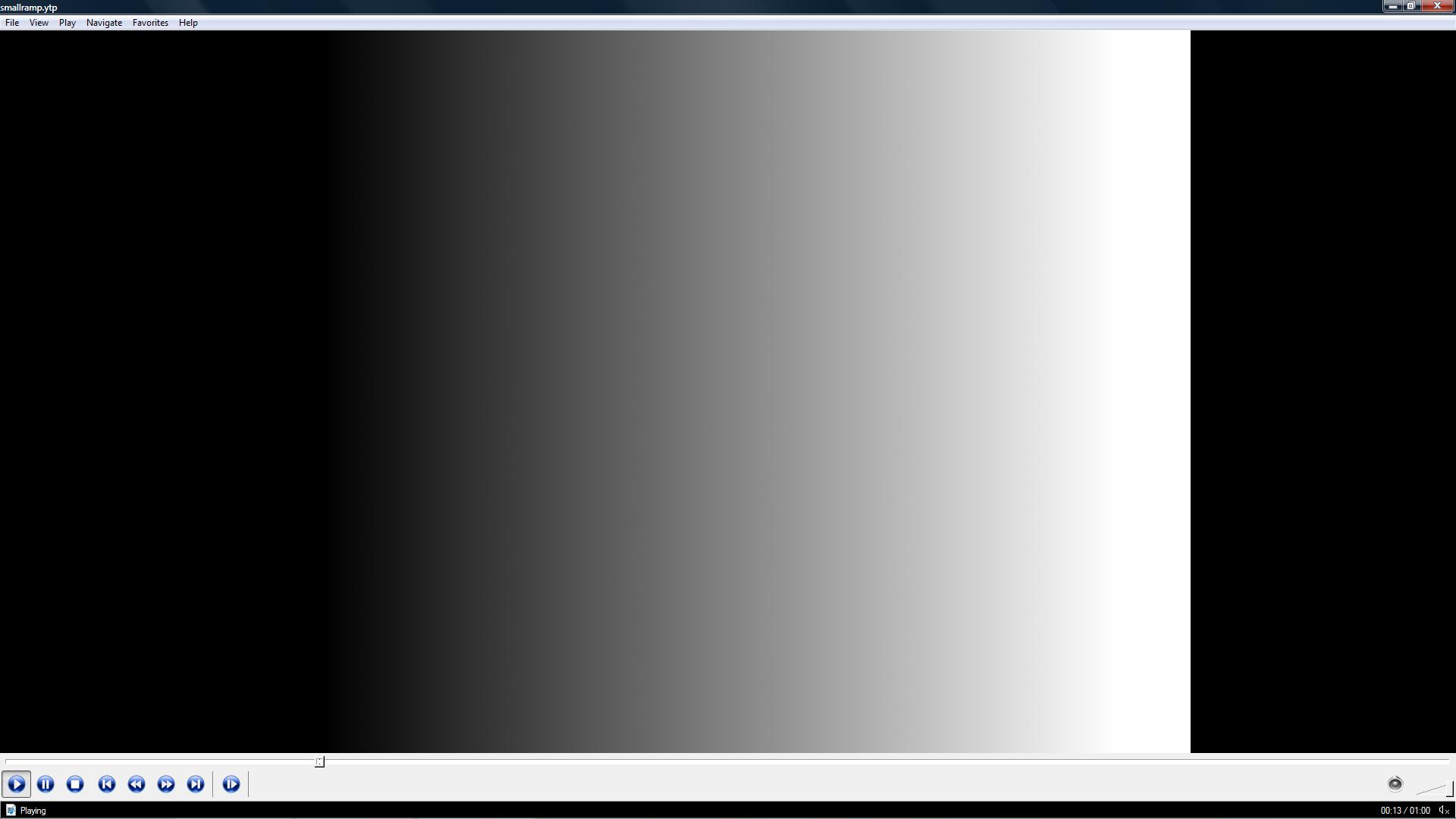
here you go. a 1920X1080P ramp pattern
| Description: |
|
| Filesize: |
72.49 KB |
| Viewed: |
4027 Time(s) |
|
|
|
| Back to top |
|
|
El Duderino
Joined: 23 Jan 2011
Posts: 4653
Location: Portland, OR
|
| Posted: Fri Mar 13, 2015 12:06 am Post subject: |
|
|
|
^^^^ I see 'bands' or 'stripes' in that too. It doesn't look 'smooth' to me. Again, it may be my monitor or HVS.
|
|
| Back to top |
|
|
mp20748
Joined: 12 Sep 2006
Posts: 5689
Location: Maryland
TV/Projector: 9500LC Ultra / Super 02 and 03 VIM
|
| Posted: Fri Mar 13, 2015 12:21 am Post subject: |
|
|
Yes, you will see bands and/or stripes. But they are Bit or conversion related and not because the pattern has Steps.
A step pattern is designed to show steps. A Ramp pattern would have abnormalities in it that are related to:
"Banding is normally introduced due to luma conversion"
I have another one that's 1920X1200 (2mb) and the banding is not visible on my monitor. And it's too big to load on this page
|
|
| Back to top |
|
|
El Duderino
Joined: 23 Jan 2011
Posts: 4653
Location: Portland, OR
|
| Posted: Fri Mar 13, 2015 12:30 am Post subject: |
|
|
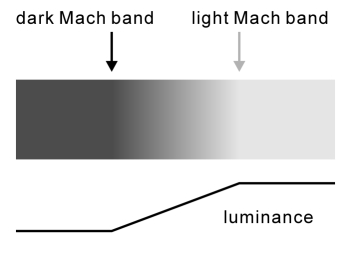
Just to clarify, Mach bands are not specific to displays, analog or digital, nor specific to encoded information, analog or digital. They were documented and named after Ernst Mach, who died in 1916.
Run a RGB pixel picker over this image and see if you can measure the two apparent bands shown. I think it should surprise you that you won't measure what you think you see.
|
|
| Back to top |
|
|
mp20748
Joined: 12 Sep 2006
Posts: 5689
Location: Maryland
TV/Projector: 9500LC Ultra / Super 02 and 03 VIM
|
| Posted: Fri Mar 13, 2015 12:41 am Post subject: |
|
|
I see your point with those bands, that appear to be large and just two of them based on the two pointers. They are quite different from the small banding that's also in that other picture you posted.
Also, the line to the bottom of that pattern is what I was talking about that went from bottom left to top right. Notice they show the line as being non-jagged or distorted - that is the Ramp
|
|
| Back to top |
|
|
El Duderino
Joined: 23 Jan 2011
Posts: 4653
Location: Portland, OR
|
| Posted: Fri Mar 13, 2015 12:52 am Post subject: |
|
|
| mp20748 wrote: | | I see your point wit those bands, that appear to be large and just two of them based on the pointer. They are quite different from the small banding that's also in that other picture you posted. |
Can you measure those two bands indicated by the pointer? No. They only exist in your perception. That's been my whole point about such patterns.
If you don't have a easy way to make measurements to prove it to yourself:
http://colorcop.net/
| mp20748 wrote: | | Notice they show the line as being non-jagged or distorted. |
Yes, they draw it as a 'smooth' transition, but it's not if one were to zoom in and slice it fine. It's a stepped (because it's digital after all) gradient and you can also measure the discrete, quantized nature of that with a picker as well. Perhaps I making a nit, but 'smooth' and 'continuous' doesn't apply in the digital domain.
Last edited by El Duderino on Fri Mar 13, 2015 1:00 am; edited 1 time in total
|
|
| Back to top |
|
|
mp20748
Joined: 12 Sep 2006
Posts: 5689
Location: Maryland
TV/Projector: 9500LC Ultra / Super 02 and 03 VIM
|
| Posted: Fri Mar 13, 2015 12:59 am Post subject: |
|
|
|
OK, that better helps me to understand what you were saying. So those lines can appear, but they are not actually in the pattern itself?
|
|
| Back to top |
|
|
|
|
|
|
|
You cannot post new topics in this forum
You cannot reply to topics in this forum
You cannot edit your posts in this forum
You cannot delete your posts in this forum
You cannot vote in polls in this forum
You cannot attach files in this forum
You can download files in this forum
|
Forum powered by phpBB © phpBB Group
|
|