|
As this forum is rarely used anymore, we've locked it. Feel free to browse and read. Questions? Please reach out to us directly. Cheers! |

|
 |
|
|
| Author |
Message |
J Kildare
Joined: 28 Sep 2006
Posts: 164
|
| Posted: Mon Dec 31, 2012 6:44 pm Post subject: JVC contrast, screen, room color etc? |
|
|
I have always maintained that room color and layout has more to do with contrast than a lot of the specs published with these projectors and a lot of their inflated ratings.
My room is fairly dark by most peoples standards, and I pay for it every time I have to work in it 
The screen is a 124" Stewart 1.3 G3 scope, and just received my projector (RS-4810) which I plan on mounting 17-18' from said screen.
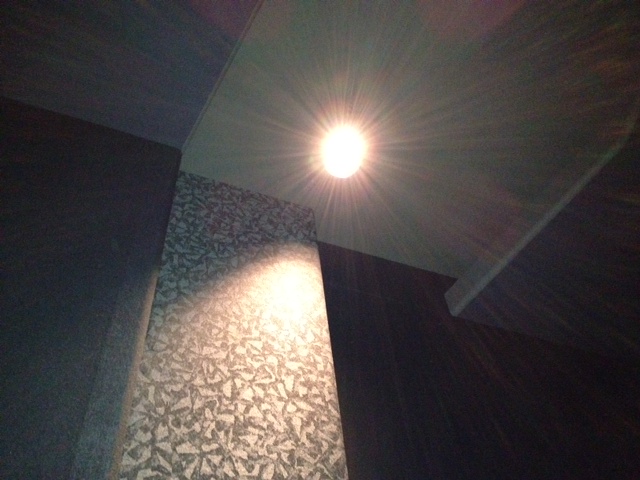
On the lower parts of my ceiling I used the flattest darkest paint I could find at the time Benjamin Moore Ulti Matt Black Iron. On the walls is GOM 701 black going out 6' past the screen. While the paint does not seem to affect colors onscreen (probably a little darker than 18% grey), you know there's a ceiling there if your looking for it, which means it will be reflecting on screen as well, affecting contrast, whereas the GOM disappears. The rest of the room, to the left in the pic is the patterned GOM which should not affect color, but again contrast rears its head.
Being as the weakest link is always the downfall of any system be it cars, projectors, or contrast is there even going to be a perceived difference in 99% of rooms going from say 50k - 120k contrast 
With proper masking a given. In a black velvet room I say possibly, anything less not likely.
Comments?
Oh, and for consideration....
| Description: |
|
| Filesize: |
110.95 KB |
| Viewed: |
10396 Time(s) |
|
|
|
| Back to top |
|
 |
HogPilot
Joined: 21 Jan 2010
Posts: 2383
TV/Projector: Vizio P702ui-B3, Pioneer Elite Pro-151FD & 111FD
|
| Posted: Mon Dec 31, 2012 8:20 pm Post subject: |
|
|
+1! I think most people underestimate how critical the room itself is to realizing the full potential of their system. The room is an equally essential component of any A/V system, and as with any other component it can only serve to detract from the original signal. Audio treatments and coloring/light absorption are as key to system performance as any other portion of one's system.
_________________
| ecrabb wrote: | | Curt Palme wrote: | | Interesting, Mac isn't returning my emails. Go figure. |
He's mad at us for making Hog a moderator. He took his ball and went home.
SC |
|
|
| Back to top |
|
|
J Kildare
Joined: 28 Sep 2006
Posts: 164
|
| Posted: Wed Jan 02, 2013 12:50 am Post subject: |
|
|
Thanks HogPilot, I'm just trying to wrap my head around the room vs contrast thing and at what point there are gains to be had.
I would still like to get a Lumigen and maybe a lens, so money does become an issue as well.
I have not unboxed the 4810 yet, and might consider the 56 if I thought there was a real world gain to be had, but I'm not sure my room is even dark enough to take advantage of it.
This is one area that does not seem to be discussed or measured much.
|
|
| Back to top |
|
|
HogPilot
Joined: 21 Jan 2010
Posts: 2383
TV/Projector: Vizio P702ui-B3, Pioneer Elite Pro-151FD & 111FD
|
| Posted: Wed Jan 02, 2013 11:50 am Post subject: |
|
|
| J Kildare wrote: | Thanks HogPilot, I'm just trying to wrap my head around the room vs contrast thing and at what point there are gains to be had.
I would still like to get a Lumigen and maybe a lens, so money does become an issue as well.
I have not unboxed the 4810 yet, and might consider the 56 if I thought there was a real world gain to be had, but I'm not sure my room is even dark enough to take advantage of it.
This is one area that does not seem to be discussed or measured much. |
In order to fully take advantage of the CR increase from a 4810 to a 56, you'd have to have a pretty darkened, non-reflective room.
_________________
| ecrabb wrote: | | Curt Palme wrote: | | Interesting, Mac isn't returning my emails. Go figure. |
He's mad at us for making Hog a moderator. He took his ball and went home.
SC |
|
|
| Back to top |
|
|
WanMan

Joined: 19 Mar 2006
Posts: 10270
|
| Posted: Wed Jan 02, 2013 8:56 pm Post subject: |
|
|
| HogPilot wrote: | | J Kildare wrote: | Thanks HogPilot, I'm just trying to wrap my head around the room vs contrast thing and at what point there are gains to be had.
I would still like to get a Lumigen and maybe a lens, so money does become an issue as well.
I have not unboxed the 4810 yet, and might consider the 56 if I thought there was a real world gain to be had, but I'm not sure my room is even dark enough to take advantage of it.
This is one area that does not seem to be discussed or measured much. |
In order to fully take advantage of the CR increase from a 4810 to a 56, you'd have to have a pretty darkened, non-reflective room. |
Ski masks?
_________________
Trust no one. Absolutely no one. Advice of the board.
|
|
| Back to top |
|
|
ecrabb
Forum Moderator

Joined: 13 Mar 2006
Posts: 15909
Location: Utah
TV/Projector: JVC RS40, Epson 5010
|
| Posted: Wed Jan 02, 2013 9:31 pm Post subject: |
|
|
| J Kildare wrote: | | I have always maintained that room color and layout has more to do with contrast than a lot of the specs published with these projectors and a lot of their inflated ratings. |
| HogPilot wrote: | | +1! I think most people underestimate how critical the room itself is to realizing the full potential of their system. The room is an equally essential component of any A/V system, and as with any other component it can only serve to detract from the original signal. Audio treatments and coloring/light absorption are as key to system performance as any other portion of one's system. |
OK, I'm going to take the contrarian view, and say that unless you have a room that's bad - light walls, light ceiling, and light carpet, that the room is much less of a factor than some would like to believe. Most of us here have a dedicated or semi-dedicated rooms with full- or mostly-full light control, and at worst, medium-colored walls, floor, and ceiling. That's my room - medium walls and ceiling, black carpet, black wall behind screen and at the opposite end of the room. I've got a 1.3-gain screen, so a more light is being reflected back into the middle of the room than if I had a 1.0-gain, so not that much back to the screen. In many of our rooms, the projector and screen are the biggest factors to the contrast, not the room itself.
| J Kildare wrote: | | Being as the weakest link is always the downfall of any system be it cars, projectors, or contrast is there even going to be a perceived difference in 99% of rooms going from say 50k - 120k contrast |
| J Kildare wrote: | | With proper masking a given. In a black velvet room I say possibly, anything less not likely. |
Wait, no... "Contrast" can mean two different things - on/off contrast and ANSI contrast. The 50k-120k figure you mentioned is on/off contrast, and the room as almost no effect whatsoever on that number. So, no - the room doesn't affect that in any meaningful way. With a dim projector and/or a low-APL scene, and for fades to black (on/off contrast), the room is essentially irrelevant, and you will see a difference between those two projectors in almost any room.
Where the room is increasingly a factor is where projector brightness and average picture level increases. In mid-to-high-APL scenes, it's a factor because the light is reflecting back to the screen and decreasing the projector's native ANSI contrast.
As for the manufacturer's claims and whether the difference is noticeable between 50k:1 and 120k:1, of course it's noticeable. It may not be noticeably like going from 300hp to 500hp in a car is noticeable, but it's noticeable nevertheless. But, just like cars, you have to decide what level of performance you're willing to pay for. For most of us, 50k:1 is very good just like 300hp is very good, and must of us will be very happy with that level of performance. For others, they're happy to pay double to go to 100k:1 or 450hp.
Having a light-colored room does have a significant negative impact on ANSI contrast, and I would highly recommend people be mindful of reflected light and colors in their rooms, especially if adjacent surfaces are close to the screen, you're using a matte screen, and/or you have a bright and/or high-performance projector... But, that also doesn't mean we need paint all the walls black, the ceiling black, install black carpet, and as Wan mentioned, wear black ski masks into the theater. 
SC
|
|
| Back to top |
|
|
HogPilot
Joined: 21 Jan 2010
Posts: 2383
TV/Projector: Vizio P702ui-B3, Pioneer Elite Pro-151FD & 111FD
|
| Posted: Wed Jan 02, 2013 9:59 pm Post subject: |
|
|
| ecrabb wrote: | | J Kildare wrote: | | I have always maintained that room color and layout has more to do with contrast than a lot of the specs published with these projectors and a lot of their inflated ratings. |
| HogPilot wrote: | | +1! I think most people underestimate how critical the room itself is to realizing the full potential of their system. The room is an equally essential component of any A/V system, and as with any other component it can only serve to detract from the original signal. Audio treatments and coloring/light absorption are as key to system performance as any other portion of one's system. |
OK, I'm going to take the contrarian view, and say that unless you have a room that's bad - light walls, light ceiling, and light carpet, that the room is much less of a factor than some would like to believe. Most of us here have a dedicated or semi-dedicated rooms with full- or mostly-full light control, and at worst, medium-colored walls, floor, and ceiling. That's my room - medium walls and ceiling, black carpet, black wall behind screen and at the opposite end of the room. I've got a 1.3-gain screen, so a more light is being reflected back into the middle of the room than if I had a 1.0-gain, so not that much back to the screen. In many of our rooms, the projector and screen are the biggest factors to the contrast, not the room itself.
SC |
I'll be honest, in reading your post we seem to agree with each other for the most part. If the room weren't an important factor in determining a system's overall performance, then people here wouldn't be doing the things that you listed above with the aesthetics and color choices of the room. I'm not saying that your theater has to be floor-to-ceiling black velvet and carpet with black micro-suede seating (as one guy did on AVS, which actually sounds pretty cool to me from a performance standpoint), it does have to be capable of supporting the gear you put in it.
_________________
| ecrabb wrote: | | Curt Palme wrote: | | Interesting, Mac isn't returning my emails. Go figure. |
He's mad at us for making Hog a moderator. He took his ball and went home.
SC |
|
|
| Back to top |
|
|
Spanky Ham

Joined: 22 Mar 2006
Posts: 5643
Location: Comedy Central
|
| Posted: Thu Jan 03, 2013 2:43 am Post subject: |
|
|
Crabb is correct. If you want to know more than you ever wanted to know, then go read my buddy Darin's article about the subject at Secrets of HT.
Hog,
I think Darin did that to one of his rooms.
|
|
| Back to top |
|
|
WanMan
Joined: 19 Mar 2006
Posts: 10270
|
| Posted: Fri Jan 04, 2013 12:15 pm Post subject: |
|
|
The whole head to toe in black velvet was discussed many years ago and gave rise to the HT term 'bat cave'. In fact, my ski mask joke has to be many years old in that is the last factor in honky reflection.
_________________
Trust no one. Absolutely no one. Advice of the board.
|
|
| Back to top |
|
|
J Kildare
Joined: 28 Sep 2006
Posts: 164
|
| Posted: Fri Jan 04, 2013 9:45 pm Post subject: |
|
|
| ecrabb wrote: |
Wait, no... "Contrast" can mean two different things - on/off contrast and ANSI contrast. The 50k-120k figure you mentioned is on/off contrast, and the room as almost no effect whatsoever on that number. So, no - the room doesn't affect that in any meaningful way. With a dim projector and/or a low-APL scene, and for fades to black (on/off contrast), the room is essentially irrelevant, and you will see a difference between those two projectors in almost any room.
Where the room is increasingly a factor is where projector brightness and average picture level increases. In mid-to-high-APL scenes, it's a factor because the light is reflecting back to the screen and decreasing the projector's native ANSI contrast.
As for the manufacturer's claims and whether the difference is noticeable between 50k:1 and 120k:1, of course it's noticeable. It may not be noticeably like going from 300hp to 500hp in a car is noticeable, but it's noticeable nevertheless. But, just like cars, you have to decide what level of performance you're willing to pay for. For most of us, 50k:1 is very good just like 300hp is very good, and must of us will be very happy with that level of performance. For others, they're happy to pay double to go to 100k:1 or 450hp.
SC |
I agree with the comments made as far as ANSI.  . .
But what's the quickest way to raise or lower on/off contrast? Raise or lower the black level. I surmise if there is any light reflected back to the screen it will quickly reduce that contrast we fight to achieve.
So what your saying as far as on/off is that a 50k machine mounted in a fully mirrored room would measure close to the same black level as one in a fully velvet treated room.
My thinking is if you can see your hand in front of your face on full fade to black, in all likelihood something is being reflected back to the screen and at these levels would diminish your contrast ratio rather quickly.
As far as your car analogy and that 500hp car, what happens to it with a single barrel 100 CFM carb mounted on top, or a single 1" exhaust?
Not trying to be a smart a$$ but increase my understanding of how room and on/off affect each other.
| Spanky Ham wrote: | Crabb is correct. If you want to know more than you ever wanted to know, then go read my buddy Darin's article about the subject at Secrets of HT.
Hog,
I think Darin did that to one of his rooms. |
Link ??
I didn't see any article on the subject but was using my phone.
|
|
| Back to top |
|
|
J Kildare
Joined: 28 Sep 2006
Posts: 164
|
| Posted: Sun Jan 06, 2013 4:27 pm Post subject: |
|
|
Still researching and came across this on AVS:
The world's most perfect calibration instrument cannot measure how our brain interprets what our eyes see. Some attempts have been made to emulate how humans perceive light but science has yet to produce an instrument which tells the whole story.
SMPTE's human factors work resulted in their Recommended Practices document RP166-1995: "Critical Viewing Conditions For Evaluation Of Color Television Pictures." This is the work from which D65 bias lighting is taken. The document actually devotes much more attention to color perception than eyestrain. Here are some links that dramatically demonstrate how ambient lighting and surrounding surface colors in the room can cause us to think we see better black levels, enhanced contrast, and/or perceive distorted colors that aren't really in the image.
http://www.echalk.co.uk/amusements/O.../illusions.htm (Note particularly the "Colour perception" and "Colour perception 2" demonstrations.)
http://www.lottolab.org/articles/illusionsoflight.asp (Note particularly the "Brightness illusions" and "Colour illusions")
Professional monitor environments (where critical image analysis is conducted for mastering video programs) use tightly controlled lighting and neutral colored surfaces surrounding the display. The demonstrations above make very clear the importance of incorporating similar room conditions, if image fidelity is desired. This material also makes abundantly clear how destructive to image fidelity the Philips 'Ambilight' colored light features and similar gimmicky fads really are.
Human visual perception is seldom sufficiently understood when consumer display systems (and even many professional ones) are designed and implemented. Since our human vision is so adaptive, we can think we perceive a "natural looking" image but actually don't, if viewing environment conditions are incorrect. The demonstration material at the links above should provide considerable practical reinforcement for folks who have a hard time being persuaded by imaging science theory alone, or even the decades of proven imaging industry professional practice.
If you think there is some trick being used in the online images, try printing out the colored demonstration patterns and making your own paper masks. You will see that the only "trick" involved is being provided by your own brain. This is why even a perfectly aligned display device can indeed look different than a calibration report says. Conflicting viewing environment conditions, such as the wrong lighting or colored room surfaces within the observer's field of view, will ALWAYS distort how a video image appears to the viewer. No calibration instrument can measure this function of the brain. It's simply a perceptual issue.
If a consumer cares about achieving the same "look" of a video program in their home that the mastering technician enjoyed, calibrate the display, and emulate the viewing environment conditions professionals consider best practices. I like to think of this extra effort as fidelity insurance.
Here's a white paper discussing these issues and how they can be incorporated into designing good viewing systems: http://www.cinemaquestinc.com/ive.htm .
Best regards and beautiful pictures,
G. Alan Brown, President
CinemaQuest, Inc.
A Lion AV Consultants Affiliate
"Advancing the art and science of electronic imaging"
-----------------------------
And post 6 here:
http://www.avsforum.com/t/1436767/the-truth-about-black-levels
Jim
|
|
| Back to top |
|
|
HogPilot
Joined: 21 Jan 2010
Posts: 2383
TV/Projector: Vizio P702ui-B3, Pioneer Elite Pro-151FD & 111FD
|
| Posted: Sun Jan 06, 2013 5:00 pm Post subject: |
|
|
^ Exactly what I was talking about. Alan is an outstanding resource in the calibration forum over there, as are several other members, and quite accurately and succinctly presents why our viewing environment is just as important as the displays that we view. Those illusions blew my mind the first time I saw them - it's amazing how relative and adaptive our visual system is, and how quickly it will fool us into thinking we're looking at something that we're not!
_________________
| ecrabb wrote: | | Curt Palme wrote: | | Interesting, Mac isn't returning my emails. Go figure. |
He's mad at us for making Hog a moderator. He took his ball and went home.
SC |
|
|
| Back to top |
|
|
Spanky Ham
Joined: 22 Mar 2006
Posts: 5643
Location: Comedy Central
|
|
| Back to top |
|
|
HogPilot
Joined: 21 Jan 2010
Posts: 2383
TV/Projector: Vizio P702ui-B3, Pioneer Elite Pro-151FD & 111FD
|
| Posted: Mon Jan 07, 2013 2:39 pm Post subject: |
|
|
I guess my original (and subsequent) response to the room issue was more global in nature and not focused on CR, which was the OP's original thrust before he started talking about white point and color perception. Darin's article above is a fantastic discussion on system CR, and I remember reading it back when he first wrote it. In terms of On/Off, the only scenario in which it can be degraded by light in the room is if you had lights on equipment pointed at the screen. This would significantly elevate your black levels, but not really affect your white levels, thus degrading your On/Off CR. Darin mentions this in his article as well. Of course in that instance controlling that light shouldn't be too difficult. Otherwise, wall brightness and color will affect your white point and ANSI CR, which are arguably just as important as On/Off.
_________________
| ecrabb wrote: | | Curt Palme wrote: | | Interesting, Mac isn't returning my emails. Go figure. |
He's mad at us for making Hog a moderator. He took his ball and went home.
SC |
|
|
| Back to top |
|
|
J Kildare
Joined: 28 Sep 2006
Posts: 164
|
| Posted: Mon Jan 07, 2013 3:24 pm Post subject: |
|
|
| HogPilot wrote: | | ^ Exactly what I was talking about. Alan is an outstanding resource in the calibration forum over there, as are several other members, and quite accurately and succinctly presents why our viewing environment is just as important as the displays that we view. Those illusions blew my mind the first time I saw them - it's amazing how relative and adaptive our visual system is, and how quickly it will fool us into thinking we're looking at something that we're not! |
I had not seen those before. Sure opened my eyes  . .
Much appreciated Spanky!! Dont know why I couldn't find that 
|
|
| Back to top |
|
|
|
|
|
|
|
You cannot post new topics in this forum
You cannot reply to topics in this forum
You cannot edit your posts in this forum
You cannot delete your posts in this forum
You cannot vote in polls in this forum
You cannot attach files in this forum
You can download files in this forum
|
Forum powered by phpBB © phpBB Group
|
|