| Author |
Message |
hansilili

Joined: 09 Mar 2007
Posts: 302
Location: Köln, Germany
|
| Posted: Fri Nov 09, 2012 12:46 pm Post subject: |
|
|
I have to correct myself from th eabove. When 1920 digital pixels are converted to an analog signal, then this causes aliasing which in fact adds information. This is why in theory it is even better to upscale the 1920 horizontal pixels and shift the aliases to frequencies higher than the bandwidth of the grafic card converter.
Also I admitt to scramble up bandwidth, rise time and max scan rate. Still have to do some learning here.
_________________
HansA, alles andere ist euer Bier!
|
|
| Back to top |
|
 |
gjaky
Joined: 05 Jun 2010
Posts: 2802
Location: Budapest, Hungary
|
| Posted: Fri Nov 09, 2012 12:55 pm Post subject: |
|
|
| hansilili wrote: | You say increase bandwidth would not increase resolution of vertical lines in my setup? I was referring to your statement:
Quote:
Resolution pattern in 1080p, the horizontal lines are a touch tighter, than the vertical lines, so the focus is better than the bandwidth -so still not a bad idea to increase the bandwidth.
|
You misunderstood me, of course it would improve, but I am working on substituting the RGB reception ic, with a better type.
Here is the theoretical bandwidth of the signal path in my PG xtra:
input->100MHz->200MHz->130MHz->CRT
And I am trying to expand the first stage's bandwidth to 150MHz.
In the case of 10PG:
input->100MHz->200MHz->65MHz->CRT
As you can see the best approach in this case would be to expand the bandwidth at the end instead of changing the input stage, that is why I said my idea won't help much on 10PG.
_________________
projectors in the past : NEC 6-9PG xtra, Electrohome Marquee 6-7500, NEC XG 1351 LC ( with super modified Electrohome VNB neckboard !!!)
current: VDC Marquee 9500LC
The MOD: VNB-DB, VIM-DB
|
|
| Back to top |
|
|
hansilili
Joined: 09 Mar 2007
Posts: 302
Location: Köln, Germany
|
| Posted: Fri Nov 09, 2012 2:53 pm Post subject: |
|
|
gjaki, thanks for clarifying (again, because you mentioned before but my ignorance won  ). With that in mind I reread the first two pages of this thread and understand much better now. ). With that in mind I reread the first two pages of this thread and understand much better now.
By now I found other sources saying the 10PG as the 1292 have significantly better beam spot size than what the electronic parts in the video signal chain can actually reproduce. The limiting factor in my case is the video amp. I followed your links to Mark_A_W but did not suceed to find the source thread. Is he not around here anymore, used to be a very helpfull guy for this community.
_________________
HansA, alles andere ist euer Bier!
|
|
| Back to top |
|
|
kabuby77
Joined: 28 Mar 2011
Posts: 147
Location: Italy
|
| Posted: Fri Nov 09, 2012 3:31 pm Post subject: |
|
|
|
The best way to avoid bandwidth problems is to install an internal moome card(if you can). It replace the original imput ic with limited band (150/200... MHz )
|
|
| Back to top |
|
|
gjaky
Joined: 05 Jun 2010
Posts: 2802
Location: Budapest, Hungary
|
| Posted: Fri Nov 09, 2012 3:46 pm Post subject: |
|
|
| kabuby77 wrote: | | The best way to avoid bandwidth problems is to install an internal moome card(if you can). It replace the original imput ic with limited band (150/200... MHz ) |
No, you can't put an internal moome card into a NEC PG, only in XG. But moome card doesn't bypass anything in XG either.
_________________
projectors in the past : NEC 6-9PG xtra, Electrohome Marquee 6-7500, NEC XG 1351 LC ( with super modified Electrohome VNB neckboard !!!)
current: VDC Marquee 9500LC
The MOD: VNB-DB, VIM-DB
|
|
| Back to top |
|
|
CasetheCorvetteman

Joined: 09 Nov 2008
Posts: 6326
Location: Australia
|
| Posted: Fri Nov 09, 2012 9:10 pm Post subject: |
|
|
|
Gabor, im not sure if you missed this earlier, but his 10PG is actually now a 6PG PLUS with 9inch tubes. Im not sure if that changes anything from your post about 4 posts up where youve got 65MHz in the chain.
|
|
| Back to top |
|
|
gjaky
Joined: 05 Jun 2010
Posts: 2802
Location: Budapest, Hungary
|
| Posted: Fri Nov 09, 2012 9:32 pm Post subject: |
|
|
| CasetheCorvetteman wrote: | | Gabor, im not sure if you missed this earlier, but his 10PG is actually now a 6PG PLUS with 9inch tubes. Im not sure if that changes anything from your post about 4 posts up where youve got 65MHz in the chain. |
No, it wasn't a mistake, both PG plain, and PG plus CRT driver is based on the same VPH06 chip which is specified to have 65MHz bandwidth, obviously NEC engineers did something to achieve the higher overall bandwidth (and did modification to do PG+ even better), but that specific VPA chip does not suggest this by it's own.
_________________
projectors in the past : NEC 6-9PG xtra, Electrohome Marquee 6-7500, NEC XG 1351 LC ( with super modified Electrohome VNB neckboard !!!)
current: VDC Marquee 9500LC
The MOD: VNB-DB, VIM-DB
|
|
| Back to top |
|
|
macgyver655
Joined: 22 Aug 2007
Posts: 8508
|
| Posted: Fri Nov 09, 2012 11:08 pm Post subject: |
|
|
|
Your leaving a valuable part out of your equations. The advertised spec of the speeds of any chip are NOT a chips true maximum capability. The advertised spec is a percentage of the actual manufactured and tested speed. This is to be sure that the device when sold and used in various harsh environments will still produce the advertized speed. The true speed of a device could be 25, 50 or even a 100% or more then what it's spec'ed at. So your 65mhz speed chip could actually have a usable speed of 100mhz or even much, much more.
|
|
| Back to top |
|
|
kabuby77
Joined: 28 Mar 2011
Posts: 147
Location: Italy
|
| Posted: Sun Nov 11, 2012 8:52 pm Post subject: |
|
|
No, that's no correct. Specification on datasheet are the result of test over many chips. They are with a tolerance associated. The manufacturer undertakes to maintain the characteristics of devices within these specifications. I'm sorry but it is impossible to have a complex device like video amp with a tolerance of 100% over speed. In reality what happens is that the bandwidth is specified for an excursion to 100% of the signal. The magic word is GBP Gain Bandwidth Product. This number is a constant that characterizes the device. For example if your VPA chip can handle 100 Volt pp at 65MHz , in theory at 50V pp it can reach 130 MHz: 100 x 65 = 50 x 130 . This is one of the reasons why it is best not to overdo the brightness.
p.s. I simplified to the maximum with the intention to understand, without claiming that it is exactly how it works
Last edited by kabuby77 on Sun Nov 11, 2012 9:01 pm; edited 1 time in total
|
|
| Back to top |
|
|
macgyver655
Joined: 22 Aug 2007
Posts: 8508
|
| Posted: Sun Nov 11, 2012 8:58 pm Post subject: |
|
|
| kabuby77 wrote: | | No, that's no correct. Specification on datasheet are the result of test over many chips. They are with a tollerance associated. The manufacturer undertakes to maintain the characteristics of devices within these specifications. I'm sorry but it is impossible to have a complex device like video amp with a tollerance of 100% over speed. In reality what happens is that the bandwidth is specified for an excursion to 100% of the signal. The magic word is GBP Gain Bandwidth Product. This number is a constant that characterizes the device. For example if your VPA chip can handle 100 Volt pp at 65MHz , in theory at 50V pp it can reach 130 MHz: 100 x 65 = 50 x 130 . This is one of the reasons why it is best not to overdo the brightness. |
Oh, so you believe the advertised spec is the maximum capability of the chip? ok..........
|
|
| Back to top |
|
|
kabuby77
Joined: 28 Mar 2011
Posts: 147
Location: Italy
|
| Posted: Sun Nov 11, 2012 9:10 pm Post subject: |
|
|
|
Yes, but the main thing is the second. The speed value is given for 100% brightness, if you keep the projector darker the speed will increase. As said before there are some bottle necks into the video chain, like video input chips , and they can cancel the advantage obtained keeping the brightness low.
|
|
| Back to top |
|
|
macgyver655
Joined: 22 Aug 2007
Posts: 8508
|
| Posted: Sun Nov 11, 2012 9:21 pm Post subject: |
|
|
|
I disagree, but I'll leave it at that. I have no desire to debate this.
|
|
| Back to top |
|
|
macgyver655
Joined: 22 Aug 2007
Posts: 8508
|
| Posted: Sun Nov 11, 2012 10:12 pm Post subject: |
|
|
Here, rather then debate it I figured I just give you the facts. It took me a couple datasheets to find the description. This is Sanyos 120mhz chip (as advertized). Now note under Features where it says "typical bandwidth". Now go to page 2 where it says Maximun frequency. Note the MAX as 160mhz. I believe that's @ 35%. Nuff said...
| Description: |
|

Download |
| Filename: |
VPA12.pdf |
| Filesize: |
78.56 KB |
| Downloaded: |
334 Time(s) |
|
|
| Back to top |
|
|
AnalogRocks
Forum Moderator

Joined: 08 Mar 2006
Posts: 26706
Location: Toronto, Ontario, Canada
TV/Projector: Sony 1252Q, AMPRO 4000G
|
| Posted: Sun Nov 11, 2012 11:30 pm Post subject: |
|
|
| macgyver655 wrote: | | Here, rather then debate it I figured I just give you the facts. It took me a couple datasheets to find the description. This is Sanyos 120mhz chip (as advertized). Now note under Features where it says "typical bandwidth". Now go to page 2 where it says Maximun frequency. Note the MAX as 160mhz. I believe that's @ 35%. Nuff said... |
Mac, don't confuse things by giving the facts. 
_________________
Tech support for nothing
CRT.
HD done right!
|
|
| Back to top |
|
|
macgyver655
Joined: 22 Aug 2007
Posts: 8508
|
| Posted: Sun Nov 11, 2012 11:34 pm Post subject: |
|
|
| AnalogRocks wrote: | | macgyver655 wrote: | | Here, rather then debate it I figured I just give you the facts. It took me a couple datasheets to find the description. This is Sanyos 120mhz chip (as advertized). Now note under Features where it says "typical bandwidth". Now go to page 2 where it says Maximun frequency. Note the MAX as 160mhz. I believe that's @ 35%. Nuff said... |
Mac, don't confuse things by giving the facts. |
Don't ya just hate that!!! 
|
|
| Back to top |
|
|
kabuby77
Joined: 28 Mar 2011
Posts: 147
Location: Italy
|
| Posted: Mon Nov 12, 2012 8:58 am Post subject: |
|
|
| AnalogRocks wrote: | | Mac, don't confuse things by giving the facts. |
 it mean you can find some devices (very few http://en.wikipedia.org/wiki/68-95-99.7_rule ) that can reach that speed but also there are chips with speed lower that 120 MHz. As said before 120 is an average value. it mean you can find some devices (very few http://en.wikipedia.org/wiki/68-95-99.7_rule ) that can reach that speed but also there are chips with speed lower that 120 MHz. As said before 120 is an average value.
|
|
| Back to top |
|
|
gjaky
Joined: 05 Jun 2010
Posts: 2802
Location: Budapest, Hungary
|
| Posted: Mon Nov 12, 2012 11:22 am Post subject: |
|
|
In my opinion, most of these chips are based on the same circuit, or even the same die. They did a preselection in the factory: the better performers got higher rates, the worse ones speced at lower rates, like in CPU manufacturing. Since there were VPH08 chips availabe over the VPH06s, I doubt VPH06s could do over 80MHz, in this case I also think the engineers took advantage of the fact that VPH06s are standing relative high suplly voltages so they got plenty headroom with under driving the circuit.
_________________
projectors in the past : NEC 6-9PG xtra, Electrohome Marquee 6-7500, NEC XG 1351 LC ( with super modified Electrohome VNB neckboard !!!)
current: VDC Marquee 9500LC
The MOD: VNB-DB, VIM-DB
|
|
| Back to top |
|
|
gjaky
Joined: 05 Jun 2010
Posts: 2802
Location: Budapest, Hungary
|
| Posted: Mon Nov 12, 2012 12:10 pm Post subject: |
|
|
Turning back to the original goal of this thread...
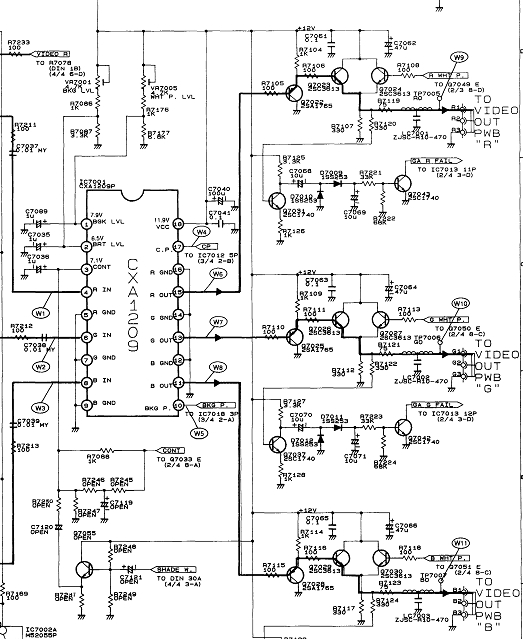
While the above mentioned diode switching circuit is working as I expected it causes further problems. The diodes causing non linear distortions. Tried with different diodes in parctice my selected super fast germanium diodes did the job the best, but on my test circuit still caused distortions even with 480i PAL signal observed on an oscilloscope.
Then I looked at the XG's service manual and found that they cut off the blanking outout of the CXA1779P at the last last buffer stage with paralelling the output transistors drived by a 'blanking slice' signal, unfortunately the output transistor are also very hard to find and high quality parts (2SC3613, 2-3,5GHz transition freq, high current, high power)
And again comes an interesting part, I took a look at the older PG schematics and found that the PG plain's GAIN CTL (PWC-3715) has those parallelized transistors at the output, instead of PG plus's and xtra's.
The wise guys are saying the PG plain GAIN CTL is not compatible with the PG xtra's, however I compared closely the two schematics and found that the only difference is in this extra brightness control which was removed from PG xtra, everything else including pin assignment, used transistors are all the same on both board, that is why I want to buy a GAIN CTL board for experimenting, ironically the PG plain's GAIN CTL board could be the key ingredient for tuning up a PG xtra.
| Description: |
|
| Filesize: |
166.87 KB |
| Viewed: |
9336 Time(s) |
|
_________________
projectors in the past : NEC 6-9PG xtra, Electrohome Marquee 6-7500, NEC XG 1351 LC ( with super modified Electrohome VNB neckboard !!!)
current: VDC Marquee 9500LC
The MOD: VNB-DB, VIM-DB
|
|
| Back to top |
|
|
macgyver655
Joined: 22 Aug 2007
Posts: 8508
|
| Posted: Mon Nov 12, 2012 3:02 pm Post subject: |
|
|
| kabuby77 wrote: | | AnalogRocks wrote: | | Mac, don't confuse things by giving the facts. |
it mean you can find some devices (very few http://en.wikipedia.org/wiki/68-95-99.7_rule ) that can reach that speed but also there are chips with speed lower that 120 MHz. As said before 120 is an average value. |
I don't think your translator is working properly. Your all over the place now.....
|
|
| Back to top |
|
|
macgyver655
Joined: 22 Aug 2007
Posts: 8508
|
| Posted: Mon Nov 12, 2012 4:23 pm Post subject: |
|
|
| gjaky wrote: | | They did a preselection in the factory: the better performers got higher rates, the worse ones speced at lower rates, . |
Are you saying.... that you think these are all the same manufactured part and they are assigned different part number based on their individual performance tests?
|
|
| Back to top |
|
|
|
|