|
As this forum is rarely used anymore, we've locked it. Feel free to browse and read. Questions? Please reach out to us directly. Cheers! |

|
 |
|
|
| Author |
Message |
ecrabb
Forum Moderator

Joined: 13 Mar 2006
Posts: 15909
Location: Utah
TV/Projector: JVC RS40, Epson 5010
|
| Posted: Thu Jan 13, 2011 8:48 pm Post subject: |
|
|
| Tom.W wrote: | | ecrabb wrote: | It's astro work, so I can the requirement for fast glass. The HD-144 is something like and f/1.1 or f/1.2 lens. But, what about the size requirement? Why does it need to be so big? What sort of imager will be used that requires a 5" image circle? If we're talking about the size of most types of imagers, then there would be a large pool of 35mm lenses from which to choose that would be nearly as fast and would be far superior to any CRT glass.
SC |
It can get expensive though...
http://www.nikonusa.com/Nikon-Products/Product/Camera-Lenses/2150/AF-S-VR-NIKKOR-200mm-f%252F2G-IF-ED.html
 |
Yeah, but that's kinda apples and oranges, Tom - that's a spanky new AF optically-stabilized lens... We're talking about older MF lenses.
Besides, the OP said he was designing "a wide-field imaging system, that could look at a large section of sky", so you wouldn't want a telephoto. I assume that's why he was looking at CRT lenses in the first place - because they're super-fast, with a large image circle. But, I'm wondering what kind of camera/sensor could even accommodate the projection...
What would you need to duplicate a CRT lens' field-of-view with a 35mm lens? Maybe a 50mm or even a 35mm yield a similar field of view? Those would be relatively inexpensive even as a super-fast example. Brand new Nikon 50 f/1.8's are pocket change, and the old MF 1.4's aren't much more.
SC
|
|
| Back to top |
|
 |
Tom.W

Joined: 09 Mar 2006
Posts: 6635
|
| Posted: Thu Jan 13, 2011 8:54 pm Post subject: |
|
|
Exactly. Not enough information was provided about speed, focal length,price range and sensor size and speed... 
|
|
| Back to top |
|
|
Tom.W
Joined: 09 Mar 2006
Posts: 6635
|
|
| Back to top |
|
|
seamaide
Joined: 12 Jan 2011
Posts: 4
Location: Ireland
|
| Posted: Fri Jan 14, 2011 2:55 pm Post subject: |
|
|
Sorry for the delay, got caught up in coursework.
Thanks for all the advice! You've all been so good to me, I'm really suprised that a group this kind and helpful can exist on the 'net, but maybe I'm a lil'jaded.
The camera I will be using is a custom made from somewhere in Cambridge, but it has specifications to this model from Andor: http://www.andor.com/scientific_cameras/ixon_emccd_camera/. The detector size is ~8mm*8mm, with pixel size of 16um*16um, and can be run in photon counting mode. It's around 40cm*30cm*10cm, a rectangular box with a cylinder on top. The system needs to be run through the night, and as the expected flashes are very short and in the visible-range, it needs to have a fast response time.
The reason I'm using that lens, is that it has been sitting around the dept. for the last couple of years, since they didn't want to throw it out. As there is a limited budget to final year projects, so I can't really buy more lenses. We've got a big optics department (http://www.nuigalway.ie/physics/research_top.html)so there are other lenses around that I could use, but the project I think was originally designed to finally have found a use for the HD-8M, so I think I'll have to prove it is no good, before I can get another lens. At least it will give me useful experince, which is one of the points of these projects.
Also, the plan with the set-up of the system it to have a flat mirror reflecting the image onto the CCD sensor, but if the back focal length (or front focal length unreversed) is only a few mm there might be problems with that arrangement, but corrective elements could be added to change this.
|
|
| Back to top |
|
|
guger
Joined: 02 Jul 2011
Posts: 1
|
| Posted: Sat Jul 02, 2011 11:24 pm Post subject: |
|
|
@ seamaide
Hi Seamaide, I wonder if you already managed to finish your project. And how successful and powerful your telescope has been made.
About five years ago I got a Delta³ HD-116D. I originally got this lens to build a video projector, but I gave up that project and the lens took it place in the basement.
Recently I was thinking about using the lens to build a telescope. To be honest, I have no idea how to modify it to increase the focal length, so I started google-ing for details and I found your post here.
Would you please provide me with informations or details in order to use the lens to build a telescope?!!
I'll be very thankful for any details.
With regards…
|
|
| Back to top |
|
|
gjaky
Joined: 05 Jun 2010
Posts: 2802
Location: Budapest, Hungary
|
| Posted: Sun Jul 03, 2011 7:22 am Post subject: |
|
|
|
If you read this topic carefully you can realize that none of the projector lenses can be used as a telescope -effectively (due to their low resolution) Plus I don't know your lens, but by the sound of it I guess it is an LC lens which means you can't achieve a fully focused image on any plain surfaces.
|
|
| Back to top |
|
|
seamaide
Joined: 12 Jan 2011
Posts: 4
Location: Ireland
|
| Posted: Mon Jul 04, 2011 10:51 pm Post subject: |
|
|
Guger if you pm me, I'll send you a copy of my thesis, so you can see some of the issues I had and the methods I resolved some of them.
But in brief, the project was somewhat of a success. I had a working setup, but I only had time to do lab testing, no field-testing, so there were errors on my measurements due to the approximations on infinity in a lab setup. And there was no full quantification of aberrations with the system.
My setup was designed to be used for detection of a specific astronomical event, so for an amateur astronomer, my setup and the data I collected may be of little use.
I calculated an angular resolution of 400 arcseconds, and my field of view, with the extra glass added, was reduced from the 52 degrees of the CRT lens by itself to 16 degrees.
Now these were acceptable values for the intended application, but they may not suitable for yours. And whether you could even replicate these values is another thing entirely. I had professors specialising in optics and astronomy helping me, along with technicians, and expensive pieces of equipment.
The reason the CRT lens was used, was that my advisor wanted to get a student to design a wide-angled lens system on the cheap. So the setup was designed to keep that field angle of the delta lens as wide as it could be. Several roadblocks were in the way of this objective, the most problematic being the issue with the image plane.
When the object your are imaging is at infinity, which it would be for astronomical purposes, the image plane was inside the lens. There was 2 solutions, either place glass in front of the lens, so the object would appear to be at a finite distance, bringing the image outside of the lens; or using glass to the rear of the lens to take it out. The former was out entirely, would restrict the field of view too much, negating the whole point of using that lens. The latter was the method used, I had a relay lens, taking the image out the CRT lens, focusing it onto the sensor.
I didn't have time to design a relay lens, so I used one that was hanging around the department. This proved the biggest limiter on field of view. I had some time after experimental working ended to start working out the specifications a 2 element relay, and only managed to get the equations for the curvatures according the the raytracing of the axial marginal ray from first principles  But this wouldn't have been that useful, even if I had worked out some concrete specifications, as I don't actually know how to correct abberations with design specs yet so the relay lens would have been aberrated to h***. (At least the HD-8 was somewhat aberration-corrected) But this wouldn't have been that useful, even if I had worked out some concrete specifications, as I don't actually know how to correct abberations with design specs yet so the relay lens would have been aberrated to h***. (At least the HD-8 was somewhat aberration-corrected)
Umm, so for tl;dr, unless you want a wide-angled field of view, and have the resources to get the necessary equipment(good relay lens, and good sensors), I would say that you are better off buying a telescope.
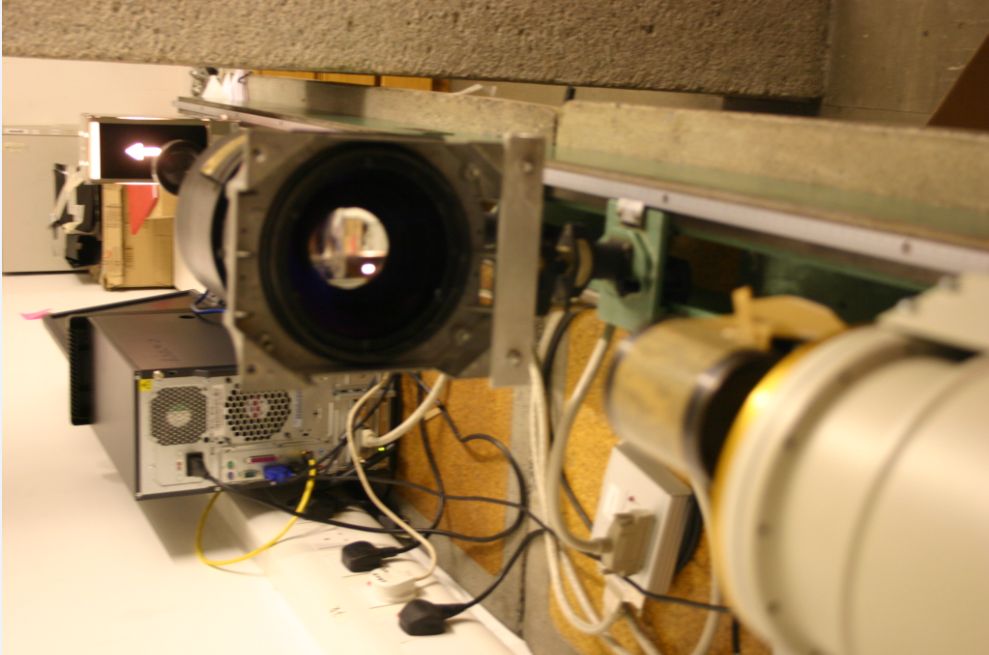
If your curious, attached is a somewhat blurry photo(sorry) of my setup in the configurations i used. Note how small the relay lens is, which was of course the biggest limitator of the system.
| Description: |
|
| Filesize: |
79.88 KB |
| Viewed: |
4079 Time(s) |
|
|
|
| Back to top |
|
|
Revox
Joined: 13 Feb 2008
Posts: 158
|
| Posted: Sun Jul 24, 2011 11:10 am Post subject: |
|
|
Can you give me a "link" or an short explanation, why you get an immage out of a lens with a glas?
I noticed that the picture on the phosphor is really sharp when i got my glases on (they ore around 0,5dpt).
Stefan
|
|
| Back to top |
|
|
|
|
|
|
|
You cannot post new topics in this forum
You cannot reply to topics in this forum
You cannot edit your posts in this forum
You cannot delete your posts in this forum
You cannot vote in polls in this forum
You cannot attach files in this forum
You can download files in this forum
|
Forum powered by phpBB © phpBB Group
|
|