| Author |
Message |
johnnynickel
Joined: 10 Jan 2011
Posts: 12
Location: Southern Vermont
|
| Posted: Tue Jan 11, 2011 6:24 pm Post subject: |
|
|
|
Just wanted to take a moment to say that this forum is great, people really know their stuff and seem eager to help anyone. So thanks for the help so far! Any advice on how to lower that voltage? Anyone have one that was running that high and fixed it?
|
|
| Back to top |
|
 |
Nashou66

Joined: 12 Jan 2007
Posts: 16171
Location: West Seneca NY
|
|
| Back to top |
|
|
macgyver655
Joined: 22 Aug 2007
Posts: 8508
|
| Posted: Tue Jan 11, 2011 7:37 pm Post subject: |
|
|
| Nashou66 wrote: | Here is a link tot he voltage fix.
http://www.curtpalme.com/forum/viewtopic.php?p=106293#106293
mac, it may be a bold statement but i leave min on all the time is about the 3.92 so that statement is from my own experience and might be out of line or incorrect. id let Scott say more on it. So Yes it was bold, my bad if wrong.
MTBF is Mean Time Between Failures, its on VDC's web site.
Glad your posting again MAc, hows the back?
Athanasios |
Neck is getting better. Not there yet though. Thanks for asking.
MTBF on VDCs site...... thats funny.
Heater being on, even at a lower then operating voltage is still cooking the cathode. The difference is the electrons are not being pulled off. So they are just sitting there boiling. This causes the surface of the cathode to harden somewhat. Now when electrons are needed the harden area cannot give off any.
This is where a CRT restorer can help. If there is still lots of cathode left (low running hours, high standby hours) The restorer can burn off the surface of the cathode to a new viable surface to give off the required amount of electrons.
If the CRT doesn't have much cathode left (high running hours and standby not relevant) then the restorer wont help. There isn't much cathode left to begin with.
However, even if its a hardened cathode there is no guarantee the restorer can burn off the hardened surface to return it to operational use.
And Scott is welcome to comment.
|
|
| Back to top |
|
|
Nashou66
Joined: 12 Jan 2007
Posts: 16171
Location: West Seneca NY
|
|
| Back to top |
|
|
johnnynickel
Joined: 10 Jan 2011
Posts: 12
Location: Southern Vermont
|
| Posted: Tue Jan 11, 2011 11:54 pm Post subject: |
|
|
|
Hmmm, kind of sounds like my tubes might have some life left in them with the help of a restorer. I think I'll at least try to find a place that has one near Southern Vermont, anyone know of such a place? There's a plan for a homemade one here http://www.anatekcorp.com/ttg/tiptrick.htm#Homemade%20CRT%20Restorer But I don't think I could pull it off myself.
|
|
| Back to top |
|
|
dvh99

Joined: 25 Dec 2009
Posts: 2158
Location: nederland
|
| Posted: Wed Jan 12, 2011 1:09 am Post subject: |
|
|
| Nashou66 wrote: | Thanks for the info Mac, I will shut off the Twins tonight when I get home !!!
Athanasios |
always a good idea if only for lightning strikes.
|
|
| Back to top |
|
|
tse
Joined: 03 May 2006
Posts: 1014
Location: Sweatbucket, Fl.
|
| Posted: Wed Jan 12, 2011 1:32 am Post subject: |
|
|
Ok, my opinions on this.
4V standby for filaments is on the manufacturer's spec sheet for the CRTs. They should know if it is ok but I don't see any good reason to run them all the time. Why?
The manufacturer's spec sheet also lists 6.6V as absolute maximum for operating voltage on the filaments.
I have seen CRT rejuvenator fix many CRTs with spurious emmisions (won't cut-off or flickering cut-off). If there is contamination on the heater/cathode that can be burned off and good emmisions can be restored. I would definately try rejuvination before tossing any bad CRT that has good phosphor.
Turning off/ unplugging the Marquee is ok. The LVPS has a nice circuit for limiting inrush current upon power application so there is no big stress with powering it up.
Scott
_________________
"Were we directed from Washington when to sow and when to reap, we would soon want bread."
Thomas Jefferson
|
|
| Back to top |
|
|
gjaky
Joined: 05 Jun 2010
Posts: 2802
Location: Budapest, Hungary
|
| Posted: Wed Jan 12, 2011 8:10 am Post subject: |
|
|
I have both Marquee and a NEC, but I didn't notice significant advantage of preheated tube -at least in powering up time, maybe 1 or 2 seconds are the difference. But even my NEC uses 40W in standby, I don't dare to measure the Marquee  So it is also a green idea to pull them off! So it is also a green idea to pull them off!
|
|
| Back to top |
|
|
macgyver655
Joined: 22 Aug 2007
Posts: 8508
|
| Posted: Wed Jan 12, 2011 4:08 pm Post subject: |
|
|
| tse wrote: |
4V standby for filaments is on the manufacturer's spec sheet for the CRTs. They should know if it is ok but I don't see any good reason to run them all the time.
|
You dont really mean that Scott, do you? 
Manufacturers have shown time and time again, even more so over the last ten years that they dont want things to last. Face it, they have to make money in replacement parts.
Also, manufacturers dont always test for long term affects. If it out last the warranty period it will pass. And long term tests are never done.
This would be a long term issue, not something in a year or 2.
So what is the story? Your running 4volts to the heater when not in use, for long periods of time.
Is the cathode still getting warm? Absolutely!
And a warm cathode wants so give off electrons. They are moving, but no where to go.
Here's an excerpt from a Sencore document. Its not my words.
The hot cathode emits electrons which form a cloud around the cathode until they're attracted toward the front of the screen by a positive voltage on the screen grid.
So the question is, what affect does this have on the surface of the cathode? Well we know for a fact that the surface of the cathode can become contaminated and loose emission. What is this caused by? You fill in the blanks.
Another excerpt from the same document:
In the rejuvenation function a charged capacitor is connected between the cathode and the control grid. When the sudden positive voltage from the capacitor is applied to G1, the electrons under the poison crust break free, essentially cracking the layer of contamination. Once the layer has been cracked, the other restore functions can be used successfully.
Again though, this would be a long term affect.
Is that the case in this thread? I have no idea. Because we dont know if the hours readings are correct.
I would also suggest rejuvenation but ONLY with a Sencore 7000. Because the 7000 uses different methods then other restorers to attempt to repair a tube without damage.
And yes, I have also seen many a tubes brought back to life again.
So its up to you guys if you want to leave that projector in standby or not. It wont hurt me a bit.... LOL 
|
|
| Back to top |
|
|
macgyver655
Joined: 22 Aug 2007
Posts: 8508
|
| Posted: Wed Jan 12, 2011 5:12 pm Post subject: |
|
|
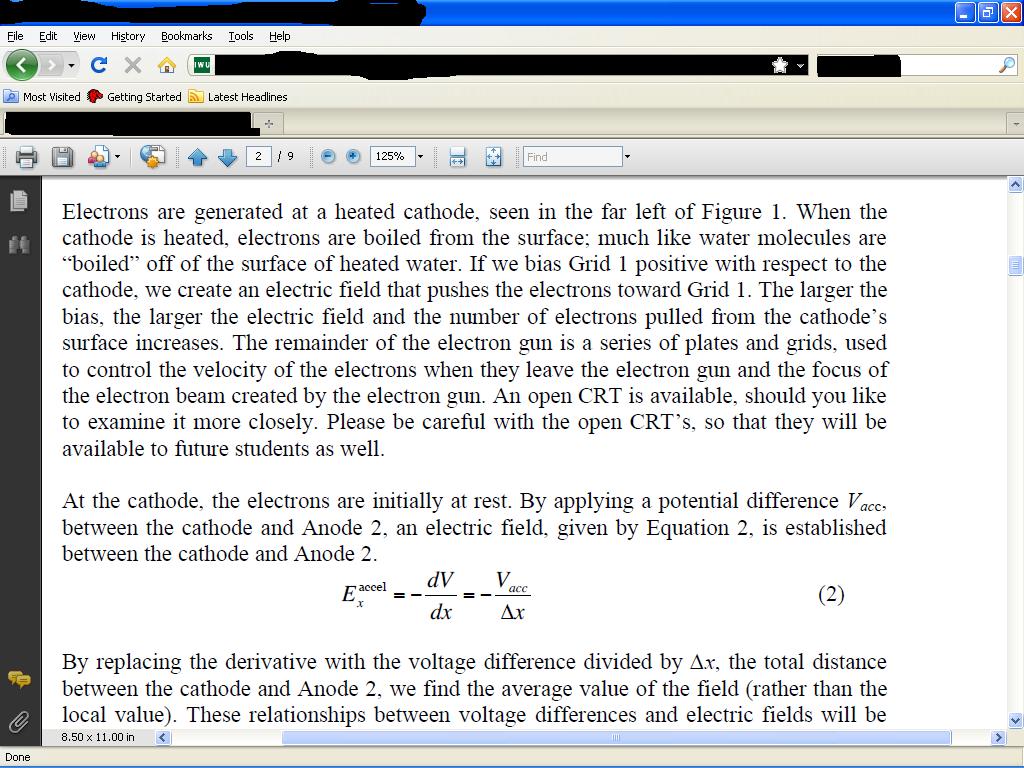
Another interesting document. The first 3 sentences pretty much only apply.
| Description: |
|
| Filesize: |
171.83 KB |
| Viewed: |
4355 Time(s) |
|
|
|
| Back to top |
|
|
tse
Joined: 03 May 2006
Posts: 1014
Location: Sweatbucket, Fl.
|
| Posted: Thu Jan 13, 2011 1:50 am Post subject: |
|
|
mac,
I do believe that Panasonic knows (knew) exactly what they were building. They wouldn't get the performance that is there if they didn't. Compare the mag focus Panasonic tubes to the Sony mag focus tubes with their lower performance, frequent arcs, and common momentary cathode to heater shorts.
The vast majority of CRTs end their life with phosphor worn out (you saw the tube room) and plenty of cathode left.
I don't think any manufacturer designs their product for failure. They might decide to install cheaper parts that will last an aceptable number of hours when they could put in more expensive parts that might last twice as long. That is to meet a cost target due to the market/competition, not to rip-off the consumer.
That's how I see it.
Scott
_________________
"Were we directed from Washington when to sow and when to reap, we would soon want bread."
Thomas Jefferson
|
|
| Back to top |
|
|
macgyver655
Joined: 22 Aug 2007
Posts: 8508
|
| Posted: Thu Jan 13, 2011 2:42 pm Post subject: |
|
|
| tse wrote: | mac,
I do believe that Panasonic knows (knew) exactly what they were building. They wouldn't get the performance that is there if they didn't. Compare the mag focus Panasonic tubes to the Sony mag focus tubes with their lower performance, frequent arcs, and common momentary cathode to heater shorts.
The vast majority of CRTs end their life with phosphor worn out (you saw the tube room) and plenty of cathode left.
I don't think any manufacturer designs their product for failure. They might decide to install cheaper parts that will last an aceptable number of hours when they could put in more expensive parts that might last twice as long. That is to meet a cost target due to the market/competition, not to rip-off the consumer.
That's how I see it.
Scott |
I do believe that tubes that are used on a fairly regular basis will live until the phosphor is worn out.
So you don't think that having a warm cathode for excessively long times will have any affect on it?
And you believe Panasonic did long term tests with a warm cathode?
|
|
| Back to top |
|
|
macgyver655
Joined: 22 Aug 2007
Posts: 8508
|
| Posted: Thu Jan 13, 2011 6:06 pm Post subject: |
|
|
Ok Scott. Don't answer those questions in the above post.
I was using my usual baiting tactics. Since a while back when another member got mad when I questioned his posts and resorted to name calling and such, I decided I wasn't going to hold back on anyone here anymore. I didn't expect a "somewhat" disagreement with you.
You see, the only way to resolve this issue is with some sort of facts. Other wise it's just opinion. And facts would require documents pertaining to the subject.
Well I already had multiple documents supporting my comments here, like I usually do. But I decided I dont want to play this game with you. I dont believe it to be proper etiquette.
So I'm not going to post any documents or comment further, unless someone else has a question.
I'll only suggest to others that standby for long periods of time should be avoided.
|
|
| Back to top |
|
|
mp20748
Joined: 12 Sep 2006
Posts: 5689
Location: Maryland
TV/Projector: 9500LC Ultra / Super 02 and 03 VIM
|
| Posted: Thu Jan 13, 2011 6:59 pm Post subject: |
|
|
| macgyver655 wrote: |
You see, the only way to resolve this issue is with some sort of facts. Other wise it's just opinion. And facts would require documents pertaining to the subject.
|
Not sure what FACTs would be needed, but maybe history could be a determiner here. The subject matter is about a CRT projector that has been in constant operation for the past 18 years, and there has NOT been one single tube or documented history of these same Panasonic tubes failing from 3.9 volts DC being on the filaments in the standby mode that has ever been documented at either Electrohome or VDC.
Reason being, is because that 3.9 volts has proven to be totally harmless to the tubes.
So think about this for a moment. Marquees has been in both 24/7 operation and standby operation for the past 18 years. If somehow there was a problem due to the 3.9 volts being on at all times during standby, you think someone at either Electohome or VDC would have came up with a solution to avoid this problem by now... the only thing they had ever found to be a problem was the filament voltage exceeding the rated voltage. And that has been the ONLY problem the marquees has ever had from the voltage that was sent to its filament.
These projectors were and are still being used in simulators, submarines and a lot of other commercial operations. I still maintain three sites that has 4 each marquees setup in stereoscopic (3D) operation. They are all running in standby, much like my personal Marquee 9500, that is also always left in the standby mode with the 3.9 volts always being in the new set of tubes I had installed a few years ago.
Not sure why they chose to run that voltage into the tubes, but for sure, there has not been a problem caused from it that I know of. And if it was, I would not be leaving my 9500 in the standby mode.
So since there has not been one tube that I've come across that has shown any problems from that 3.9 volts, I prefer to leave mine in the standby mode.
I've seen Marquees that had more than 40,000 hours on the Standby counter, but has never had to change a single tube because of the 3.9 standby voltage.
I understand the theory here and agree, but it just does not apply to the Marquee and the Panasonic tubes it has been using.
|
|
| Back to top |
|
|
macgyver655
Joined: 22 Aug 2007
Posts: 8508
|
| Posted: Thu Jan 13, 2011 7:10 pm Post subject: |
|
|
|
No comment on the above poster and I still wont post supporting documents.
|
|
| Back to top |
|
|
Nashou66
Joined: 12 Jan 2007
Posts: 16171
Location: West Seneca NY
|
|
| Back to top |
|
|
macgyver655
Joined: 22 Aug 2007
Posts: 8508
|
| Posted: Fri Jan 14, 2011 12:47 am Post subject: |
|
|
| Nashou66 wrote: | LOL, umm wasnt the last comment a comment?
Gotta luv ya mac, your itchin to post!!
Come on I want to now the factual data, please !!!! |
I Pm'ed you a snippet from 1 of the documents I have on the subject. If anyone else wants some info from these documents you can email or PM me and I'll gladly send some. I dont want to waste my time posting stuff here if that parker guy is going to start posting..........
I also reserve the right to deny such return info at my choosing...... 
|
|
| Back to top |
|
|
Nashou66
Joined: 12 Jan 2007
Posts: 16171
Location: West Seneca NY
|
|
| Back to top |
|
|
Sparky015

Joined: 12 May 2009
Posts: 1185
Location: Cleveland / Akron, OH
|
| Posted: Fri Jan 14, 2011 1:15 am Post subject: |
|
|
OK, I want to clear one thing up, because it seems like maybe "standby" is being tossed around as "projector off". This discussion is around projector standby and not projector off, correct? In other words, we are discussing the cathode voltage when you hit the standby button, not the projector power button. Just want to be clear.
_________________
~Paul
|
|
| Back to top |
|
|
Nashou66
Joined: 12 Jan 2007
Posts: 16171
Location: West Seneca NY
|
|
| Back to top |
|
|
|
|