|
As this forum is rarely used anymore, we've locked it. Feel free to browse and read. Questions? Please reach out to us directly. Cheers! |

|
 |
|
|
| Author |
Message |
WanMan

Joined: 19 Mar 2006
Posts: 10270
|
| Posted: Thu Jan 14, 2010 1:14 pm Post subject: Hot-Rodding |
|
|
No, I am not talking about this

But more applicable to our visual hobby
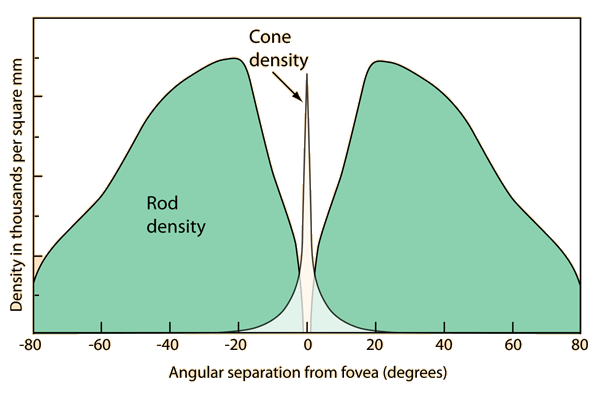
So, if I read what is said on this GSU web page I am left asking a whole bunch of questions.
For instance, the the ratio of rods to cones being ~20:1 the rods give an apparent overall sensitivity that is greater than that of the cones. But, is this increased sensitivity based on this larger rod population, or is it that the individual rod is just more sensitive than the individual cone?
Also, the diagram implies, to me, that for every rod there is a cone in the center, but we know that cannot be otherwise there would be just as many cones as there were rods, no? So, the the diagram suppose to convey numerous rods surround a cone? Are the rod and cone distributions [about] the same? WRONG! I just re-read it and that diagram is for the retinal area cross-section and the vertical magnitude in the diagram represents density. 
I read previously ( a couple of years back) that the rod and cones are not linearly distributed across the back of the eye, and the the majority of the retina maintains a much higher density that what we'd call the retina periphery. Will the next step in our desire to see a better picture be genetic with the effort places on increasing the number of cones?**
** Are folks that are into digital projectors just born with too few rods, and as a result their sensitivity to light is lower? I wonder about this as I am the [extreme] opposite and now wonder if I have too many rods.  
Also, it seems that the relative number of blue-sensitive cones is paltry in comparison to red and green cones. I was stunned by this and wonder if it has to do with a combination of being a case in which the blue-sensitive cones are too caffeinated. Or, if it is just a condition in which blue scatters so easily that far fewer cones are needed to sense.
I now wonder with the LC limitation in project lens assy if the same thing results within the eye, and especially due to the large retinal area consumption by the rods. I wonder if columnating the light coming into the eye, while potentially] reducing overall light amount being perceived, might actually help to reduce the light scatter that occurs as light passes through a liquid volume.
So, this is what happens when I drink 1-quart of coffee with 3-shots of Irish cream at 4AM.
_________________
Trust no one. Absolutely no one. Advice of the board.
|
|
| Back to top |
|
 |
cmjohnson

Joined: 03 Apr 2006
Posts: 5180
Location: Buried under G90s
|
| Posted: Thu Jan 14, 2010 2:25 pm Post subject: |
|
|
I'll throw a few things in for you to think about.
Our foveal vision (central vision) is considerably higher resolution than our peripheral vision. This is why it is very difficult to read anything
that is considerably off the axis of our central vision. Try it. Look at this page and look at the words to the left side of it. Without
changing the point you're actually looking at, see how far down the line you can ACTUALLY read. You'll only get a few words down the line.
It's been estimated that if you were to define the range of coverage of human vision as a resolution range, our total left to right and top to bottom visual area could be represented generally as an 8K x 8K image on a round screen. 8K any way across it. But HALF our
resolution capacity is concentrated in the narrow angle of our foveal vision.
The lens in our eye has a slight yellowish tint to it. You don't notice it but if a lens is removed from the eye for whatever reason, upon
examination the yellowish tint is obvious. This forms a natural blue filter, albeit not a strong one.
You may find this to be very interesting:
http://www.neuronresearch.net/vision/files/tetrachromat.htm
This suggests that we are actually equipped with a tetrachromatic (four color sensing) vision system, but the fourth channel (UV) is
blocked, almost certainly by our lens.
It's interesting to note that many patients who have had their natural lenses replaced, usually as part of cataract surgery, report
that their visual acuity to colors in the blue spectrum is substantially improved.
All predatory birds (hawks, falcons, eagles, owls, etc) have a greater density of visual receptors in their retinas, and their foveal vision
extends to their ENTIRE visual field. If they could read, they could read the whole page without moving their eyes. This is a survival
skill for an airborne predator seeking small game, but hasn't been necessary for OUR survival or we'd have it.
CJ
|
|
| Back to top |
|
|
|
|
|
|
|
You cannot post new topics in this forum
You cannot reply to topics in this forum
You cannot edit your posts in this forum
You cannot delete your posts in this forum
You cannot vote in polls in this forum
You cannot attach files in this forum
You can download files in this forum
|
Forum powered by phpBB © phpBB Group
|
|