| Author |
Message |
Spanky Ham
Joined: 22 Mar 2006
Posts: 5643
Location: Comedy Central
|
| Posted: Thu Jan 07, 2010 8:23 pm Post subject: |
|
|
Gary and Tim,
| tse wrote: |
The LEDs in the current projectors run at the equivalent of a color wheel spinning 20 revolutions per picture frame. It's supposed to eliminate the rainbows and I have to say that I don't see any.
Scott |
Tim,
As far as I know (not much:)), TI did away with wobulation.
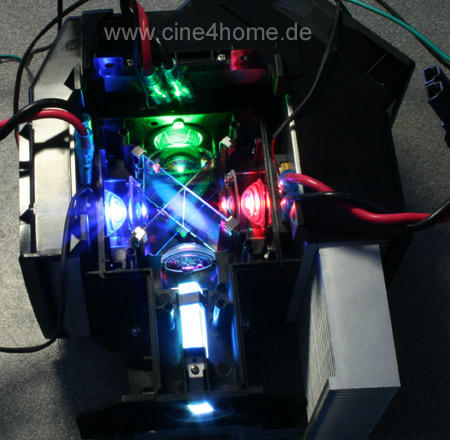
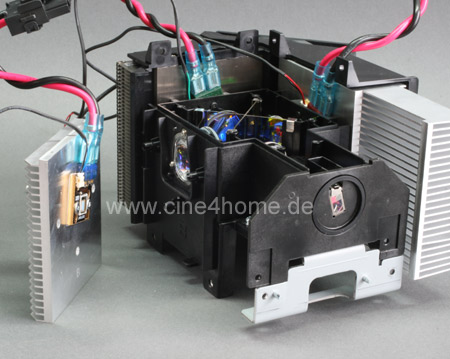
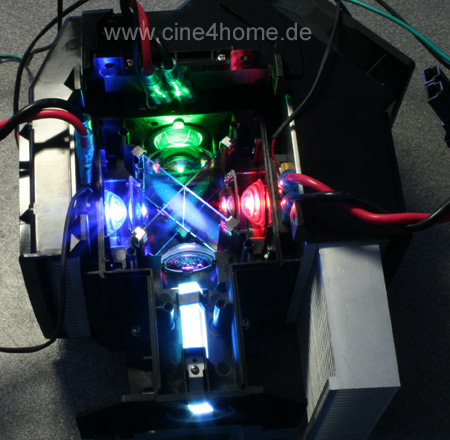
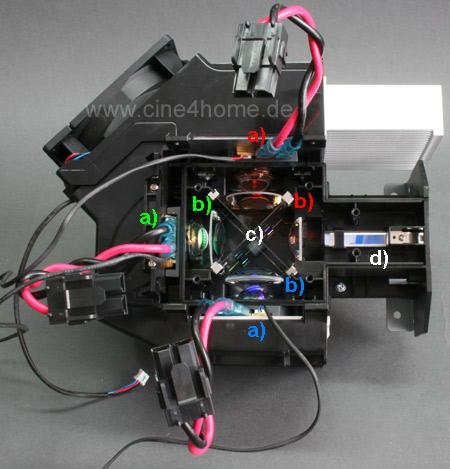
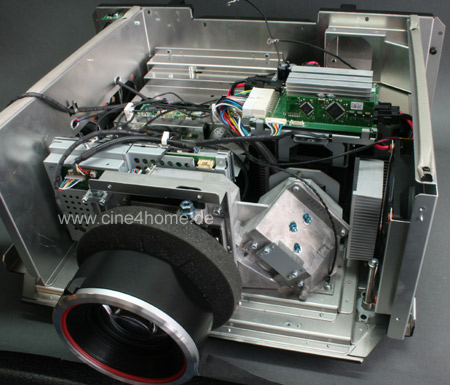
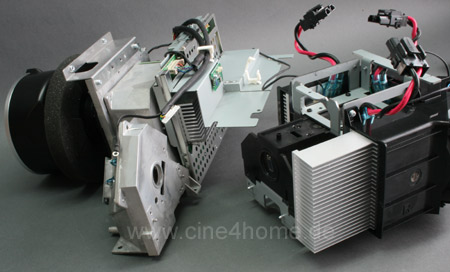
I think Cine4home does a good job reviewing pjs, but I don't read them because they are in German. What is worse is that people over at AVS will dissect the reviews with babelfish, etc. They actually speak English and participate at AVS, so I don't know why they don't do an English page. Anyway, they did a review of the Vivitek back in September. Here is the link, if it doesn't show just scroll down to the Vivitek LED review. They took the pj apart and show the internals. It is what Mac and Scott are to afraid to show. 
http://www.cine4home.de/
|
|
| Back to top |
|
 |
Nashou66

Joined: 12 Jan 2007
Posts: 16171
Location: West Seneca NY
|
|
| Back to top |
|
|
Spanky Ham
Joined: 22 Mar 2006
Posts: 5643
Location: Comedy Central
|
| Posted: Thu Jan 07, 2010 8:32 pm Post subject: |
|
|
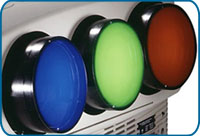
Here are some pics
| Description: |
|
| Filesize: |
49.22 KB |
| Viewed: |
8799 Time(s) |
|
| Description: |
|
| Filesize: |
62.89 KB |
| Viewed: |
8799 Time(s) |
|
| Description: |
|
| Filesize: |
31.88 KB |
| Viewed: |
8799 Time(s) |
|
|
|
| Back to top |
|
|
Spanky Ham
Joined: 22 Mar 2006
Posts: 5643
Location: Comedy Central
|
| Posted: Thu Jan 07, 2010 8:34 pm Post subject: |
|
|
More pics
| Description: |
|
| Filesize: |
59.32 KB |
| Viewed: |
8795 Time(s) |
|
| Description: |
|
| Filesize: |
35.9 KB |
| Viewed: |
8795 Time(s) |
|
|
|
| Back to top |
|
|
macgyver655
Joined: 22 Aug 2007
Posts: 8508
|
| Posted: Thu Jan 07, 2010 8:54 pm Post subject: |
|
|
| VideoGrabber wrote: | > Well now I'm really going to throw your a curve and it pertains to my comment on more then 1 mirror per pixel. <
I'll avoid pointing out that there's still only 1 mirror being used to display each pixel on-screen, even though there are more display pixels than source pixels. Whoops. 
|
Quoting 1 line in my post changes what I said. I explained in more detail in the entire post.
|
|
| Back to top |
|
|
macgyver655
Joined: 22 Aug 2007
Posts: 8508
|
| Posted: Thu Jan 07, 2010 9:21 pm Post subject: |
|
|
| garyfritz wrote: |
Sure, that's how it works with any scaled image. But that's not a feature of the DMD itself -- it's just displaying the pixels it's told to.
Nothing is a feature of the DMD. It can't do anything without being told. And if its told to turn on 4 mirrors for 1 pixel of the input signal, that's what it does.
That's the scaler stretching the 480p image to fit a 1080p panel. You'd get the exact same pixels displayed if you sent the same scaled output to an SXRD or LCD panel.
Correct, its still doing the same thing. Its producing more pixels then the input signal. More pixels on the panel for 1 pixel of input signal.
There's still 1 mirror per pixel, but it's per pixel of the post-scaler output, not the 480p input. It has nothing to do with special DMD processing for contrast or shading, or getting brighter images by "smearing" the pixels. It's just scaling the input to match the panel resolution. |
Lets revert to CRT technology. If you take a 480i signal and line triple it so your displaying more lines then the original signal. And a line tripled image is brighter then not tripled. Same input signal scaled to a different image signal.
|
|
| Back to top |
|
|
ecrabb
Forum Moderator

Joined: 13 Mar 2006
Posts: 15909
Location: Utah
TV/Projector: JVC RS40, Epson 5010
|
| Posted: Thu Jan 07, 2010 9:33 pm Post subject: |
|
|
| macgyver655 wrote: | | Lets revert to CRT technology. If you take a 480i signal and line triple it so your displaying more lines then the original signal. And a line tripled image is brighter then not tripled. Same input signal scaled to a different image signal. |
But, that has nothing to do with contrast as we're discussing it here, Mac. It's brighter because by running a higher res/scan frequency, you eliminate gaps between the scan lines. No such paradigm exists with a DMD (or any other fixed-pixel device for that matter).
SC
|
|
| Back to top |
|
|
macgyver655
Joined: 22 Aug 2007
Posts: 8508
|
| Posted: Thu Jan 07, 2010 9:50 pm Post subject: |
|
|
| ecrabb wrote: | | macgyver655 wrote: | | Lets revert to CRT technology. If you take a 480i signal and line triple it so your displaying more lines then the original signal. And a line tripled image is brighter then not tripled. Same input signal scaled to a different image signal. |
But, that has nothing to do with contrast as we're discussing it here, Mac. It's brighter because by running a higher res/scan frequency, you eliminate gaps between the scan lines. No such paradigm exists with a DMD (or any other fixed-pixel device for that matter).
SC |
I agree that analogy is not a good source. My method was merely so show that by using surrounding area the light output is increased. Plus there is no separation between mirrors so your not filling empty space like CRT but your creating reflecting area.
If you were only to turn on 1 mirror for 1 pixel of lower resolution input signal on the high rez DMD then you would have dark areas surrounding the 1 mirror turned on. So surrounding mirrors would be also turned on for the 1 pixel of input signal.
|
|
| Back to top |
|
|
ecrabb
Forum Moderator
Joined: 13 Mar 2006
Posts: 15909
Location: Utah
TV/Projector: JVC RS40, Epson 5010
|
| Posted: Thu Jan 07, 2010 10:13 pm Post subject: |
|
|
| macgyver655 wrote: | | If you were only to turn on 1 mirror for 1 pixel of lower resolution input signal on the high rez DMD then you would have dark areas surrounding the 1 mirror turned on. So surrounding mirrors would be also turned on for the 1 pixel of input signal. |
Right, but then you're not talking about turning on some surrounding mirrors to increase the brightness of one mirror anymore... At that point, you're simply talking about the effect of scaling - or resampling - which is complete irrespective of display technology, or even medium for that matter.
SC
|
|
| Back to top |
|
|
macgyver655
Joined: 22 Aug 2007
Posts: 8508
|
| Posted: Thu Jan 07, 2010 10:33 pm Post subject: |
|
|
| ecrabb wrote: | | macgyver655 wrote: | | If you were only to turn on 1 mirror for 1 pixel of lower resolution input signal on the high rez DMD then you would have dark areas surrounding the 1 mirror turned on. So surrounding mirrors would be also turned on for the 1 pixel of input signal. |
Right, but then you're not talking about turning on some surrounding mirrors to increase the brightness of one mirror anymore... At that point, you're simply talking about the effect of scaling - or resampling - which is complete irrespective of display technology, or even medium for that matter.
SC |
Depends on what resolution your talking. Any resolution below the native resolution of the panel then yes it would increase brightness as compared to just turning on the number of mirrors that pertains to the input signal.
|
|
| Back to top |
|
|
macgyver655
Joined: 22 Aug 2007
Posts: 8508
|
| Posted: Thu Jan 07, 2010 10:41 pm Post subject: |
|
|
| Spanky Ham wrote: | | It is what Mac and Scott are to afraid to show. |
I dont know about Scott but for me I have to be careful of what I post. Most of my documents come right from the manufacturers and they have warnings on the entrance page about reproducing documents. First there is the issue of copyright but there is also the issue of loosing access to that info which is actually more important to me. This is also why I sometimes go back and delete images later of stuff I post to help someone.
|
|
| Back to top |
|
|
macgyver655
Joined: 22 Aug 2007
Posts: 8508
|
| Posted: Thu Jan 07, 2010 10:47 pm Post subject: |
|
|
| ecrabb wrote: |
But, that has nothing to do with contrast as we're discussing it here, Mac. It's brighter because by running a higher res/scan frequency, you eliminate gaps between the scan lines. No such paradigm exists with a DMD (or any other fixed-pixel device for that matter).
SC |
Actually it would exist if you took away the internal scaler. If the panel was only producing the pixels of the low rez input signal then you would have gaps between the lines. It just different as to how the anomaly is produced.
|
|
| Back to top |
|
|
Spanky Ham
Joined: 22 Mar 2006
Posts: 5643
Location: Comedy Central
|
| Posted: Thu Jan 07, 2010 10:52 pm Post subject: |
|
|
| macgyver655 wrote: | | Spanky Ham wrote: | | It is what Mac and Scott are to afraid to show. |
I dont know about Scott but for me I have to be careful of what I post. Most of my documents come right from the manufacturers and they have warnings on the entrance page about reproducing documents. First there is the issue of copyright but there is also the issue of loosing access to that info which is actually more important to me. This is also why I sometimes go back and delete images later of stuff I post to help someone. |
I realize that, but I thought I would have a little fun.
Since most are using the same engine, I would guess the internals looks similar. I wonder what the price is for VDCs.
|
|
| Back to top |
|
|
macgyver655
Joined: 22 Aug 2007
Posts: 8508
|
| Posted: Thu Jan 07, 2010 11:02 pm Post subject: |
|
|
| Spanky Ham wrote: |
Since most are using the same engine, I would guess the internals looks similar. I wonder what the price is for VDCs. |
Did he indicate who they are going to market to? Consumer, commercial or other?
|
|
| Back to top |
|
|
cmjohnson

Joined: 03 Apr 2006
Posts: 5180
Location: Buried under G90s
|
| Posted: Thu Jan 07, 2010 11:10 pm Post subject: |
|
|
I got a look at TSE's new DLP toy, too, and there's a lot to like about it. There is no rainbow effect for all intents and purposes, but I
could see it when scanning my eyes rapidly by when looking at the projector lens. Not visible on the screen even when I tried.
The color gamut is impressive. It's obviously wider than you've ever seen on a CRT. The red is incredibly rich and deep, and the green doesn't have a trace of yellow in it. Blue is as good as I've ever seen. The gamut is so wide that the mix colors (yellow and cyan
and magenta) are different shades than you're used to. But it's not hard to color space correct the image to the "right" colors when
the projector's color space is wider than that of the original source.
Brightness is certainly quite adequate for a home theater or simulator system, but it's no light cannon. No doubt future versions will
be more optically efficient and have higher output.
The motion artifact reduction mode was IMPRESSIVE. At a slight loss of brightness, the gains in viewability (and readability) of moving
objects on the screen were fantastic.
It's not that big a projector, either. It's hardly tiny, but it's really no bigger than a full sized PC's case. In the CRT world, that's small
for a projector.
I'm now sure that when my 9500LC finally gives out, I'll be able to get a low to zero maintenance replacement that is fully its equal
in performance. But with just 250 hours on my tubes, it'll be a while. 
CJ
|
|
| Back to top |
|
|
macgyver655
Joined: 22 Aug 2007
Posts: 8508
|
| Posted: Thu Jan 07, 2010 11:24 pm Post subject: |
|
|
| cmjohnson wrote: | I got a look at TSE's new DLP toy, too, and there's a lot to like about it. There is no rainbow effect for all intents and purposes, but I
could see it when scanning my eyes rapidly by when looking at the projector lens. Not visible on the screen even when I tried.
The color gamut is impressive. It's obviously wider than you've ever seen on a CRT. The red is incredibly rich and deep, and the green doesn't have a trace of yellow in it. Blue is as good as I've ever seen. The gamut is so wide that the mix colors (yellow and cyan
and magenta) are different shades than you're used to. But it's not hard to color space correct the image to the "right" colors when
the projector's color space is wider than that of the original source.
Brightness is certainly quite adequate for a home theater or simulator system, but it's no light cannon. No doubt future versions will
be more optically efficient and have higher output.
The motion artifact reduction mode was IMPRESSIVE. At a slight loss of brightness, the gains in viewability (and readability) of moving
objects on the screen were fantastic.
It's not that big a projector, either. It's hardly tiny, but it's really no bigger than a full sized PC's case. In the CRT world, that's small
for a projector.
I'm now sure that when my 9500LC finally gives out, I'll be able to get a low to zero maintenance replacement that is fully its equal
in performance. But with just 250 hours on my tubes, it'll be a while.
CJ |
Ya know CJ. I think if they can get some more light out of the LEDs and put them in a 3 chip DLP it would be a killer projector.
|
|
| Back to top |
|
|
Spanky Ham
Joined: 22 Mar 2006
Posts: 5643
Location: Comedy Central
|
| Posted: Thu Jan 07, 2010 11:40 pm Post subject: |
|
|
| macgyver655 wrote: | | Spanky Ham wrote: |
Since most are using the same engine, I would guess the internals looks similar. I wonder what the price is for VDCs. |
Did he indicate who they are going to market to? Consumer, commercial or other? |
Mac,
Does the industrial look give you any idea? I hope Scott doesn't kill me:), but it will be military and anyone else who wants one. I didn't talk to him long enough, so maybe CJ can expand on it. My guess is that they will be priced above the other LEDs out there, because of the demands of being able to last on a ship. Of course the extreme variability in price between manufacturers shows that there are some huge margins in there. For manufacturers who are using basically the same engine, the price delta doesn't make sense. Scott did say they hope to sell a lot of them, so maybe they are down around the $15k range. If that is the case, then you could get a delicate Runco or Sim or a heavy duty VDC.
|
|
| Back to top |
|
|
Spanky Ham
Joined: 22 Mar 2006
Posts: 5643
Location: Comedy Central
|
| Posted: Thu Jan 07, 2010 11:43 pm Post subject: |
|
|
| cmjohnson wrote: |
The motion artifact reduction mode was IMPRESSIVE. At a slight loss of brightness, the gains in viewability (and readability) of moving
objects on the screen were fantastic.
CJ |
That is HUGE. Motion and on/off are the last and biggest advantages of CRT. No wonder Scott seems enthusiastic about LED.
|
|
| Back to top |
|
|
garyfritz

Joined: 08 Apr 2006
Posts: 12088
Location: Fort Collins, CO
|
| Posted: Thu Jan 07, 2010 11:54 pm Post subject: |
|
|
| macgyver655 wrote: | | Ya know CJ. I think if they can get some more light out of the LEDs and put them in a 3 chip DLP it would be a killer projector. |
But if you go to 3-chip you end up with converence issues. Single-chip DLPs have a huge advantage there. Get rid of the rainbow disadvantage and I think 1-chip DLP is the sweet spot, at least for home HT.
| ecrabb wrote: | | Gary, that 1,024 level brightness limit is probably a time-imposed limitation, with human eye sensitivity also a factor. In essence, that may be for a single DMD running monochrome with no color wheel. Perhaps throwing a 6-segment color wheel in the light path and forcing the DMD to represent 6 different luma values in the same time it would usually represent one, may cut the color to something like 7-bits/per pixel. |
?? I thought it meant the DMD was capable of flapping its mirrors to represent 1024 levels of grayscale. That's 10 bits of grayscale **per color**. You can represent 1024 levels when the color wheel is showing red, 1024 when it's showing blue, etc. So that should give you the equivalent of 10 bits per color, or 30 bits of color resolution.
|
|
| Back to top |
|
|
ecrabb
Forum Moderator
Joined: 13 Mar 2006
Posts: 15909
Location: Utah
TV/Projector: JVC RS40, Epson 5010
|
| Posted: Fri Jan 08, 2010 12:19 am Post subject: |
|
|
| garyfritz wrote: | | ?? I thought it meant the DMD was capable of flapping its mirrors to represent 1024 levels of grayscale. That's 10 bits of grayscale **per color**. |
Yeah, it does do 1024 levels of greyscale, but because it's a pulse-width modulation system, that number is impacted negatively when the DMD has alternate rapidly between different values to show all those different levels of greyscale by rotating a segmented color wheel in front of it at thousands of RPM.
| garyfritz wrote: | | You can represent 1024 levels when the color wheel is showing red, 1024 when it's showing blue, etc. So that should give you the equivalent of 10 bits per color, or 30 bits of color resolution. |
That's not the way I understand it. I think you'd have 30 bits of color with a 3-chip machine, and much less with a single-chip machine.
I think it's the reason the early single-chip DLP's looked like ass... They had horrendous banding and dithering. It's also why the 3-chip DLP still has an advantage... It isn't just to increase brightness and eliminate rainbows; it's to (tremendously) increase color resolution.
I could be wrong... I'll see if I can find the info, but that's my impression.
SC
|
|
| Back to top |
|
|
|
|