|
As this forum is rarely used anymore, we've locked it. Feel free to browse and read. Questions? Please reach out to us directly. Cheers! |
|
|
 |
|
|
| Author |
Message |
MaximRecoil
Joined: 28 Nov 2008
Posts: 22
|
| Posted: Mon Nov 30, 2009 11:28 am Post subject: Some questions before trying my projector for the first time |
|
|
The projector is a Barco Graphics 808s.
1. For now I am just going to set the projector on a table (I may ceiling-mount later). Is there an ideal height for the table?
2. I'm going to start with something basic, like setting my PC to 640x480, and hooking it to the projector via a VGA > 5xBNC cable. Will the projector be okay with that? How high can I go with the resolution?
3. I've noticed that a lot of people run 1080i from HTPCs to projectors, but there seem to be a lot of "flavors" of 1080i. I have an old Nvidia GeForce 6600 video card with the latest drivers (v6.14.11.9562) in this PC, and I have Nvidia Control Panel v2.8.254.08 and PowerStrip v3.83 b635.
I wasn't able to get anywhere in Nvidia Control Panel with regard to creating a 1080i resolution, but in PowerStrip's Advanced Timing > Custom Resolutions window, there is a list of predefined resolutions you can choose, including several flavors of 1080i:
1920x1080i (HDTV derived)
1920x1080i (HDTV PAL-derived)
1920x1080i (ATI HDTV)
1920x1080i 60Hz (EIA/CEA-861B)
1920x1080i 50Hz (EIA/CEA-861B)
1920x1080i 25PsF
1920x1080i 24PsF
I tried the first one (HDTV derived) and the graphics driver accepted it, and it switched to a 1920x1080 resolution that was definitely interlaced (first time I've ever seen interlaced video on my PC monitor). So will that be fine for sending to the projector, or do I need to know more about the different flavors of 1080i?
4. What about 1080p? Can my projector support it, and if so, how does it look?
5. Given that this will be my first time using a video projector of any sort, is there anything I should be aware of before firing it up for the first time?
|
|
| Back to top |
|
 |
Elaine Benes
Joined: 25 Apr 2006
Posts: 1416
|
| Posted: Fri Dec 04, 2009 2:59 am Post subject: |
|
|
An 808s will accept any of those resolutions and easily display them, but the low refresh ones (24/25PsF) would be totally unwatchable because of flicker. I use 1080p, it looks fine, lots of people will cry about how you can't fully resolve it, but who cares if you like the look of it ?
Why not use 1440x810, I've just been trying it and its nice to be able to read the file names with the slightly larger type it affords...
Some people recommend 1080i with a refresh rate that is an even multiple of film rate, I think that would be ideal, but I've never, ever been able to get it to actually work...
|
|
| Back to top |
|
|
MikeEby

Joined: 24 Jun 2007
Posts: 5237
Location: Osceola, Indiana
|
| Posted: Fri Dec 04, 2009 3:20 am Post subject: |
|
|
I run 1600X900 72Hz (71.928) on my XG. It looks great. A lot of people like 1080i 96Hz.

Mike
_________________
Doing HD since the last century!
|
|
| Back to top |
|
|
betel

Joined: 20 Apr 2006
Posts: 448
Location: Maryville, Tennessee (Just South of Knoxville)
|
| Posted: Fri Dec 04, 2009 3:30 am Post subject: Re: Some questions before trying my projector for the first |
|
|
[quote="MaximRecoil"]The projector is a Barco Graphics 808s.
1. For now I am just going to set the projector on a table (I may ceiling-mount later). Is there an ideal height for the table?
The closer the height of the projector to the center of the screen the better. Perfectly centered would result in zero keystone which means maximum use of the tube phosphor. Of course this presents a problem in front projection.
|
|
| Back to top |
|
|
AnalogRocks
Forum Moderator
Joined: 08 Mar 2006
Posts: 26706
Location: Toronto, Ontario, Canada
TV/Projector: Sony 1252Q, AMPRO 4000G
|
| Posted: Fri Dec 04, 2009 3:31 am Post subject: Re: Some questions before trying my projector for the first |
|
|
[quote="betel"] | MaximRecoil wrote: | The projector is a Barco Graphics 808s.
1. For now I am just going to set the projector on a table (I may ceiling-mount later). Is there an ideal height for the table?
The closer the height of the projector to the center of the screen the better. Perfectly centered would result in zero keystone which means maximum use of the tube phosphor. Of course this presents a problem in front projection. |
Don't forget the reflection factor here. I have mine setup that way and you end up with the light reflecting back into the lenses.
_________________
Tech support for nothing
CRT.
HD done right!
|
|
| Back to top |
|
|
betel
Joined: 20 Apr 2006
Posts: 448
Location: Maryville, Tennessee (Just South of Knoxville)
|
| Posted: Fri Dec 04, 2009 3:37 am Post subject: |
|
|
|
I didn't realize reflection would be a problem. My projector is ceiling mounted by the way. How does light reflecting back into the lens effect the image? I always thought it would be ideal although impratical. The person I purchased my projector from had it set up as rear projection on center and it looked great. I didn't notice any hot spotting.
|
|
| Back to top |
|
|
MikeEby
Joined: 24 Jun 2007
Posts: 5237
Location: Osceola, Indiana
|
| Posted: Fri Dec 04, 2009 3:41 am Post subject: |
|
|
My problem with that setup is the projector has the best seat in the house. With it that high you can't see over it. I like to set dead center of the screen.
With my projector ceiling mounted Im right below it. If you set it lower then at least you can at least see over the top.
Mike
_________________
Doing HD since the last century!
Last edited by MikeEby on Fri Dec 04, 2009 4:00 am; edited 1 time in total
|
|
| Back to top |
|
|
AnalogRocks
Forum Moderator
Joined: 08 Mar 2006
Posts: 26706
Location: Toronto, Ontario, Canada
TV/Projector: Sony 1252Q, AMPRO 4000G
|
| Posted: Fri Dec 04, 2009 3:48 am Post subject: |
|
|
| betel wrote: | | I didn't realize reflection would be a problem. My projector is ceiling mounted by the way. How does light reflecting back into the lens effect the image? I always thought it would be ideal although impratical. The person I purchased my projector from had it set up as rear projection on center and it looked great. I didn't notice any hot spotting. |
In rear projection it's not an issue. It's just in front projection. Doug Baisey brought this to my attention. While it will work and looks pretty good he was saying that the light reflected back into the lens will lessen the contrast ratio.
_________________
Tech support for nothing
CRT.
HD done right!
|
|
| Back to top |
|
|
MaximRecoil
Joined: 28 Nov 2008
Posts: 22
|
| Posted: Fri Dec 04, 2009 6:31 am Post subject: |
|
|
| Elaine Benes wrote: | An 808s will accept any of those resolutions and easily display them, but the low refresh ones (24/25PsF) would be totally unwatchable because of flicker. I use 1080p, it looks fine, lots of people will cry about how you can't fully resolve it, but who cares if you like the look of it ?
Why not use 1440x810, I've just been trying it and its nice to be able to read the file names with the slightly larger type it affords...
Some people recommend 1080i with a refresh rate that is an even multiple of film rate, I think that would be ideal, but I've never, ever been able to get it to actually work... |
Wouldn't doing the even multiple of film rate only make sense if you have a film-rate source to begin with? Progressive NTSC video for example, is 23.976 FPS, rather than 24 FPS. Still though, I'd like to see a screen shot of PowerStrip for a working 1080i/96 configuration, if anyone has one.
I was thinking of going with a table that is 3 feet high, does that sound reasonable? My ceiling is only 7 feet though, so I don't know if that will cause any problems with fitting the displayed image on a large screen. It is a false drop-ceiling that is limiting the height to 7 feet, one which I've been thinking about removing (there is no real reason for it to be there; the idea was that it would save on heating costs I guess). The real ceiling is 9 feet.
Where can I get a summary of the various frequencies and how they relate to digital resolutions? I know of two frequency parameters associated with displays; horizontal scan rate, and vertical refresh rate. Are there any others to worry about? What about "sync rate", is that something different or just an alternate term for "scan rate"? The "96" part of "1080i/96" refers to a 96Hz vertical refresh rate, is that correct?
I have a lot of standard resolution RGB arcade monitors (CRT-based), and they are often called "15kHz monitors" (they are actually 15.75kHz, but most people just type "15kHz" as an abbreviation), and that indicates that they are "standard resolution" monitors. These are the type of monitors you would find in most of the classic arcade machines, such as Pac-Man or Donkey Kong. Some games used "medium resolution" monitors, and those are often referred to as "25kHz monitors". Some of the newer games had "high resolution" monitors, AKA "VGA" monitors, and those are often referred to as "30kHz" monitors. So anyway, that is obviously not talking about refresh rate, since it is in kHz; and it also seems to have a direct relationship with the maximum resolution that the monitor is capable of. Is that referring to scan rate? Sync rate? Other?
According to the BG808s brochure, it has a "Horizontal autolock scan frequency range of 15-110 kHz". Aren't displays like this usually considered "multisync"? If so, that would indicate that "scan rate" and "sync rate" are the same thing (?). Since it can go down to 15kHz, I guess that would mean I could hook up an old arcade gameboard to it via RGB if I wanted to (that would be interesting). Now if 15kHz translates to ~320x240, and 30kHz translates to ~640x480, then does that mean that 110kHz translates to ~2,346x1760 (which is well above 1920x1080)?
And then there is a parameter that is in MHz: (From the brochure) "RGB bandwidth of 120 MHz". Now what is "RGB bandwidth", and how does that relate to resolution, and/or everything else?
Edit: I found some information that explained a good deal of this. Apparently, the important thing is how many lines need to be drawn in a given amount of time. So for 1080p/60 as an example, you need to draw 1080 lines x 60 per second, which comes to 64,800 lines per second total, meaning you'd need a 64.8kHz H-scan rate. That's well within the 110 kHz scan rate capability of the BG808s, but I still don't know what exactly RGB bandwidth is, and how it comes into play.
Last edited by MaximRecoil on Fri Dec 04, 2009 7:18 am; edited 1 time in total
|
|
| Back to top |
|
|
ecrabb
Forum Moderator

Joined: 13 Mar 2006
Posts: 15909
Location: Utah
TV/Projector: JVC RS40, Epson 5010
|
| Posted: Fri Dec 04, 2009 7:15 am Post subject: |
|
|
| AnalogRocks wrote: | | In rear projection it's not an issue. It's just in front projection. Doug Baisey brought this to my attention. While it will work and looks pretty good he was saying that the light reflected back into the lens will lessen the contrast ratio. |
It's still an issue in rear projection - just not much of an issue. With a typical modest-gain angular-reflective screen like most of us have, you'd need to have a bat cave and an EM machine along with test equipment to measure the decrease in contrast from an 0-degree throw angle projection setup.
In other words, don't worry about it. If you want to set it up on a table, and elevate the ass end of the projector to center the rasters, do it. You've got Scheimpflug on the BG808S to nail top/bottom focus, too.
SC
|
|
| Back to top |
|
|
ecrabb
Forum Moderator
Joined: 13 Mar 2006
Posts: 15909
Location: Utah
TV/Projector: JVC RS40, Epson 5010
|
| Posted: Fri Dec 04, 2009 8:06 am Post subject: |
|
|
| MaximRecoil wrote: | | Wouldn't doing the even multiple of film rate only make sense if you have a film-rate source to begin with? Progressive NTSC video for example, is 23.976 FPS, rather than 24 FPS. |
Yes, from film... Which is represents about 95% of what most of us here watch... Movies. Yes, you'd use a multiple of 23.976. (Actually, NTSC is 29.97, so line-doubled progressive is 59.94).
| MaximRecoil wrote: | | I was thinking of going with a table that is 3 feet high, does that sound reasonable? My ceiling is only 7 feet though, so I don't know if that will cause any problems with fitting the displayed image on a large screen. |
3'-high table should work just fine.
| MaximRecoil wrote: | | According to the BG808s brochure, it has a "Horizontal autolock scan frequency range of 15-110 kHz". Aren't displays like this usually considered "multisync"? If so, that would indicate that "scan rate" and "sync rate" are the same thing (?). Since it can go down to 15kHz, I guess that would mean I could hook up an old arcade gameboard to it via RGB if I wanted to (that would be interesting). Now if 15kHz translates to ~320x240, and 30kHz translates to ~640x480, then does that mean that 110kHz translates to ~2,346x1760 (which is well above 1920x1080)? |
15.5khz is standard 480i NTSC, and 30khz is line-doubled (progressive) 480p. It's analog - not digital - but, you can think of them both 640x480, but 480i is interlaced. Yes, the projector is multisync.
| MaximRecoil wrote: | | And then there is a parameter that is in MHz: (From the brochure) "RGB bandwidth of 120 MHz". Now what is "RGB bandwidth", and how does that relate to resolution, and/or everything else? |
Think of refresh as simply how fast the entire screen is refreshed.
Think of horizontal scan frequency as the speed of the electron beam across the screen. At any given refresh rate, the more horizontal lines you add to the signal (that's actually vertical resolution), the more quickly the projector has to scan each line.
Think of bandwidth as how quickly the electronics in the projector change from one value to another... Bandwidth capability has a profound effect on how well a projector can display fine detail at higher resolutions.
So, you've got:
horizontal scan frequency (khz) = number of horizontal lines (scans across the tube face) * refresh
bandwidth = horizontal resolution * vertical resolution * refresh
So, take 1080p for example:
1920x1080
60hz refresh
Hscan = 1080*60 = 64.8khz (actual Hscan is about 10% higher because of retrace)
pixel clock = 1920*1080*60 = 124mhz
bandwidth = (pixel clock * 2)/3 or 186mhz.
Bandwidth is debatable. You'll get plenty of spirited debate over it around here. The bottom line is though, that a machine like a BG808 (or my machine - a Sony G70) will not come anywhere near close to being able to display alternating black and white vertical lines at 1080 with any degree of sharpness, because it doesn't have the necessary bandwidth. We call that "fully resolving" and no machines but the very best 9" can came close to fully resolving 1080p. With CRT resolution, there aren't really absolutes as much as there are varying degrees. Bandwidth is a deep subject.
SC
|
|
| Back to top |
|
|
MaximRecoil
Joined: 28 Nov 2008
Posts: 22
|
| Posted: Fri Dec 04, 2009 8:49 am Post subject: |
|
|
Excellent. Thanks for the very informative reply.
| ecrabb wrote: |
Yes, from film... Which is represents about 95% of what most of us here watch... Movies. Yes, you'd use a multiple of 23.976. (Actually, NTSC is 29.97, so line-doubled progressive is 59.94). |
What I was referring to is, when you take NTSC video, e.g., from a DVD, and IVTC it so that you are left with only the progressive frames, the result is 23.976 FPS.
So does the BG808s have any problems using odd refresh rates such as 71.928 or 95.904 Hz (exact multiples of 23.976 FPS)?
What are the details of the video signal that you send to your Sony G70?
|
|
| Back to top |
|
|
ecrabb
Forum Moderator
Joined: 13 Mar 2006
Posts: 15909
Location: Utah
TV/Projector: JVC RS40, Epson 5010
|
| Posted: Fri Dec 04, 2009 4:13 pm Post subject: |
|
|
| MaximRecoil wrote: | | So does the BG808s have any problems using odd refresh rates such as 71.928 or 95.904 Hz (exact multiples of 23.976 FPS)? |
Nope. It will display whatever you send it (within reason).
| MaximRecoil wrote: | | What are the details of the video signal that you send to your Sony G70? |
Me? I send 720p@60 or 1080p@60 from my HTPC, and 1080p/60 from my other sources (either natively, or through the scaler in my prepro.) I'm one of those crazy guys that would rather watch movies than screw around for hours on end tweaking video drivers and driver settings, ReClock, audio drivers and driver settings, filters... Ug. The list goes on. Screw that. I have better things to do with my time.
The funny thing is, there's all this hubub about judder... Displaying 24hz source material at 60hz... It's horrible, terrible, how can anybody watch it, it's unwatchable. Get this: I'm REALLY anal about image quality... I create video, and I used to do animation myself - I know what frame-rate mismatch judder looks like. Somehow, I can watch film-source material from a PS3 or a set-top box at 60hz all day long, and it doesn't bother me one bit.
An HTPC is just starting to be worth it again, in my opinion. But, if you're more into watching movies than screwing around with stuff to make it work right, I still say skip it. I have one, but I just don't see the big deal.
SC
|
|
| Back to top |
|
|
MaximRecoil
Joined: 28 Nov 2008
Posts: 22
|
| Posted: Sat Dec 05, 2009 3:54 am Post subject: |
|
|
I hooked a VGA>BNC cable from my PC to it but it didn't work. The cable has a red, green, and blue cable, plus 2 thinner sync cables; one is yellow and the other is white. I hooked the white to H-sync, and the yellow to V-sync; I don't know if that's correct or not. I read somewhere that Barcos need negative sync; is that true? Does my video card output negative or positive sync by default, and can it be changed in PowerStrip? If anyone here has hooked a PC to this particular model of projector using VGA>BNC cables; an explanation of the details would be great.
I also tried a DVD player with component input to the projector (uses the same RGB BNC connections, you just select component input on the remote) , which worked fine, except the convergence was way off, and it is set up to focus at a very close throw distance (like 6' away). Also, the picture is upside down, so I guess the previous owner had it mounted on a ceiling. I'm not sure yet how to change that. I think I'm going to have to start digging into the manuals.
A thing I'm concerned about it is, when I move the screen to the distance from the projector that I want, it is going to be way too blurry to see the displayed menus for focusing. Any ideas on how I should approach that?
|
|
| Back to top |
|
|
AnalogRocks
Forum Moderator
Joined: 08 Mar 2006
Posts: 26706
Location: Toronto, Ontario, Canada
TV/Projector: Sony 1252Q, AMPRO 4000G
|
| Posted: Sat Dec 05, 2009 3:55 am Post subject: |
|
|
Just focus the lenses then do the mechanical tow in. Make sure you are parallel to the screen too.
_________________
Tech support for nothing
CRT.
HD done right!
|
|
| Back to top |
|
|
MaximRecoil
Joined: 28 Nov 2008
Posts: 22
|
| Posted: Sat Dec 05, 2009 6:08 am Post subject: |
|
|
| AnalogRocks wrote: | | Just focus the lenses then do the mechanical tow in. Make sure you are parallel to the screen too. |
I don't know what you mean by "mechanical tow in".
BTW, I fixed the upside down picture issue (via a set of switches beneath the vertical and horizontal deflection cards). That's a handy feature. On arcade monitors, to accomplish the same thing you have to either flip the yoke or swap deflection wires around on the yoke, which is a pain (though some game boards have a dipswitch to flip the image, which flips it from the video source).
I'm wondering, how important is it to have the projector in the same position every time you use it? Right now I have it on a cart with wheels, so I can move it out of the way when I'm not using it. It is easy enough to get it back into roughly the same position each time, but how precise does it need to be? If the projector is in a different position by say an inch, will it make the picture look out of adjustment?
With arcade monitors, the white wire is H-sync and the yellow wire is V-sync. Can anyone confirm that it is the same way on VGA>BNC cables? Also, what sort of sync signal is required? Most arcade monitors can accept anything depending on which pins you use on the connector, i.e., separate negative sync, separate positive sync, negative composite sync, and positive composite sync.
This is how I hooked it up from the PC (set to 640x480p/60Hz) with the VGA>BNC cables:

But when I select input 4 or 5, all it does is briefly display text that says no source is available.
Edit: Problem solved on the PC input. In the case of these particular cables, yellow is H-sync, and white is V-sync (I checked the cables with a continuity meter and a VGA pinout for reference). When I switched them around the PC input worked immediately.
|
|
| Back to top |
|
|
dturco

Joined: 06 Feb 2009
Posts: 3778
Location: Eastern Shore Maryland
TV/Projector: Runco DLP VX-3000i Marquee 9500 parts doner
|
| Posted: Sat Dec 05, 2009 1:58 pm Post subject: |
|
|
Have you read the set up instructions on Curt's site? No it's not for your machine exactly ,but all CRT's mechanical alignment are basically the same. It's a great and necessary place to start.
http://www.curtpalme.com/CRTSetupGuide.shtm
_________________
Firefly rules. Can't stop the signal.
http://www.hulu.com/firefly
|
|
| Back to top |
|
|
AnalogRocks
Forum Moderator
Joined: 08 Mar 2006
Posts: 26706
Location: Toronto, Ontario, Canada
TV/Projector: Sony 1252Q, AMPRO 4000G
|
| Posted: Sat Dec 05, 2009 2:38 pm Post subject: |
|
|
| MaximRecoil wrote: | | AnalogRocks wrote: | | Just focus the lenses then do the mechanical tow in. Make sure you are parallel to the screen too. |
I don't know what you mean by "mechanical tow in".
BTW, I fixed the upside down picture issue (via a set of switches beneath the vertical and horizontal deflection cards). That's a handy feature. On arcade monitors, to accomplish the same thing you have to either flip the yoke or swap deflection wires around on the yoke, which is a pain (though some game boards have a dipswitch to flip the image, which flips it from the video source).
I'm wondering, how important is it to have the projector in the same position every time you use it? Right now I have it on a cart with wheels, so I can move it out of the way when I'm not using it. It is easy enough to get it back into roughly the same position each time, but how precise does it need to be? If the projector is in a different position by say an inch, will it make the picture look out of adjustment?
With arcade monitors, the white wire is H-sync and the yellow wire is V-sync. Can anyone confirm that it is the same way on VGA>BNC cables? Also, what sort of sync signal is required? Most arcade monitors can accept anything depending on which pins you use on the connector, i.e., separate negative sync, separate positive sync, negative composite sync, and positive composite sync.
This is how I hooked it up from the PC (set to 640x480p/60Hz) with the VGA>BNC cables:
But when I select input 4 or 5, all it does is briefly display text that says no source is available.
Edit: Problem solved on the PC input. In the case of these particular cables, yellow is H-sync, and white is V-sync (I checked the cables with a continuity meter and a VGA pinout for reference). When I switched them around the PC input worked immediately. |
If you move it you will have to tweak the setup every time you use it.
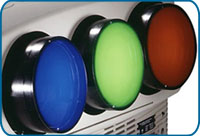
Mechanical tow in will be in the manual. The green lens doens't move, the red and blue swing side to side to get them aligned with the green when you have the cross hairs test pattern up.
These projectors will sync to RGBHV, RGBS and RGsB. If you don't get a picture from the RGBHV cable try reversing the H+V leads. Start off with an easy signal from the PC like 1024x768 and work your way up from there.
Oh yeah and one last thing
RTFM!
_________________
Tech support for nothing
CRT.
HD done right!
|
|
| Back to top |
|
|
MaximRecoil
Joined: 28 Nov 2008
Posts: 22
|
| Posted: Mon Dec 07, 2009 7:27 am Post subject: |
|
|
| dturco wrote: | Have you read the set up instructions on Curt's site? No it's not for your machine exactly ,but all CRT's mechanical alignment are basically the same. It's a great and necessary place to start.
http://www.curtpalme.com/CRTSetupGuide.shtm |
Excellent, thanks.
So in simplified terms, it looks like I have to do rough focus and convergence adjustments manually, and then fine-tune it through the menu setup controls. This is not going to be fun, I can see that already.
I wonder what the advantage of using 3 monochrome CRTs is as opposed to using a single full color CRT in a projector (that would make setup a breeze). Is it because a single full color CRT needs a shadow mask, which drastically reduces electron beam efficiency, limits maximum viewable resolution to the shadow mask hole and phosphor dot pitch size, and would probably be distractingly visible when the image is blown up to typical projector screen sizes?
Still though, I have to wonder what it would look like if you were to stick a big lens in front of a Sony GDM-FW900 PC monitor. If I had to guess, I would say that the image would look great, but would be lacking in brightness.
|
|
| Back to top |
|
|
Mark_A_W
Joined: 15 Mar 2006
Posts: 3068
Location: Sunny Melbourne Australia
|
| Posted: Mon Dec 07, 2009 8:14 am Post subject: |
|
|
| Elaine Benes wrote: |
Some people recommend 1080i with a refresh rate that is an even multiple of film rate, I think that would be ideal, but I've never, ever been able to get it to actually work... |
Nvidia or ATi?
|
|
| Back to top |
|
|
|
|
|
|
|
You cannot post new topics in this forum
You cannot reply to topics in this forum
You cannot edit your posts in this forum
You cannot delete your posts in this forum
You cannot vote in polls in this forum
You cannot attach files in this forum
You can download files in this forum
|
Forum powered by phpBB © phpBB Group
|
|