| Author |
Message |
Sparky015

Joined: 12 May 2009
Posts: 1185
Location: Cleveland / Akron, OH
|
| Posted: Thu Nov 12, 2009 8:22 pm Post subject: |
|
|
| Quote: |
Ahhh...Thats my man Sparky. Always bringing up key points to support my point...  |
I aim to please 
|
|
| Back to top |
|
 |
macgyver655
Joined: 22 Aug 2007
Posts: 8508
|
| Posted: Thu Nov 12, 2009 8:53 pm Post subject: |
|
|
Ok, next I guess we'll look at ripple currents and how the affect cap life. Some say that ripple current has little affect and others will say it has great affect. So lets see if we can understand why.
Basically its not the ripple current itself that causes issues but what affect it has on the capacitor. The more ripple current the capacitor has to deal with the higher the core temperature of the capacitor will get.
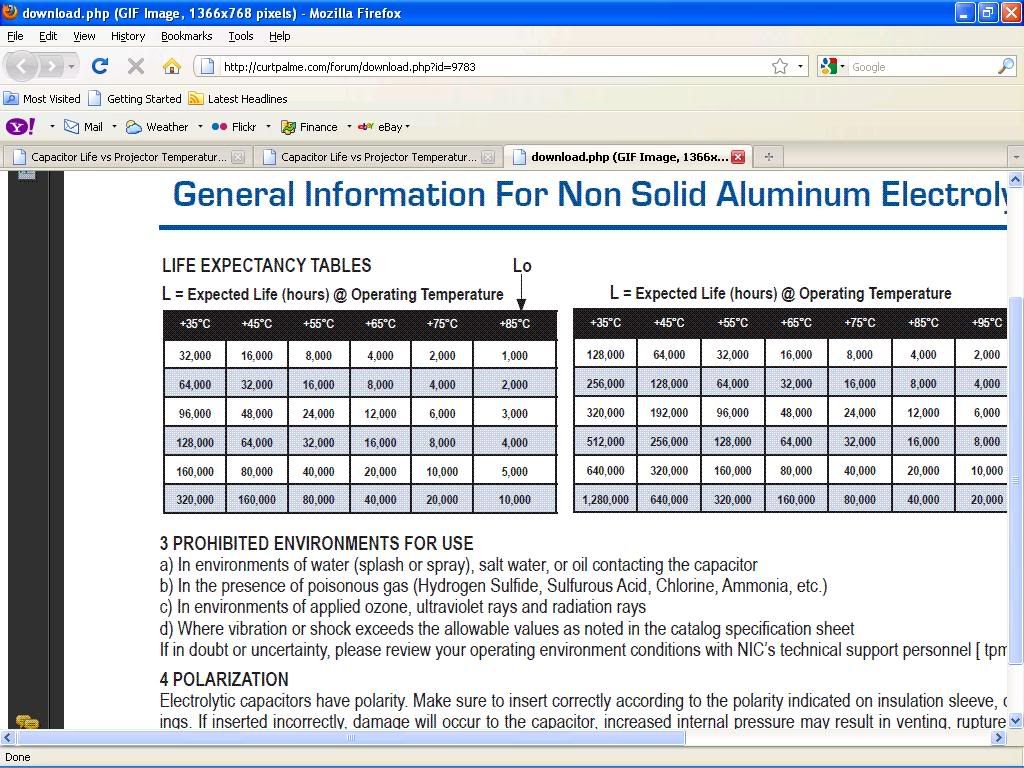
Now as discussed earlier, temp has alot of influence on cap life. So temp doesn't just pertain to ambient temp but also core temp. This is where the life chart still applies. If a capacitor is in an ambient temp of 45 degrees C but the core temp is higher, say 65 degree C because of high ripple current, then the life is dependent on the higher temp, which is the core temp of 65C. So if we look at the chart for a 85C/2000 hour cap at 65C we can see an expected life of app. 8000 hours. Even thought the ambient temp of 45C would indicate 32,000 hours. The cap is still running warmer because of the core temp.
The same applies if the ambient temp is high and the core is low, the higher (ambient) temp would apply for affect on cap life.
Now the reason some say ripple current has little affect on cap life is because its controllable. The is part of the design factor. A good designer will attempt to control these currents to increase component life. Plus the circuit reacts better. So if the original design showed a high core temp on a cap then the circuit could be altered to reduce this current affect.
Even if ripple currents were causing a core temp equal or lesser then ambient temp, then the ripple current would have no affect and only ambient temp would affect cap life.
Let me also say that most higher ripple currents are produced in power supplies (low voltage and high voltage) and horizontal drive circuits, but are also very controllable with a good design and will keep core temp very low.
Also, most capacitors in a device have very little if any ripple currents so would only be affected by ambient temp.
If you look back at Ile's thermal pictures you can see that there are very few hot spots and none jump out as caps. If a cap was running hot from a high core temp it would stand out in a thermal image.
Let the games begin....... 
|
|
| Back to top |
|
|
Spanky Ham

Joined: 22 Mar 2006
Posts: 5643
Location: Comedy Central
|
| Posted: Fri Nov 13, 2009 6:57 pm Post subject: |
|
|
| macgyver655 wrote: | | Spanky Ham wrote: | Mac,
I am following this. I have my mouth shut for fear of saying something I shouldn't. |
Please, post what you think. This is the point of this thread. But if you need to contradict anything I post with some sort of support, please have some sort of support to the contrary.  |
It wasn't anything you said. I think the cap issue in the pjs has been overblown to a degree. It looks like from what you are saying that as long as you are using correct caps then you shouldn't have any issues.
What I was biting my tongue about is Nash's Pooge. That sounds more like the first three letters. Audio can get away with a lot of this stuff, because it is so subjective.
|
|
| Back to top |
|
|
Ile
Joined: 09 Mar 2006
Posts: 1491
Location: Jyväskylä, Finland
|
| Posted: Sat Nov 14, 2009 11:24 am Post subject: |
|
|
| macgyver655 wrote: | | Now as discussed earlier, temp has alot of influence on cap life. So temp doesn't just pertain to ambient temp but also core temp. This is where the life chart still applies. If a capacitor is in an ambient temp of 45 degrees C but the core temp is higher, say 65 degree C because of high ripple current, then the life is dependent on the higher temp, which is the core temp of 65C. So if we look at the chart for a 85C/2000 hour cap at 65C we can see an expected life of app. 8000 hours. Even thought the ambient temp of 45C would indicate 32,000 hours. The cap is still running warmer because of the core temp. |
This is getting interesting...
So it must be ripple current that have killed these 85C caps in many medium hour Barco smps.
http://www.curtpalme.com/docs/Barco_FSB04_SMPU_Capacitor_Upgrade.pdf
It can't be ambient temp, because these are next to 120mm fan.
They learned they lesson and later models like 1209s have those caps listed as 105C in part list. Not sure if boards actually have 105C (subcontracted?), but least they updated documents.
Except some of this kind design faults, about 30000 hour life sounds right for projector cap life.
Cheap chinese caps in newer consumer and computer electronics is different story. I have found that these fail much earlyer and doesn't have nominal value even when new. For example my cable modem lasted under year and caps looked like in this picture I found.
http://farm4.static.flickr.com/3013/2401441384_aba0c729c8.jpg
After I replaced caps, it have worked two years now.
These are my favorites.
http://farm4.static.flickr.com/3059/2618014599_811b038cbc.jpg
|
|
| Back to top |
|
|
mp20748
Joined: 12 Sep 2006
Posts: 5689
Location: Maryland
TV/Projector: 9500LC Ultra / Super 02 and 03 VIM
|
| Posted: Sat Nov 14, 2009 2:56 pm Post subject: |
|
|
One of the best threads ever posted on the forums..
|
|
| Back to top |
|
|
Sparky015
Joined: 12 May 2009
Posts: 1185
Location: Cleveland / Akron, OH
|
| Posted: Sat Nov 14, 2009 3:43 pm Post subject: |
|
|
|
Did I really see that right in the last picture? They packaged a 35 volt 2200uF cap in a bigger package and called it a 50V 6800uF? Wow! Even if the reason was to cut costs, I can't imagine all that repackaging is cheaper than installing the right cap to begin with. I've never seen that before.
|
|
| Back to top |
|
|
macgyver655
Joined: 22 Aug 2007
Posts: 8508
|
| Posted: Mon Nov 16, 2009 2:14 am Post subject: |
|
|
| Ile wrote: | | Except some of this kind design faults, about 30000 hour life sounds right for projector cap life. |
Yes and that's if the originals were 2000 hour ones. Just think if the originals were 4000 hours ones..... 64,000 hours!!!!!!!
|
|
| Back to top |
|
|
macgyver655
Joined: 22 Aug 2007
Posts: 8508
|
| Posted: Mon Nov 16, 2009 2:16 am Post subject: |
|
|
|
Ok, just got back after being gone for the weekend. I'll right some thing up either later or tomorrow for the next subject. It also pertains to something Ile just posted above so I'll respond to that later also...... Stay tuned.....
|
|
| Back to top |
|
|
macgyver655
Joined: 22 Aug 2007
Posts: 8508
|
| Posted: Mon Nov 16, 2009 2:19 am Post subject: |
|
|
| mp20748 wrote: | | One of the best threads ever posted on the forums.. |
Thanks Mike. Glad your enjoying....
|
|
| Back to top |
|
|
AnalogRocks
Forum Moderator
Joined: 08 Mar 2006
Posts: 26706
Location: Toronto, Ontario, Canada
TV/Projector: Sony 1252Q, AMPRO 4000G
|
| Posted: Mon Nov 16, 2009 2:31 am Post subject: |
|
|
Mac, I have a question will storage temperature affect capacitor life? For example if I have two radios that are in storage. One is stored in a closet beside the hot air return and the closet is 90 degrees the other in a normal room at 70 degrees. Both non operating.
Will that affect capacitor life?
_________________
Tech support for nothing
CRT.
HD done right!
|
|
| Back to top |
|
|
km987654

Joined: 25 Jul 2007
Posts: 2874
Location: Australia
TV/Projector: Barco BG809s
|
| Posted: Mon Nov 16, 2009 3:21 am Post subject: |
|
|
| AnalogRocks wrote: | Mac, I have a question will storage temperature affect capacitor life? For example if I have two radios that are in storage. One is stored in a closet beside the hot air return and the closet is 90 degrees the other in a normal room at 70 degrees. Both non operating.
Will that affect capacitor life? |
Beat me to it.
|
|
| Back to top |
|
|
macgyver655
Joined: 22 Aug 2007
Posts: 8508
|
| Posted: Mon Nov 16, 2009 4:21 am Post subject: |
|
|
| AnalogRocks wrote: | Mac, I have a question will storage temperature affect capacitor life? For example if I have two radios that are in storage. One is stored in a closet beside the hot air return and the closet is 90 degrees the other in a normal room at 70 degrees. Both non operating.
Will that affect capacitor life? |
Ok, in keeping with the theme here I will use documents rather the opinion. I checked a bunch of documents on this issue and they are all consistent. I'm just going to do a copy and paste so its easy for everyone to just read rather then go to a link. But I assure you its valid but if anyone wants to call me on it then I'll post links.
Now your question is 70F which is 21C and 90F which is 32C. Cap temp ratings are in C so thats why I converted. For purpose of the document, 35C equals 95F.
I chose this document because it gives a good clear explanation. If you have any questions just ask but its pretty self explanatory.
Here's the copy and paste:
Storage of Electrolytic Capacitors
Avoid high temperature or high humidity environments. Keep the storage temperature at 5°C to 35°C, with relative humidity at less than 75%.
Capacitor leakage current tends to increase when stored for a long period, and compounds if the ambient storage temperature is high. It can be decreased by application of voltage, which should be made on any capacitor stored for one year or more.
Do not store capacitors at a place where there is a possibility of exposure to water, salt or oil.
Do not store capacitors at locations where the air contains hazardous gasses, such as hydrogen sulfide, sulfurous acid, nitrous acid, chlorine or ammonia.
Do not store where capacitors can be exposed to ultra-violet or radioactive rays.
|
|
| Back to top |
|
|
macgyver655
Joined: 22 Aug 2007
Posts: 8508
|
| Posted: Mon Nov 16, 2009 4:34 am Post subject: |
|
|
|
Some manufacturers even quote storing at 40C or under is fine but I used the lesser to make everyone happy....
|
|
| Back to top |
|
|
AnalogRocks
Forum Moderator
Joined: 08 Mar 2006
Posts: 26706
Location: Toronto, Ontario, Canada
TV/Projector: Sony 1252Q, AMPRO 4000G
|
| Posted: Mon Nov 16, 2009 6:42 am Post subject: |
|
|
Hmmmmm Maybe that's why allot of my stuff craps out. I have high humidity here most of the time. Hi heat too.
_________________
Tech support for nothing
CRT.
HD done right!
|
|
| Back to top |
|
|
macgyver655
Joined: 22 Aug 2007
Posts: 8508
|
| Posted: Mon Nov 16, 2009 2:51 pm Post subject: |
|
|
| AnalogRocks wrote: | | Hmmmmm Maybe that's why allot of my stuff craps out. I have high humidity here most of the time. Hi heat too. |
Well that depends. Is it the capacitors that are failing? Or your not sure. The high humidity is only a factor in that it causes oxidation on the leeds which would then have to be cleaned before soldering in. In your case they are already installed so the humidity wouldn't be a factor. As far as the heat, even 40C has no affect on storage and anything up to the rated temp only has limited affect and at a much lesser rate then the chart because they are not in use.
If you know for sure it was a capacitor failure then a clearer reason could be discussed.....
If you have high humidity which creates condensation and your turning this stuff on like that then that will surely take it out. High humidity areas are always a problem for electronics. But not the caps. Voltage just shorts somewhere where the condensation lies.
|
|
| Back to top |
|
|
AnalogRocks
Forum Moderator
Joined: 08 Mar 2006
Posts: 26706
Location: Toronto, Ontario, Canada
TV/Projector: Sony 1252Q, AMPRO 4000G
|
| Posted: Mon Nov 16, 2009 4:32 pm Post subject: |
|
|
Ohh I'm not sure. I seldom have time to take it all apart. It's a matter of putting something away for a while. Taking it out and finding out the closet gremlins broke it while it was in storage. 
_________________
Tech support for nothing
CRT.
HD done right!
|
|
| Back to top |
|
|
macgyver655
Joined: 22 Aug 2007
Posts: 8508
|
| Posted: Mon Nov 16, 2009 5:35 pm Post subject: |
|
|
Ok. Next we're going to discuss operating voltage vs rated voltage. Originally I wasn't going to get to involved in this because for the most part this has little affect on cap life. This is because as long as the cap is operated below the rated voltage there is pretty much no affect. But if you put a cap in a place where the operating voltage is above the rated voltage then the cap has little chance of survival.
However, the more I thought about this I believe there are situations where understanding voltage affects could be important.
I'm going to try my best to explain this so everyone can understand.
Lets first think of electricity as water. If you have a garden house with water running you have 2 things. You have pressure and volume. Pressure in electricity is voltage and volume is amperage. Now if you were to double the size of your hose you would double the volume(amps) and would fill a bucket twice as fast. Your pressure would also drop but for this discussion were mostly interested in volume. Now if you put a nozzle on the larger hose the pressure would then increase but you would loose volume again. This would be a restriction in the volume. Pretty simple, no?
Now if we take this scenario to house electricity the pressure would be your voltage (lets use 110 for this part) and your volume would be amps. So if you had a device that uses less the 20 amps you would use a 20 amp breaker and 20 amp wire(12 guage). So as long as your device is using less then 20 amps every thing is fine. But if you unplug that device and install a device that draws 30 amps, what will happen. Breaker would trip. So you change the beaker to 30 amp. Now if you run the device the breaker wont trip but if you feel the wire it will be warm (temp). The device is trying to draw more volume of electricity then the wire is capable to pass through is. Amps is also consider current so what you have is a high current draw causing the wire to heat up. If your device was drawing 40 amps (volume) and breaker again was 40 then the wire would get real hot and possibly cause a fire. To solve the problem you need to increase the wire size to allow the device to draw the required amps (volume) it needs.
Now if you had a device that requires 110 volts but you plug it into a 220 socket what happens? Instant failure. More voltage then the device is capable of handling.
So when it comes to capacitors, if one was placed in a circuit running more voltage then its rated it will run warm or hot and cause failure. This can also apply to currents. Capacitors also have a max current rating (ripple current) but its not usually discussed much because higher current ratings are a given with higher voltage ratings.
Think out it like this. A higher voltage capacitor has everything larger from the internals to the leeds which also means the case is usually larger. Now remember the hose and house wire. If they are larger then they will pass more volume(current). Same applies here. Larger components for higher voltage also allow for more current (amps or volume).
Now I know newer technology capacitor sizes are getting smaller with the same voltage rating but its the ratings that apply not the size when figuring date of technology. If it will carry the voltage, it will carry the current.
I'll stop here for now in case I didn't explain it clear enough and you can ask questions.
Does your head hurt yet??????
|
|
| Back to top |
|
|
Nashou66

Joined: 12 Jan 2007
Posts: 16171
Location: West Seneca NY
|
|
| Back to top |
|
|
Sparky015
Joined: 12 May 2009
Posts: 1185
Location: Cleveland / Akron, OH
|
| Posted: Tue Nov 17, 2009 1:17 pm Post subject: |
|
|
|
Yes, nice explaination. Funny, my basic DC classes in college used the same water analogy. The other is around electricity looking for the easiest path to ground, which when you think about it, applies to just about everything. Everything is looking for the easiest path. Anyway, I read your post and thought, this guy sounds like a professor!
|
|
| Back to top |
|
|
Nashou66
Joined: 12 Jan 2007
Posts: 16171
Location: West Seneca NY
|
|
| Back to top |
|
|
|
|