|
As this forum is rarely used anymore, we've locked it. Feel free to browse and read. Questions? Please reach out to us directly. Cheers! |

|
 |
|
|
| Author |
Message |
wallace123456

Joined: 14 Aug 2006
Posts: 2236
Location: Northwest VA area
|
| Posted: Thu Nov 05, 2009 11:29 pm Post subject: |
|
|
| Nashou66 wrote: | this age thing has been discussed all over the internet and its tiring , some EE's thing it matters others don't. lets move on to the next topic about capacitors.
Athanasios |
Chill out!!! Take a nap.. Geez Loueeze! If it has been discussed that much, there must be a conclusive answer. NO?
I beleive the topic of this thread is just that.
| macgyver655 wrote: | | Oh, wait. Does that mean you think age(years) is a factor in cap life? Other then a sealant issue? |
Yes. Is it enough to be identified in a crt projector? Probably not for the most part.
If a capacitor will perform well after years of sitting, why change the design or make new ones?
wallace
_________________
Life Is Good, But BBQ Is Better! BBQ Competition Team
|
|
| Back to top |
|
 |
macgyver655
Joined: 22 Aug 2007
Posts: 8508
|
| Posted: Thu Nov 05, 2009 11:30 pm Post subject: |
|
|
| Nashou66 wrote: | this age thing has been discussed all over the internet and its tiring , some EE's thing it matters others don't. lets move on to the next topic about capacitors.
Athanasios |
Let me also say something about EE's and Scott knows I dont direct this to him since I've had conversations with him on this issue.
EE's have absolutely no clue on parts after they leave the factory and are out in the field unless they are an engineer that specifically does testing on parts after long term usage.
Enough said on that......
|
|
| Back to top |
|
|
draganm

Joined: 08 Mar 2006
Posts: 8990
Location: Colorado
|
| Posted: Fri Nov 06, 2009 1:50 am Post subject: |
|
|
| Quote: | Actually, the most common failure in aluminum electrolytics (at least for through-hole aluminums) is not loss of capacitance or leakage, but increase in ESR, due to loss of water from the electrolyte.
chain reaction goes something like this
dry cap= high Resistance cap= hot cap= bad cap or underperforming cap. |
| macgyver655 wrote: | | Again true. But also again not from age itself but from use. |
I don't follow you? The caps drying out and it's ESR goes way up. If it's drying out that can happen just sitting there no?
think of it as a sponge. You need a wet sponge to clean the counter. Once the sponge dry's out you can't clean with it anymore. 
|
|
| Back to top |
|
|
macgyver655
Joined: 22 Aug 2007
Posts: 8508
|
| Posted: Fri Nov 06, 2009 1:53 am Post subject: |
|
|
| draganm wrote: | | Quote: | Actually, the most common failure in aluminum electrolytics (at least for through-hole aluminums) is not loss of capacitance or leakage, but increase in ESR, due to loss of water from the electrolyte.
chain reaction goes something like this
dry cap= high Resistance cap= hot cap= bad cap or underperforming cap. |
| macgyver655 wrote: | | Again true. But also again not from age itself but from use. |
I don't follow you? The caps drying out and it's ESR goes way up. If it's drying out that can happen just sitting there no?
think of it as a sponge. You need a wet sponge to clean the counter. Once the sponge dry's out you can't clean with it anymore. |
No.....
|
|
| Back to top |
|
|
macgyver655
Joined: 22 Aug 2007
Posts: 8508
|
| Posted: Fri Nov 06, 2009 2:46 am Post subject: |
|
|
| draganm wrote: | | Quote: | Actually, the most common failure in aluminum electrolytics (at least for through-hole aluminums) is not loss of capacitance or leakage, but increase in ESR, due to loss of water from the electrolyte.
chain reaction goes something like this
dry cap= high Resistance cap= hot cap= bad cap or underperforming cap. |
| macgyver655 wrote: | | Again true. But also again not from age itself but from use. |
I don't follow you? The caps drying out and it's ESR goes way up. If it's drying out that can happen just sitting there no?
think of it as a sponge. You need a wet sponge to clean the counter. Once the sponge dry's out you can't clean with it anymore. |
Try to think of it this way. If you fill a jar with water and put a lid on it that seals tight, will it evaporate even after years?
How about your 5 or 10 thousand hour 105C caps.
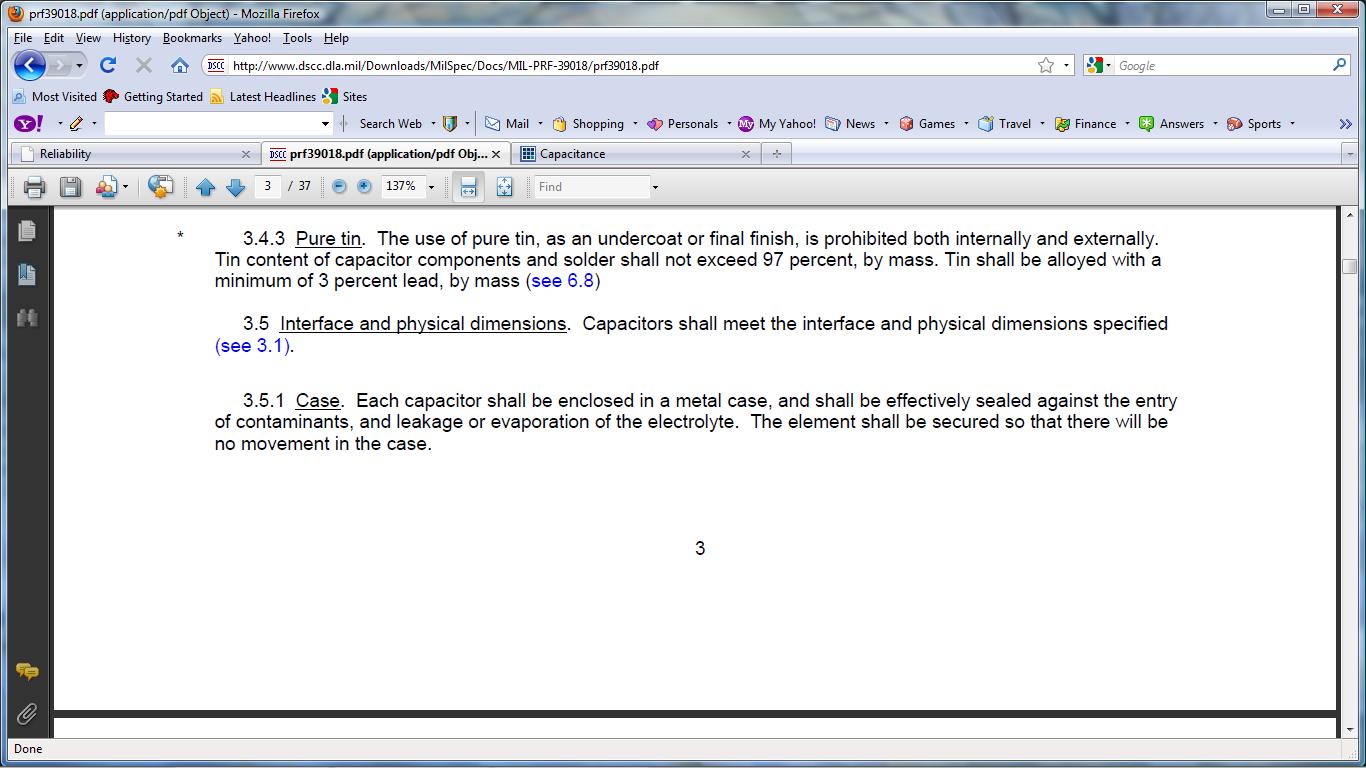
How about I just use facts. Defense dept stores caps for 15 years or longer and are still deemed acceptable.
Here's another document:
| Description: |
|
| Filesize: |
135.66 KB |
| Viewed: |
8860 Time(s) |
|
|
|
| Back to top |
|
|
macgyver655
Joined: 22 Aug 2007
Posts: 8508
|
| Posted: Fri Nov 06, 2009 2:57 am Post subject: |
|
|
The reason I'm spending so much time on this issue is because this age of capacitor thing seems to be the most common statement used when someone suggests changing caps that show no other signs of defect.
Everybody..... tell me how many times on here you've heard someone say.... You need to change all those caps because its 15 years old so they are no longer any good.........
And no regard to hours of use. Which by the way is the next topic of discussion. I just want to be sure this is properly put to rest.
If anyone has any documents to the contrary.....lets see them.
So let me say this. As long as the sealant is intact.... the electrolyte can not evaporate.......
We can also discuss ESR later but the big one is next.......Temp and hours of use.... This should be fun..
|
|
| Back to top |
|
|
macgyver655
Joined: 22 Aug 2007
Posts: 8508
|
| Posted: Sat Nov 07, 2009 2:59 pm Post subject: |
|
|
Ok so I guess we can move on now. If anyone is still not quite sure I can post more documents on this issue.
So now the big one. Temp and hours of use. I know there are other things that can also affect life of use but these are considered engineer issues and very insignificant. We can address those later.
So to start out we will look at the 85 degree C caps. These can be rated at 1000 to 10,000 hours. As Draganm points out most he sees are 2000 hour ones but this can vary in your projector. But we will use 2000 hour to start our conversation.
So what do these numbers mean. Well 85c/2000 means that if you use that cap in an 85c ambient temp environment it should last a minimum of 2000 hours. Thats right, I said MINIMUM. Usually specified as guaranteed or assured. So even being used at a consistent 85C ambient temp they can last much longer then the 2000 hour rating but failure in less then 2000 hours would be considered a manufacturers defect.
Now we also know that high temp is not a good thing for caps and high temp can shorten their life.
But what if they are being used in ambient temps of less then the spec'd temp?
I'll leave you with this for a few hours.
|
|
| Back to top |
|
|
draganm
Joined: 08 Mar 2006
Posts: 8990
Location: Colorado
|
| Posted: Sat Nov 07, 2009 5:17 pm Post subject: |
|
|
| macgyver655 wrote: | | How about I just use facts. Defense dept stores caps for 15 years or longer and are still deemed acceptable. |
where the hell does it say that? This sounds highly unlikley that the military would allow this for even 5 years. According to Nichikon specs the rated shelf life storage time is 2 years under the right conditions. after that it needs a "voltage treatment" to re-condition it.
http://www.nmr.mgh.harvard.edu/~reese/electrolytics/tec2.pdf
| Quote: | 2-1-6. Storage
( 1 ) Do not keep the capacitor in high temperature and
high humidity.
Storage ambient should be;
Temperature : 5oC~35oC, Humidity : less than 75%.
Place: Indoor
( 2 ) Avoid enviroment conditions: where capacitors can
be covered with water, brine or oil.
( 3 ) Avoid ambient conditions: where capacitors are
exposed to poisonous gases such as hydrogen
sulfide, sulfurous acid, nitrous acid, chlorine,
ammonium etc.
( 4 ) Do not keep the capacitors in conditions, that
expose the capacitor to ozone, ultraviolet ray or
radiation.
In the capacitors were stored in the above conditions
for up to 2 years, since an extremely little increased
leakage current is expected, the capacitor could be
used without voltage treatment. |
|
|
| Back to top |
|
|
Sparky015

Joined: 12 May 2009
Posts: 1185
Location: Cleveland / Akron, OH
|
| Posted: Sat Nov 07, 2009 5:22 pm Post subject: |
|
|
Ok, my opinion again!
If the component is being used in an environment below 85C, the 2000 hour minumum number goes up. Normally the manufacturer gives a pretty graph to show the curve. In my worklife, we test parts to understand this curve because our electronics are not always at their max temperature, so we model it to understand life expectancy. The other key here is how hard the part is being driven. If it is being driven hard, chances are it is generating it's own heat, which can cause the part itself to meet or exceed that 85C number when combined with the ambient heat around it. This is where you need to understand the circuit, and in the case of PJs, understand how well the pj was setup over the course of it's life.
For example, a cap on a convergence board will run much hotter on a pj not properly mechanically setup because the electronic convergence is maxed (or near the rails) to make up for it, whereas a proper mechanical setup would allow less electronic convergence and cooler running electronics, therefore increasing the life. Of course, if it was well designed, even the hardest running electronics should be designed to last for some period of hours. In the case of today's Marquee, for example, I'm sure Scott is making sure the electronics last to some spec given by the government for the life expectancy of a flight simulator (My humble guess not being in that industry).
_________________
~Paul
|
|
| Back to top |
|
|
draganm
Joined: 08 Mar 2006
Posts: 8990
Location: Colorado
|
| Posted: Sat Nov 07, 2009 5:37 pm Post subject: |
|
|
| Sparky015 wrote: | Ok, my opinion again!
If the component is being used in an environment below 85C, the 2000 hour minumum number goes up. Normally the manufacturer gives a pretty graph to show the curve. In my worklife, we test parts to understand this curve because our electronics are not always at their max temperature, so we model it to understand life expectancy. The other key here is how hard the part is being driven. If it is being driven hard, chances are it is generating it's own heat, which can cause the part itself to meet or exceed that 85C number when combined with the ambient heat around it. This is where you need to understand the circuit, and in the case of PJs, understand how well the pj was setup over the course of it's life. . |
absolutely, it's a complex equation with many variables, not something you can generalize in a simplified forum discussion.
However it seems that in term's of the cap drying out, I was probably mistaken as, according to Conrnell this only happens in really old cap designs or very small EL caps. According to them, ESR is the number one start to what then becomes a chain reaction of cap degradation
http://www.cde.com/tech/reliability.pdf
so instead of this
dry cap= high Resistance cap= hot cap= bad cap or under performing cap.
you would see something more like this
high ESR cap= hot cap= dry cap= failed or under performing cap.
that's also overy simplified though, look at the white paper and there's some great graphs and charts showing the relationship between temp. applied voltage, and lifetime.
|
|
| Back to top |
|
|
macgyver655
Joined: 22 Aug 2007
Posts: 8508
|
| Posted: Sat Nov 07, 2009 10:49 pm Post subject: |
|
|
| draganm wrote: | | macgyver655 wrote: | | How about I just use facts. Defense dept stores caps for 15 years or longer and are still deemed acceptable. |
where the hell does it say that? This sounds highly unlikley that the military would allow this for even 5 years. According to Nichikon specs the rated shelf life storage time is 2 years under the right conditions. after that it needs a "voltage treatment" to re-condition it.
http://www.nmr.mgh.harvard.edu/~reese/electrolytics/tec2.pdf
| Quote: | 2-1-6. Storage
( 1 ) Do not keep the capacitor in high temperature and
high humidity.
Storage ambient should be;
Temperature : 5oC~35oC, Humidity : less than 75%.
Place: Indoor
( 2 ) Avoid enviroment conditions: where capacitors can
be covered with water, brine or oil.
( 3 ) Avoid ambient conditions: where capacitors are
exposed to poisonous gases such as hydrogen
sulfide, sulfurous acid, nitrous acid, chlorine,
ammonium etc.
( 4 ) Do not keep the capacitors in conditions, that
expose the capacitor to ozone, ultraviolet ray or
radiation.
In the capacitors were stored in the above conditions
for up to 2 years, since an extremely little increased
leakage current is expected, the capacitor could be
used without voltage treatment. |
|
Check the links Athanosis posted. It links you to defense dept cap storage. I also have nuclear power plant test sheets and storage data.. I'll post stuff later. I dont have time now.
|
|
| Back to top |
|
|
macgyver655
Joined: 22 Aug 2007
Posts: 8508
|
| Posted: Sun Nov 08, 2009 3:18 am Post subject: |
|
|
| draganm wrote: | | macgyver655 wrote: | | How about I just use facts. Defense dept stores caps for 15 years or longer and are still deemed acceptable. |
where the hell does it say that? This sounds highly unlikley that the military would allow this for even 5 years. According to Nichikon specs the rated shelf life storage time is 2 years under the right conditions. after that it needs a "voltage treatment" to re-condition it.
http://www.nmr.mgh.harvard.edu/~reese/electrolytics/tec2.pdf
| Quote: | 2-1-6. Storage
( 1 ) Do not keep the capacitor in high temperature and
high humidity.
Storage ambient should be;
Temperature : 5oC~35oC, Humidity : less than 75%.
Place: Indoor
( 2 ) Avoid enviroment conditions: where capacitors can
be covered with water, brine or oil.
( 3 ) Avoid ambient conditions: where capacitors are
exposed to poisonous gases such as hydrogen
sulfide, sulfurous acid, nitrous acid, chlorine,
ammonium etc.
( 4 ) Do not keep the capacitors in conditions, that
expose the capacitor to ozone, ultraviolet ray or
radiation.
In the capacitors were stored in the above conditions
for up to 2 years, since an extremely little increased
leakage current is expected, the capacitor could be
used without voltage treatment. |
|
I'm not sure if your using this quote as a defense that caps stored for more then 2 years are no good, because thats not what I'm reading. Its say that even after 2 years of storage they can still be used without reforming. After that then reforming maybe required to return the cap to full performance. Some manufacturers say 3 or 4 and some even 5 years may test well without reforming. After that then reforming maybe required to bring them back to FULL functionality.
THATS WHAT I'VE BEEN SAYING......
Now unless your going to store them in your oven, on bake for a few years or in your bathtub?
Or put them in your room that contains your poisonous gases?
Also turn off your radiation generator.
Now did you find the link to the defense dept Draganm or do you need me to help you find it. Or would you like the link to a study done at a nuclear power plant that stores their caps for decades and finds that caps stored for 10, 20 and even 30 years were tested before and after reforming and found to be completely usable and 100% of them passed.
YEA THATS RIGHT....30 YEARS
Let me make this clear though. I myself dont believe that they will be ok 100% of the time after long storage but its a low percentage.
But I also dont think that brand new ones will pass 100% of the time either. There are and will always be bad ones.
|
|
| Back to top |
|
|
macgyver655
Joined: 22 Aug 2007
Posts: 8508
|
| Posted: Sun Nov 08, 2009 3:28 am Post subject: |
|
|
| Sparky015 wrote: | Ok, my opinion again!
If the component is being used in an environment below 85C, the 2000 hour minumum number goes up. Normally the manufacturer gives a pretty graph to show the curve. In my worklife, we test parts to understand this curve because our electronics are not always at their max temperature, so we model it to understand life expectancy. The other key here is how hard the part is being driven. If it is being driven hard, chances are it is generating it's own heat, which can cause the part itself to meet or exceed that 85C number when combined with the ambient heat around it. This is where you need to understand the circuit, and in the case of PJs, understand how well the pj was setup over the course of it's life.
For example, a cap on a convergence board will run much hotter on a pj not properly mechanically setup because the electronic convergence is maxed (or near the rails) to make up for it, whereas a proper mechanical setup would allow less electronic convergence and cooler running electronics, therefore increasing the life. Of course, if it was well designed, even the hardest running electronics should be designed to last for some period of hours. In the case of today's Marquee, for example, I'm sure Scott is making sure the electronics last to some spec given by the government for the life expectancy of a flight simulator (My humble guess not being in that industry). |
Sparky, I believe your comment pertains to high core temps cause by ripple currents. I was going to get into this later on but I'll touch on it real quick. This is something that should be addressed by the designer/engineer which you also referenced. Now to place this is real life situations, if there was an issue of a cap that was being subjected to this then the core would be running hot and causing premature failure. but this is easily identified. You would have a certain make and model, certain board and specific cap that was consistently failing at low hours. Meaning 70 to 90 percent failure rate.
Now I can tell you I have seen this in direct view and RPTV's. So it does exist. It is a design flaw. Now if this is evident in any CRT projector then Curt, Tim, Mike....should be able to verify.
In direct view and RPTV's this is usually cured by upping the value or voltage slightly or both.
I planned on getting more into this later along with other stuff.
|
|
| Back to top |
|
|
macgyver655
Joined: 22 Aug 2007
Posts: 8508
|
| Posted: Sun Nov 08, 2009 3:41 am Post subject: |
|
|
| draganm wrote: | | Sparky015 wrote: | Ok, my opinion again!
If the component is being used in an environment below 85C, the 2000 hour minumum number goes up. Normally the manufacturer gives a pretty graph to show the curve. In my worklife, we test parts to understand this curve because our electronics are not always at their max temperature, so we model it to understand life expectancy. The other key here is how hard the part is being driven. If it is being driven hard, chances are it is generating it's own heat, which can cause the part itself to meet or exceed that 85C number when combined with the ambient heat around it. This is where you need to understand the circuit, and in the case of PJs, understand how well the pj was setup over the course of it's life. . |
absolutely, it's a complex equation with many variables, not something you can generalize in a simplified forum discussion.
However it seems that in term's of the cap drying out, I was probably mistaken as, according to Conrnell this only happens in really old cap designs or very small EL caps. According to them, ESR is the number one start to what then becomes a chain reaction of cap degradation
http://www.cde.com/tech/reliability.pdf
so instead of this
dry cap= high Resistance cap= hot cap= bad cap or under performing cap.
you would see something more like this
high ESR cap= hot cap= dry cap= failed or under performing cap.
that's also overy simplified though, look at the white paper and there's some great graphs and charts showing the relationship between temp. applied voltage, and lifetime. |
Variables can exist everywhere but are usually accompanied by abnormalities. If you really want to start talking variables now then I'll give you some that will make your head spin and make you sick to your stomach. And they will be supported by more then opinion.
Let me explain my goal in this thread. I believe that caps are one of the highest failure parts there are. But this is based on experience and for reasons that are far different from what many believe. But I also believe that caps can live a very, very long life.My goal is to help many here understand the various things that affect caps and then they can make their own decisions on how to proceed in the event they have a problem. And this goes much further then just projectors.
But I'm trying to keep this in an orderly fashion and only discuss the current topic to prevent confusion.
|
|
| Back to top |
|
|
macgyver655
Joined: 22 Aug 2007
Posts: 8508
|
| Posted: Sun Nov 08, 2009 3:51 am Post subject: |
|
|
| Sparky015 wrote: | Ok, my opinion again!
If the component is being used in an environment below 85C, the 2000 hour minimum number goes up. |
Sparky is correct again. Now this issue is very consistent for almost every one. Now again, leave out the variable crap. Were trying to talk under normal circumstances here. Variables would be abnormalities.
So who knows the numbers for hours vs lower temps?
|
|
| Back to top |
|
|
Robert A. Hill
Joined: 19 May 2006
Posts: 182
Location: Simpsonville, SC
|
| Posted: Sun Nov 08, 2009 7:57 pm Post subject: |
|
|
Mac,
There cannot be a generic long storage interval (non-charge) that is acceptable for wet electrolytics (Aluminum or Tantalum). I would think it woud depend greatly on the circuit and how critical the application. It would also depend on the peak voltage necessary to withstand or what is an acceptable electical leakage.
A lot of work is being done in the medical implant area where these are used to deliver current/voltage for defillrators and such. The eletroytics are used to deliver the current needed to restart the heart since the internal battery cannot provide enough power. The caps may not be used for many months (or years) but must work 100% when required. Having a catastrophic failure from dielectric breakdown is unacceptable. Alternately, when current leakage occurs, the battery is drained quickly and patients must return to the clinic for recharging very often. These devices actually spend a lot of measurement time and power testing the caps and reform cycles are a common parameter of the device operation.
I assume similar concerns exist with weapon systems where long term storage is a given, but he device must be 100% reliable when called upon to work. Our older projectors may be just as mission critical for some of us, especially if replacement parts are not available. I know the vintage radio/amp groups dread turning on an old set that has been in storage for years as majic smoke releases are common from old caps.
|
|
| Back to top |
|
|
macgyver655
Joined: 22 Aug 2007
Posts: 8508
|
| Posted: Mon Nov 09, 2009 1:46 am Post subject: |
|
|
| Robert A. Hill wrote: | Mac,
There cannot be a generic long storage interval (non-charge) that is acceptable for wet electrolytics (Aluminum or Tantalum). I would think it woud depend greatly on the circuit and how critical the application. It would also depend on the peak voltage necessary to withstand or what is an acceptable electical leakage.
A lot of work is being done in the medical implant area where these are used to deliver current/voltage for defillrators and such. The eletroytics are used to deliver the current needed to restart the heart since the internal battery cannot provide enough power. The caps may not be used for many months (or years) but must work 100% when required. Having a catastrophic failure from dielectric breakdown is unacceptable. Alternately, when current leakage occurs, the battery is drained quickly and patients must return to the clinic for recharging very often. These devices actually spend a lot of measurement time and power testing the caps and reform cycles are a common parameter of the device operation.
I assume similar concerns exist with weapon systems where long term storage is a given, but he device must be 100% reliable when called upon to work. Our older projectors may be just as mission critical for some of us, especially if replacement parts are not available. I know the vintage radio/amp groups dread turning on an old set that has been in storage for years as majic smoke releases are common from old caps. |
I'm not really sure what your posting here Robert. Generic long term storage?
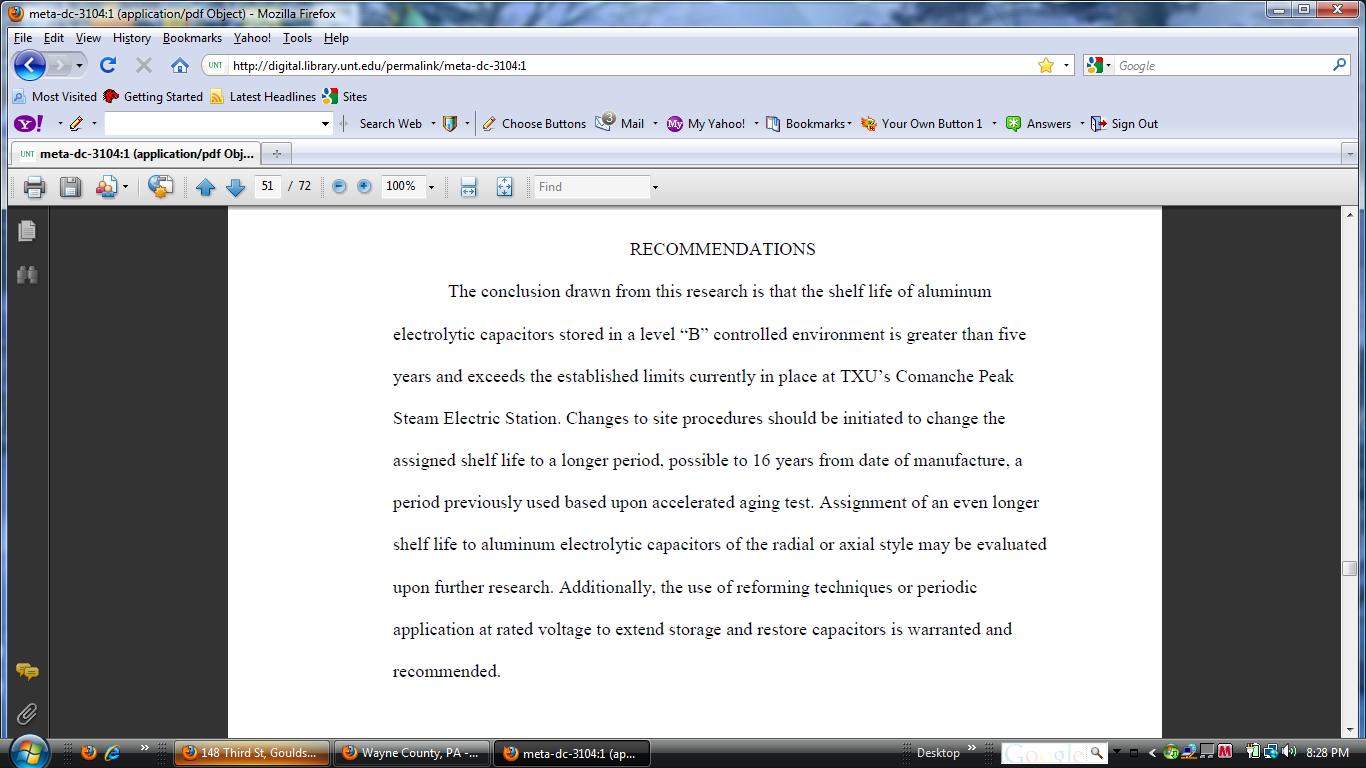
The stuff I'm posting is not just mere opinion crap nor is it my opinion. I have read so many documents on cap storage my eyes hurt. Most were from dept of defense and power plants which I find more supportive and surely not affected by manufacturer influence. I'm not going into this anymore so everyone can take what they want but I'll attach 1 last document. This was only suppose to be a basis for the overall conclusion.
I had planned on addressing all various influences on capacitors based on all sorts of info. You would of found me taking both sides of the coin and giving you confusion but end the end everyone would of had a good understanding of things you never thought of.
However there seems to be very little interest in this topic so I'm just going to let this topic drift off into oblivion. If nothing else my own thoughts on some aspects have changed and I will be applying then to my own use.
Here is my last post on shelf life.
| Description: |
|
| Filesize: |
136.12 KB |
| Viewed: |
8866 Time(s) |
|
|
|
| Back to top |
|
|
AnalogRocks
Forum Moderator

Joined: 08 Mar 2006
Posts: 26706
Location: Toronto, Ontario, Canada
TV/Projector: Sony 1252Q, AMPRO 4000G
|
| Posted: Mon Nov 09, 2009 1:53 am Post subject: |
|
|
Mac, isn't this the point where you should be saying:
"Class, CLASS!! SHADDDDUPP!"
_________________
Tech support for nothing
CRT.
HD done right!
|
|
| Back to top |
|
|
wallace123456
Joined: 14 Aug 2006
Posts: 2236
Location: Northwest VA area
|
| Posted: Mon Nov 09, 2009 2:16 am Post subject: |
|
|
| macgyver655 wrote: | | I had planned on addressing all various influences on capacitors based on all sorts of info. You would of found me taking both sides of the coin and giving you confusion but end the end everyone would of had a good understanding of things you never thought of. |
Continue on. This is good stuff.
wallace
_________________
Life Is Good, But BBQ Is Better! BBQ Competition Team
|
|
| Back to top |
|
|
jask

Joined: 17 Mar 2006
Posts: 10187
Location: kamloops BC
|
| Posted: Mon Nov 09, 2009 8:40 am Post subject: |
|
|
|
I wish I had access to those warehouses full of 30 year old Milspec caps.
|
|
| Back to top |
|
|
|
|
|
|
|
You cannot post new topics in this forum
You cannot reply to topics in this forum
You cannot edit your posts in this forum
You cannot delete your posts in this forum
You cannot vote in polls in this forum
You cannot attach files in this forum
You can download files in this forum
|
Forum powered by phpBB © phpBB Group
|
|